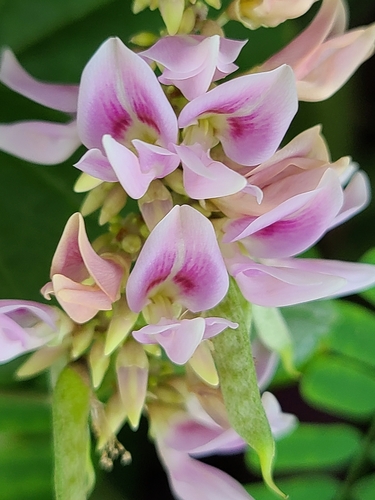
Dialium procerum
(van Steenis) Steyaert
Keranji tunggal

President and Fellows of Harvard College

President and Fellows of Harvard College

President and Fellows of Harvard College
What to Eat
Edible parts: Fruit
The fruit is eaten.
Where to Find It
A tropical plant.
Asia, Malaysia, Sarawak, SE Asia,
How to Identify
A tropical tree in the legume family, native to Southeast Asia where about 40 Dialium species occur, all with edible fruit.
How to Grow
This species has a symbiotic relationship with certain soil bacteria, these bacteria form nodules on the roots and fix atmospheric nitrogen. Some of this nitrogen is utilized by the growing plant but some can also be used by other plants growing nearby.
Other Uses
This tree is one of several species yielding a timber known as 'Keranji'. The general description of this wood is as follows:- The heartwood is golden-brown or red-brown; clearly demarcated from the white to yellowish sapwood. The texture is fine to moderately coarse and even; the grain interlocked or wavy. The wood is heavy; moderately durable but the sapwood is susceptible to insect and fungal attack. It can be easy to very difficult to resaw and cross-cut depending on the species; planing is easy to slightly difficult, and the planed surface is moderately smooth; nailing property is good. The wood is suitable for heavy construction, flooring, handles for striking tools and batons.
Notes
There are about 40 Dialium species. They grow in tropical SE Asia. They probably all have edible fruit. Also as Caesalpinaceae.
Names & Synonyms
Keranji
References (2)
- Chai, P. P. K. (Ed), et al, 2000, A checklist of Flora, Fauna, Food and Medicinal Plants. Lanjak Entimau Wildlife Sanctuary, Sarawak. Forestry Malaysia & ITTO. p 168
- Saw, L.G., LaFrankie, J. V. Kochummen, K. M., Yap S. K., 1991, Fruit Trees in a Malaysian Rain Forest. Economic Botany, Vol. 45, No. 1, pp. 120-136