Synsepalum afzelii
(Engl.) Pennington

Royal Botanic Gardens, Kew

MBG
What to Eat
Edible parts: Fruit Pulp
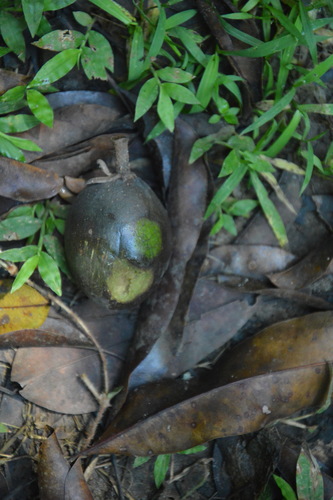
Fruit - raw. The pulp has a sweetly sour flavour. Fruit an ellipsoid berry c. 2.5 cm long, red when ripe, 1-seeded.
Where to Find It
It is a tropical plant. It grows in lowland evergreen rain-forest especially near rivers and swamps.
Africa, Benin, Cameroon, CAR, Central Africa, Central African Republic, CAR, Côte d'Ivoire, Equatorial-Guinea, Gabon, Ghana, Ivory Coast, Liberia, Nigeria, Sierra Leone, Togo, West Africa,
How to Identify
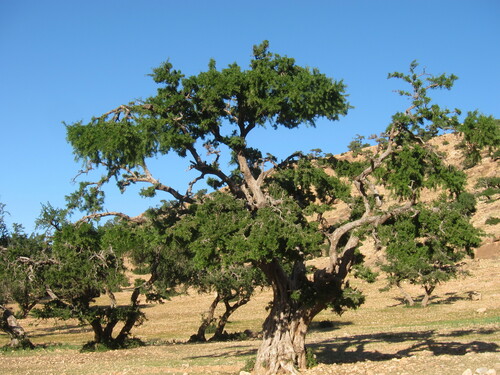
A tree. It grows to 30 m high. The trunk is 1.7 across. The leaves are alternate and simple. They are sword shaped and 6-13 cm long by 2.5-4 cm wide. The fruit are 2.5 cm long by 1.5 cm wide. There is one seed.
How to Grow
Natural regeneration is often abundant, with many seedlings below parent trees.
Other Uses
The heartwood is reddish brown, the sapwood reddish yellow. The grain is usually straight; texture fine. The wood is hard, heavy and durable, though occasionally attacked by termites. The wood saws slowly, with occasional charring and a strong dulling effect on sawteeth; it is recommended that logs be quartersawn to reduce warping. The wood can be finished to a smooth surface; the gluing properties are moderate. It is used for poles and is suitable for heavy construction, heavy flooring, mine props, vehicle bodies, sporting goods, railway sleepers and implements. The wood is used for fuel and can be made into good quality charcoal.
Notes
There are about 20 Synsepalum species. Sapotaceae are tropical trees.
Names & Synonyms
Akuedao, Azimomo, Bakunini, Kolon ngaume, Olo-tombo
References (8)
- Abbiw, D.K., 1990, Useful Plants of Ghana. West African uses of wild and cultivated plants. Intermediate Technology Publications and the Royal Botanic Gardens, Kew. p 46 (As Afrosersalisia afzelii)
- Burkill, H. M., 1985, The useful plants of west tropical Africa, Vol. 5. Kew.
- Jardin, C., 1970, List of Foods Used In Africa, FAO Nutrition Information Document Series No 2.p 118 (As Afrosersalisia afzelii)
- Keay, R.W.J., 1989, Trees of Nigeria. Clarendon Press, Oxford. p 398 (As Afrosersalisia afzelii)
- Kunkel, G., 1965, The Trees of Liberia. German Forestry Mission Report No. 3 p 26 (As Afrosersalisia afzelii)
- Vivien, J. & Faure, J.J., 1985, Abres des forets dense d'Afrique Centrale. Agence de Cooperation Culturelle et Technique. Paris. p 410 (As Afrosersalisia afzelii)
- Vivien, J., & Faure, J.J., 1996, Fruitiers Sauvages d'Afrique. Especes du Cameroun. CTA p 313 (As Afrosersalisia afzelii)
- World Checklist of Useful Plant Species 2020. Royal Botanic Gardens, Kew