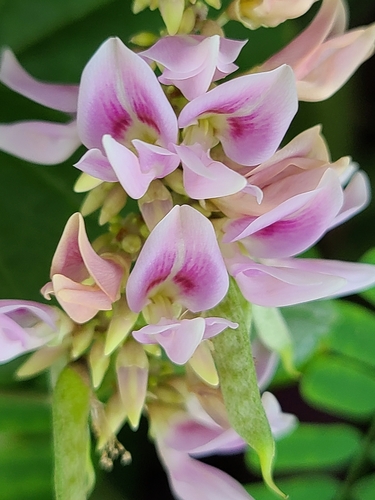
Dipteryx odorata
(Aublet) Willd.
Tonka Bean

(c) Rich Hoyer, some rights reserved (CC BY-NC-SA), uploaded by Rich Hoyer
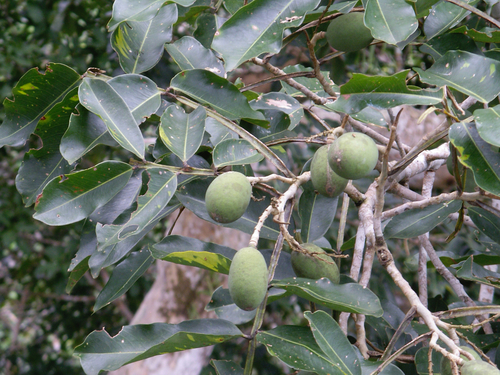
(c) Miguel A. Casado, some rights reserved (CC BY-NC)
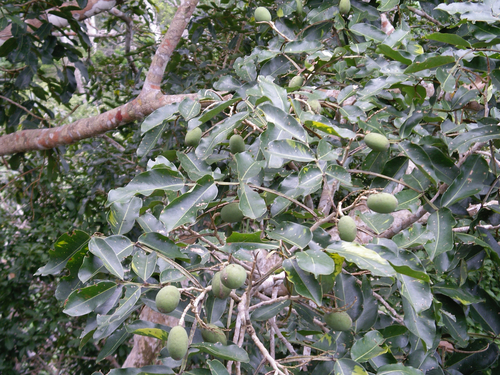
(c) Miguel A. Casado, some rights reserved (CC BY-NC)
What to Eat
Edible parts: Seeds, Spice, Caution
A coumarin-like flavouring is extracted from the seeds through fermentation and has been used commercially as a vanilla substitute in baked goods, ice cream, cocoa and other foods. Its use is banned in some countries due to potential health problems associated with coumarins. The seed pods are 5–6cm long and around 3cm in diameter; the pulp inside is eaten raw. The seeds themselves are eaten after boiling to remove toxins.
Known Hazards
Where to Find It
It is a tropical plant. It suits hot humid tropical lowland climates. It grows in tropical rainforest often along river banks. It needs a rainfall of 1500-1750 mm per year. It grows up to 350 m altitude. It does best in humus rich soils which are low in calcium.
Amazon, Asia, Bolivia, Brazil, Central America, Colombia, Costa Rica, Fiji, French Guiana, Guianas, Guyana, Honduras, Indonesia, Malaysia, Nauru, Pacific, Panama, Peru, SE Asia, Seychelles, Singapore, South America*, Suriname, Trinidad, Venezuela,
How to Identify
A tree. It grows up to 40 m tall. The trunk can be 1 m across. The taproot is only 1 m deep but it has anchor roots and a mass of surface roots. The leaves are alternate. They are compound with leaflets along the stalk. The leaves are leathery and glossy green. The axis of the leaf is flattened and has wings. There are 3-6 leaflets. They can be opposite or alternate. They are elliptical but have unequal sides. They are 15 cm long by 8 cm wide. The flowering panicle has red-blue flowers. The fruit is fleshy and with a stone inside. It is oval and 7-10 cm long by 3-6 cm wide. It is pale yellow-brown. The flesh is pulpy. The skin is hard. The seed is usually wrinkled and 3-5 cm long by 1-2 cm wide. It is dull black and weighs 3g.
How to Grow
Plants are usually grown from seed. It can be grown from cuttings. Plants are spaced 3 m apart and thinned out later. Trees are topped when 2 m tall to encourage branching.
Propagation: Seed viability is very short; sow as soon as ripe, preferably in situ or in individual containers as seedlings transplant poorly. Fresh seed germinates in approximately 6 weeks.
Medicinal Uses
The bark is astringent and febrifuge. A decoction combining the bark with the crushed whole plant of Tonina fluviatilis is used to prepare an infant fortifier. The fragrant seeds are rich in coumarin and are considered antiasthmatic, antispasmodic, cardiotonic and emmenagogue. A decoction of seed and sugar is taken as a cold remedy, and seeds mixed with rum form a tincture rubbed onto snakebite, contusions and rheumatic areas. The seeds were historically used to treat whooping cough, but research has shown their aromatic coumarins can have detrimental effects on the heart and liver, and may be carcinogenic. The seed oil is used to relieve stomach aches, treat mouth sores, fortify the scalp, improve hair growth and control dysentery. A cold water infusion of the leaves serves as an ear wash for earache, and the leaves are crushed into a snuff powder. The seed contains coumarin used in perfumery and for flavouring tobacco and whisky. The bark contains isoflavones and umbelliferone; the leaves contain salicylic, hydroxycoumaric, coumaric and ferulic acids.
Other Uses
The trees are grown to provide shade in cocoa plantations. Coumarin from the seeds is added to perfumes as a fixative and used as an aromatic ingredient in tobaccos and snuffs. The seeds are also used in pot pourri. The fresh heartwood is reddish-brown to purplish-brown with light yellowish-brown or purplish streaks, seasoning to a variegated reddish and yellowish brown before gradually becoming uniform yellowish brown or light brown with light exposure; it is clearly demarcated from a 3–5cm wide band of brownish-yellow to yellowish-brown sapwood. The wood has a fine texture, medium lustre, irregular to often interlocked grain, no distinctive taste, a faint vanilla-like or rancid odour and a waxy or oily feel. It is extremely hard and heavy, comparable to lignum vitae (Guaiacum spp.), and is also very strong, dense, tough and highly resistant to decay in contact with soil. Its high density and hardness make it difficult to saw and bore, though clean edges and holes result when this is done; where grain is not severely interlocked, the wood planes and finishes smoothly. It glues poorly, as is common with very high-density woods, but takes a high polish and weathers well when exposed unpainted to the elements. The wood is used for cogs, shafts, heavy construction, turnery, fishing rods, paving blocks, barge and dock fenders, and flooring. It is particularly suited to tool handles, agricultural implements and sporting goods owing to its high bending strength and shock resistance. Its oily hardness also suits it for bearings, cogs and shafts as a substitute for lignum vitae where friction wear is a concern. It performs well as railway crossties and posts, being durable and resistant to splitting. It is also considered excellent for boat keels and frames, ice sheathing, industrial flooring and other applications requiring strength and durability. Small quantities have been exported to the United States for high-grade face veneer.
Wikipedia
Source ↗Dipteryx odorata (commonly known as "cumaru", "kumaru", or "Brazilian teak") is a species of flowering tree in the pea family, Fabaceae. The tree is native to Northern South America and is semi-deciduous. Its seeds are known as tonka beans, but sometimes spelled tonkin beans or tonquin beans (not related to Tonkin). The seeds are black and wrinkled and have a smooth, brown interior. They have a strong fragrance similar to sweet woodruff due to their high content of coumarin. The word tonka is taken from the Galibi (Carib) tongue spoken by natives of French Guiana; it also appears in Tupi, another language of the same region, as the name of the tree. The old genus name, Coumarouna, was formed from another Tupi name for the tree, kumaru. Many anticoagulant prescription drugs, such as warfarin, are based on 4-hydroxycoumarin, a chemical derivative of coumarin initially isolated from this bean. Coumarin itself, however, does not have anticoagulant properties.
Production
Flowering and fruiting start after 7-10 years. Good crops are only produced every 2-3 years. Plants are pollinated by insects. The yield of dried beans per tree is 1 kg per year, but yields of 25 kg are possible. Plants can probably live for 1,100 years.
Other Information
The main production is Venezuela, Brazil and Colombia.
Notes
It contains couarin.
Names & Synonyms
Choiba, Cimaru, Coumarou, Cumaru, Dutch Tonka bean, Gaiac, Guayac, Karapa Bossi, Muirapaye, Pohon kumaru, Pohon polong tongka, Sarrapia, Sarrapio, Tonquin bean
References (29)
- Arora, R. K., 2014, Diversity in Underutilized Plant Species - An Asia-Pacific Perspective. Bioversity International. p 102
- Brazil: Biodiversity for Food and Nutrition. http://www.b4fn.org/countries/brazil/
- Brouk, B., 1975, Plants Consumed by Man. Academic Press, London. p 282
- Brown, D., 2002, The Royal Horticultural Society encyclopedia of Herbs and their uses. DK Books. p 195
- Burkill, I.H., 1966, A Dictionary of the Economic Products of the Malay Peninsula. Ministry of Agriculture and Cooperatives, Kuala Lumpur, Malaysia. Vol 1 (A-H) p 859
- Etkin, N.L. (Ed.), 1994, Eating on the Wild Side, Univ. of Arizona. p 137 (As Coumarouna odorata)
- Facciola, S., 1998, Cornucopia 2: a Source Book of Edible Plants. Kampong Publications, p 104
- Grandtner, M. M., 2008, World Dictionary of Trees. Wood and Forest Science Department. Laval University, Quebec, Qc Canada. (Internet database http://www.WDT.QC.ca)
- Grandtner, M. M. & Chevrette, J., 2013, Dictionary of Trees, Volume 2: South America: Nomenclature, Taxonomy and Ecology. Academic Press p 205
- Hermandez Bermejo, J.E., and Leon, J. (Eds.), 1994, Neglected Crops. 1492 from a different perspective. FAO Plant Production and Protection Series No 26. FAO, Rome. p18
- ILDIS Legumes of the World http:www:ildis.org/Legume/Web
- Johnson, M. and Colquhoun, A., 1996, Preliminary Ethnobotanical Survey of Kurupukari: An Amerindian Settlement of Central Guyana. Economic Botany, Vol. 50, No. 2, pp. 182-194
- Kew Plants of the World Online
- Kiple, K.F. & Ornelas, K.C., (eds), 2000, The Cambridge World History of Food. CUP p 1871
- Lorenzi, H., 2002, Brazilian Trees. A Guide to the Identification and Cultivation of Brazilian Native Trees. Vol. 02 Nova Odessa, SP, Instituto Plantarum p 214
- Macbride. J. F., 1942, Flora of Peru. Leguminosae. Field Museum Natural History. Chicago. p 254 As Coumarouna odorata)
- Martin, F. W., et al, 1987, Perennial Edible Fruits of the Tropics. USDA Handbook 642 p 33 (As Coumarouna odorata)
- Menninger, E.A., 1977, Edible Nuts of the World. Horticultural Books. Florida p 92 (As Coumarouna odorata)
- Philips, O., 1992, The potential for harvesting fruits in tropical rainforests: new data from Amazonian Peru. Biodiversity and Conservation 2, 18-38
- PROSEA handbook Volume 13 Spices. p 252
- Purseglove, J.W., 1968, Tropical Crops Dicotyledons, Longmans. p 258
- Roa, J. A. G. & Boada, D. S. G., 2018, Fundación para el Fortalecimiento de la Fruticultura y Plantas Alimenticias no Convencionales en Colombia.
- Seidemann J., 2005, World Spice Plants. Economic Usage, Botany, Taxonomy. Springer. p 137
- Smith, A.C., 1985, Flora Vitiensis Nova, Lawaii, Kuai, Hawaii, Volume 3 p 155
- Smith, N., Mori, S.A., et al, 2004, Flowering Plants of the Neotropics. Princeton. p 155
- Sp. pl. 3(2):910. 1802
- Sukarya, D. G., (Ed.) 2013, 3,500 Plant Species of the Botanic Gardens of Indonesia. LIPI p 245
- Wiersema, J. H. & Leon, B., 2013, World Economic Plants. A Standard Reference CRC Press. 2nd Ed. p 252
- World Checklist of Useful Plant Species 2020. Royal Botanic Gardens, Kew