Disphyma australe
(Soland. ex Aiton) J.M. Black
Round-leaved Pigface, Moonflower

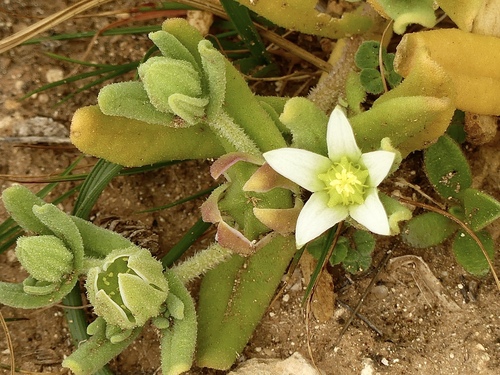
(c) dr.scott.mills, some rights reserved (CC BY-SA), uploaded by dr.scott.mills

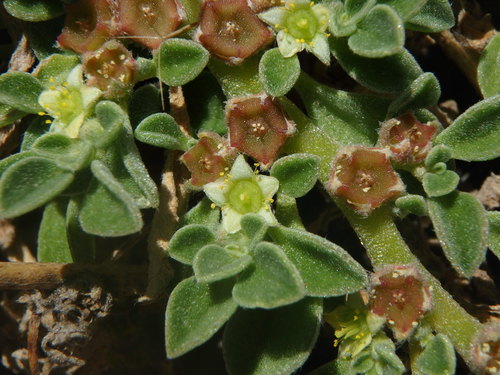
(c) seung hee, han, some rights reserved (CC BY-NC)

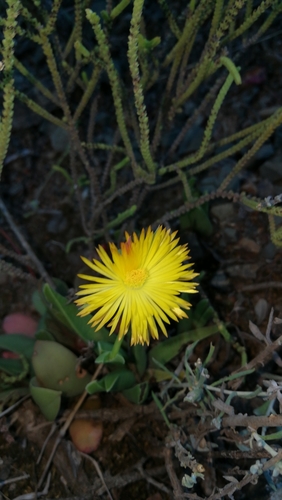
(c) Kaitlyn, some rights reserved (CC BY-NC), uploaded by Kaitlyn
What to Eat
Edible parts: Fruit, Leaves
The leaves are used pickled. The inner portion of the fruit is also eaten, though no further preparation details are given.
Where to Find It
It is a temperate plant. It does best in light, well-drained soil. It needs an open, sunny position. It is resistant to drought and frost. It can grow near beaches on pure sand.
Australia, New Zealand*, Tasmania,
How to Identify
A plant that keeps growing from year to year. It grows 50 cm high and spreads 50 cm wide. The stems are succulent and red. They form mats. The leaves are bright green and triangle shaped in cross section. They are 2 cm long. The flowers are pink and at the ends of the branches. The flowers open in the middle of the day.
How to Grow
It can be grown by seed or cuttings.
Propagation: Sow seed in a greenhouse in early spring. Prick seedlings into individual pots once large enough to handle and plant out after the last expected frosts. Cuttings can be taken in summer.
Medicinal Uses
None known.
Other Uses
None known.
Wikipedia
Source ↗Disphyma australe is a species of flowering plant in the family Aizoaceae and is endemic to New Zealand. It is a prostrate, succulent annual shrub or short-lived perennial plant with stems up to 2 m (6 ft 7 in) long, leaves that are three-sided in cross-section with a rounded lower angle, and white to deep pink daisy-like flowers that are 2–4 cm (0.79–1.57 in) in diameter with 3–5 rows of petals and multiple stamens. Disphyma australe is a coastal plant and therefore can be found at cliff faces, gravel beaches, salt meadows and estuaries.
Notes
There are 3 Disphyma species. The reference by Curtis may be incorrect.
Names & Synonyms
Horokaka
References (6)
- Bodkin, F., 1991, Encyclopedia Botanica. Cornstalk publishing, p 349
- Crowe, A., 1997, A Field Guide to the Native Edible Plants of New Zealand. Penguin. p 82
- Curtis, W.M., 1963, The Students Flora of Tasmania Vol 2 p 239
- Matthews, J., 1987, New Zealand Native Plants for your Garden. Pacific Publishers, p 44
- Morley, B.D., & Toelken, H.R., (Eds), 1983, Flowering Plants in Australia. Rigby. p 73
- Plants for a Future database, The Field, Penpol, Lostwithiel, Cornwall, PL22 0NG, UK. http://www.scs.leeds.ac.uk/pfaf/