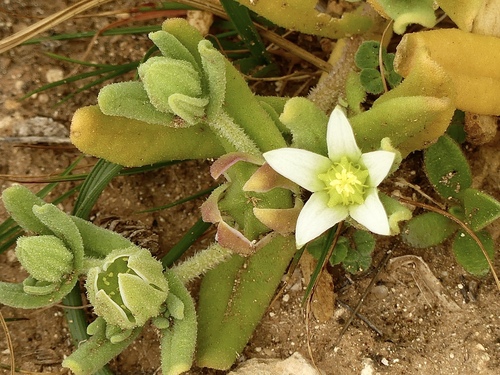
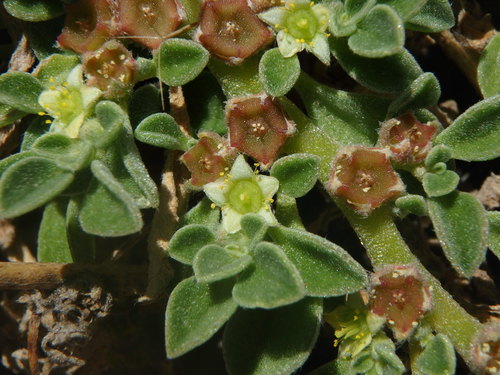
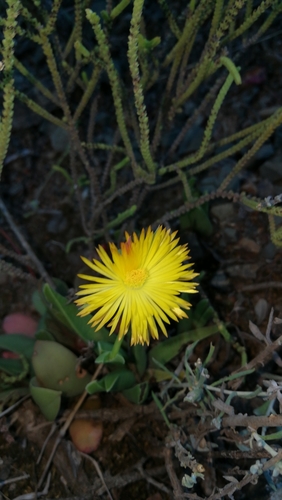
Disphyma clavellatum
(Haw.) Chinnock
Round Noon-flower, Round-leaf pigface, Austral pigface

(c) sammatonk, some rights reserved (CC BY-NC)

(c) Colin Meurk, some rights reserved (CC BY-SA)
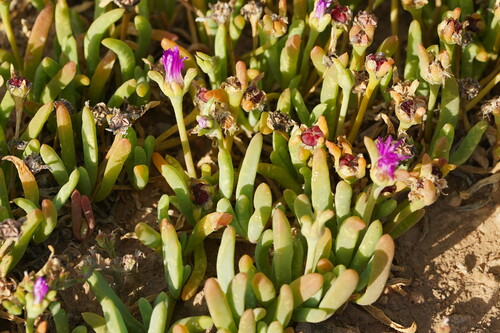
(c) Reiner Richter, some rights reserved (CC BY-NC-SA)
What to Eat
Edible parts: Flowers, Fruit
The leaves have become a popular native vegetable in Australia marketed under the name "karkalla". It typically has a salty flavour and can be used fresh or as a pickled ingredient.
Where to Find It
It is a temperate plant. It grows along coastal areas and near rivers. It will grow in light to heavy soils. It needs an open, sunny position. It is resistant to drought but damaged by frost. It is tolerant of salt.
Australia*, Tasmania*,
How to Identify
A succulent plant. The stems lie along the ground. They form roots at the nodes. It grows 50 cm high and spreads 50 cm wide. The leaves are opposite but are often clustered in tufts near the base. The leaves are smooth and juicy and almost round in cross section with blunt ends. The flowers occur singly. They are pink or purple and on slender stalks.
How to Grow
It can be grown from seeds, cuttings or division.
Notes
There are 3 Disphyma species.
Names & Synonyms
References (8)
- Blomberry, A.M., 1979, Australian Native Plants. Angus and Robertson p 90 Bodkin, F., 1991, Encyclopedia Botanica. Cornstalk publishing, p 349 (As Disphyma crassifolium subsp. clavellatum)
- Cronin, L., 1989, The Concise Australian Flora. Reed. p 103 Crowe, A., 1997, A Field Guide to the Native Edible Plants of New Zealand. Penguin. p 82
- Elliot, W.R., & Jones, D.L., 1984, Encyclopedia of Australian Plants suitable for cultivation. Vol 3. Lothian. p 302
- Hibbert, M., 2002, The Aussie Plant Finder 2002, Florilegium. p 88
- Lamp, C & Collet F., 1989, Field Guide to Weeds in Australia. Inkata Press. p 106
- Tasmanian Vascular Plant Census 2021
- Woolmore, E et al, 2002, King Island Flora: A Field Guide. p 21 (As Disphyma crassifolium subsp. clavellatum)
- www.charlessturt.sa.gov.auwebdata/resources.files. Local_Coastal_Plants.pdf (As Disphyma crassifolium subsp. clavellatum)