Docynia indica
(Collebr. in Wall.) Decne.
Indian crab apple, Assam apple
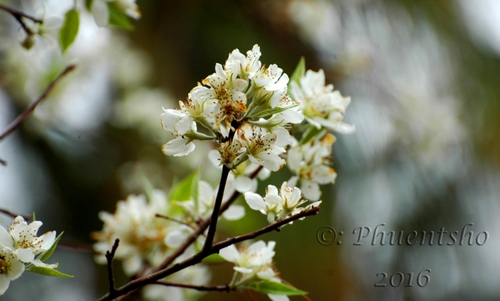
(c) Phuentsho, some rights reserved (CC BY-NC-SA), uploaded by Phuentsho
What to Eat
Edible parts: Fruit
The fruit is edible when fully ripe, though it is also eaten when only half ripe. The fruit reaches about 5cm in diameter.
Where to Find It
A tropical and subtropical plant. In Nepal it grows between 1000-2000 m altitude. In India it grows between 900-1,800 m altitude. It grows in open places. In Sichuan and Yunnan.
Asia, Bhutan, China, Himalayas, India, Indochina, Myanmar, Nepal, Northeastern India, Pakistan, SE Asia, Sikkim, Thailand, Tibet, Vietnam,
How to Identify
A tree. It grows to 5-12 m high. It loses its leaves during the year. The leaves are 3.5-10 cm long. They are oblong to sword shaped and taper to the tip. They have teeth along the edge. They have woolly hairs underneath. Flowers are white and 2.5 cm wide. The fruit is round or spindle shaped.
Nutrition
| Part | Moisture | kJ | kcal | Protein | Vit A | Vit C | Iron | Zinc |
|---|---|---|---|---|---|---|---|---|
| Fruit | 82.5 | — | — | — | — | 1 | — | — |
How to Grow
Plants are grown from seed or cuttings.
Propagation: Sow seed as soon as it is ripe in autumn in a cold frame. Prick seedlings out into individual pots once large enough to handle and grow on under glass for at least their first winter. Plant out into permanent positions in late spring or early summer, after the last expected frosts.
Medicinal Uses
No medicinal uses are known for this plant.
Other Uses
The wood is hard, close-grained, and even-textured.
Wikipedia
Evergreen tree growing to 4m tall, flowering April to May with seeds ripening September to November. Hardy to UK zone 8. Tolerates light, medium, and heavy soils with good drainage; accepts mildly acid to basic pH. Requires full sun and prefers moist soil. Hermaphrodite flowers pollinated by insects.
Production
Yields can be 6-58 kg per tree. In NE India plants flower and fruit February to September.
Other Information
Fruit are sold in markets.
Notes
The tree is used as a rootstock for apples.
Names & Synonyms
Chipfoshi, Chiphoshi, Dieng-soh-po, Ekere, False quince, Heitup, Kipho, Likung, Losu, Maao, Mael, Mago, Magon, Mail, Malanthi, Mehel, Mehul, Passy, Phoshi, Pin-sein, Qile, Soh-phoh, Soh-phoh-heh, Sohptet, Sopho, Sun-hlu-phi, Tao meo, Theipan, Theithup
References (32)
- Ambasta, S.P. (Ed.), 2000, The Useful Plants of India. CSIR India. p 181 (Also as Docynia hookeriana)
- Angami, A., et al, 2006, Status and potential of wild edible plants of Arunachal Pradesh. Indian Journal of Traditional Knowledge 5(4) October 2006, pp 541-550
- Arora, R. K., 2014, Diversity in Underutilized Plant Species - An Asia-Pacific Perspective. Bioversity International. p 68
- Chase, P. & Singh, O. P., 2016, Bioresources of Nagaland: A Case of Wild 4 Edible Fruits in Khonoma Village Forest. in J. Purkayastha (ed.), Bioprospecting of Indigenous Bioresources of North-East India. p 50
- Dangol, D. R. et al, 2017, Wild Edible Plants in Nepal. Proceedings of 2nd National Workshop on CUAOGR, 2017.
- Dobriyal, M. J. R. & Dobriyal, R., 2014, Non Wood Forest Produce an Option for Ethnic Food and Nutritional Security in India. Int. J. of Usuf. Mngt. 15(1):17-37 (As Docynia hookeriana)
- Facciola, S., 1998, Cornucopia 2: a Source Book of Edible Plants. Kampong Publications, p 198
- Flora of China. www.eFloras.org Volume 9
- Gautam, R. S., et al, 2020, Wild Edible Fruits of Nepal. Int. J. Appl. Sci. Biotechnol. Vol 8(3): 289-304
- Ghimeray, A. K., Lamsal, K., et al, 2010, Wild edible angiospermic plants of the Illam Hills (Eastern Nepal) and their mode of use by local community. Korean J. Pl. Taxon. 40(1)
- Jeeva, S., 2009, Horticultural potential of wild edible fruits used by the Khasi tribes of Meghalaya. Journal or Horticulture and Forestry Vol. 1(9) pp. 182-192 (Also as Docynia hookeriana)
- Jin, Chen et al, 1999, Ethnobotanical studies on Wild Edible Fruits in Southern Yunnan: Folk Names: Nutritional Value and Uses. Economic Botany 53(1) pp 2-14
- Kar, A., et al, 2013, Wild Edible Plant Resources used by the Mizos of Mizoram, India. Kathmandu University Journal of Science, Engineering and Technology. Vol. 9, No. 1, July, 2013, 106-126
- Manandhar, N.P., 2002, Plants and People of Nepal. Timber Press. Portland, Oregon. p 206
- Manju, S., and Sundriyal, R. C., 2001, Wild Edible Plants of the Sikkim Humalaya: Nutritive Values of Selected Species. Economic Botany 55(3): 377-390 (As Erioloba indica)
- Meitei, L. R., et al, 2022, An ethnobotanical study on the wild edible plants used by forest dwellers in Yangoupokpi Lokchao Wildlife Sanctuary, Manipur, India. Ethnobotany Research and Application 23:15
- Mozhui, R., et al, 2011, Wild edible fruits used by the tribals of Dimapur district of Nagaland, India. Pleione 5(1): 56 - 64.
- Nouv. Arch. Mus. Hist. Nat. 10:131, t. 14. 1874
- Pfoze, N. L., et al, 2012, Assessment of Local Dependency on Selected Wild Edible Plants and fruits from Senapati district, Manipur, Northeast India. Ethnobotany Research & Applications 10:357-367
- Pfoze, N. L., et al, 2012, Survey and assessment of floral diversity on wild edible plants from Senapati district of Manipur, Northeast India. Journal of Biodiversity and Environmental Sciences. 1(6):50-52
- Plants for a Future database, The Field, Penpol, Lostwithiel, Cornwall, PL22 0NG, UK. http://www.scs.leeds.ac.uk/pfaf/ (As Docynia hookeriana)
- Rymbai, H., et al, 2016, Analysis study on potential underutilized edible fruit genetic resources of the foothills track of Eastern Himalayas, India. Genetic. Resourc. Crop Evol. (2016) 63:125-139
- Savita, et al, 2006, Studies on wild edible plants of ethnic people in east Sikkim. Asian J. of Bio Sci. (2006) Vol. 1 No. 2 : 117-125
- Sawian, J. T., et al, 2007, Wild edible plants of Meghalaya, North-east India. Natural Product Radiance Vol. 6(5): p 415 (Also as Docynia hookeriana)
- Shin, T., et al, 2018, Traditional knowledge of wild edible plants with special emphasis on medicinal uses in Southern Shan State, Myanmar. Journal of Ethnobiology and Ethnomedicine (2018) 14:48
- Singh, H.B., Arora R.K.,1978, Wild edible Plants of India. Indian Council of Agricultural Research, New Delhi. p 56 (Also as Docynia hookeriana)
- Singh, V. B., et al, (Ed.) Horticulture for Sustainable Income and Environmental Protection. Vol. 1 p 216 (Also as Docynia hookeriana)
- Sundriyal, Manju and R. C. Sundriyal, 2003, Underutilized edible plants of the Sikkim Himalaya: Need for domestication. Current Science, Vol. 85, No. 6, p 731 (As Eriolobus indica)
- Tanaka,
- Tsering, J., et al, 2017, Ethnobotanical appraisal on wild edible plants used by the Monpa community of Arunchal Pradesh. Indian Journal of Traditional Knowledge. Vol 16(4), October 2017, pp 626-637
- Wild edible plants of Himachal Pradesh (Also as Docynia hookeriana)
- World Checklist of Useful Plant Species 2020. Royal Botanic Gardens, Kew
More from Rosaceae


