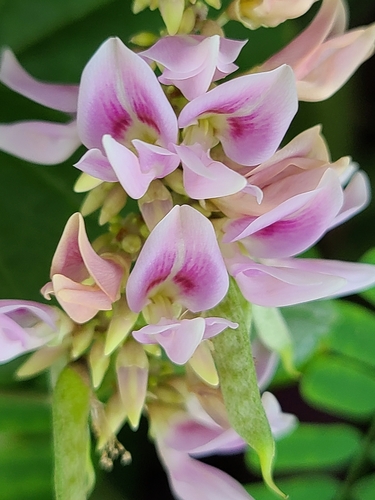
Afzelia bijuga
Gray
Fidji afzelia

Wikimedia Commons - Denis.prévôt

Wikimedia Commons - Steve Fitzgerald
What to Eat
Edible parts: Seeds, Leaves
The aril (layer around the seeds) is eaten. The seeds contain oil.
Where to Find It
It is a tropical plant.
Africa, Andamans, Asia, Bangladesh, Cambodia, East Africa, Indochina, Madagascar, Polynesia, SE Asia, Thailand,
How to Identify
A tall tree. It grows 30 m high. The leaves have leaflets along the stalk and one at the end. There are 2 pairs of leaflets. The flowers have one petal. They are white or red. They have a scent. They are in clusters. The fruit are pods that are thick and rough.
Medicinal Uses
The timber of this species is often used due to its durablity and termite resistance compared to other types of wood, making it suitable in engineering and construction contexts as well as decorative work. It has a density of 830 kg/m3 (1,400 lb/cu yd) and an above-ground life expectancy of more than 40 years. The tree had many uses in the indigenous communities where the tree is found—the timber was used for house building and for the construction of canoes and rafts, and for the carving of ornaments and tools. A dye can be extracted from the wood, and an insect repellent can be made from the seeds. Decoctions from various parts of the tree have been used to treat a range of ailments such as diarrhoea, rheumatism, pain, colds and influenza.
Notes
There are 15 Afzelia species. They occur in the tropics. Also as Caesalpinaceae.
Names & Synonyms
Intsy, Katrovato, Kitrato, Phkai proek, Voahintsy
References (4)
- Ambasta S.P. (Ed.), 2000, The Useful Plants of India. CSIR India. p 18
- Bircher, A. G. & Bircher, W. H., 2000, Encyclopedia of Fruit Trees and Edible Flowering Plants in Egypt and the Subtropics. AUC Press. p 12
- Jardin, C., 1970, List of Foods Used In Africa, FAO Nutrition Information Document Series No 2.p 24
- Martin, F.W. & Ruberte, R.M., 1979, Edible Leaves of the Tropics. Antillian College Press, Mayaguez, Puerto Rico. p 197