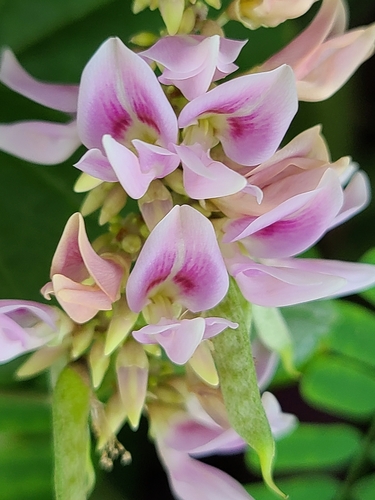
Nesphostylis bracteata
(Baker) D. Potter & J. J. Doyle
Indian nesphostylis

iNaturalist · cc-by-sa
(c) Dinesh Valke, some rights reserved (CC BY-SA)
(c) Dinesh Valke, some rights reserved (CC BY-SA)

iNaturalist · cc-by-sa
(c) Dinesh Valke, some rights reserved (CC BY-SA)
(c) Dinesh Valke, some rights reserved (CC BY-SA)

iNaturalist · cc-by-sa
(c) Dinesh Valke, some rights reserved (CC BY-SA)
(c) Dinesh Valke, some rights reserved (CC BY-SA)
What to Eat
Edible parts: Leaves, Tubers, Root, Seeds
Young seedpods - cooked. Usually boiled. The seedpod is 12 - 15cm long and 10mm wide, containing 10 - 12 seeds. Leaves - cooked.
Where to Find It
A tropical plant.
Asia, India,
Countries: United Arab Emirates, Afghanistan, Armenia, Azerbaijan, Bangladesh, Bahrain, Brunei, Bhutan, China, Georgia, Indonesia, Israel, India, Iraq, Iran, Jordan, Japan, Kyrgyzstan, Cambodia, North Korea, South Korea, Kuwait, Kazakhstan, Laos, Lebanon, Sri Lanka, Myanmar, Mongolia, Maldives, Malaysia, Nepal, Oman, Philippines, Pakistan, Qatar, Saudi Arabia, Singapore, Syria, Thailand, Tajikistan, Timor-Leste, Turkmenistan, Turkey, Taiwan, Uzbekistan, Vietnam, Yemen
How to Identify
A climbing herb. It keeps growing from year to year. The leaves have 3 leaflet. The flowers occur singly in the axils of leaves. The flowers are large and blue or purple. The fruit are narrow pods. There are many seeds.
Names & Synonyms
Bhendri, Raan pavata
Dolichos bracteatus BakerDolichos ghaticus Santapu & PanthakiSphenostylis bracteata (Baker) J. B. Gillet
References (3)
- Ambasta, S.P. (Ed.), 2000, The Useful Plants of India. CSIR India. p 182 (As Dolichos bracteatus)
- Martin, F.W. & Ruberte, R.M., 1979, Edible Leaves of the Tropics. Antillian College Press, Mayaguez, Puerto Rico. p 199 (As Dolichos bracteatus)
- Terra, G.J.A., 1973, Tropical Vegetables. Communication 54e Royal Tropical Institute, Amsterdam, p 45 (As Dolichos bracteatus)