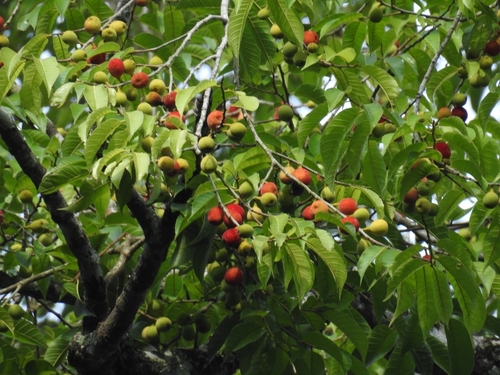
Dorstenia sp.

Wikimedia Commons - Shyamal

Wikimedia Commons - Irina-kab
What to Eat
Edible parts: Leaves
The leaves are edible.
Where to Find It
A tropical plant. They need a warm climate and adequate moisture.
Africa, East Africa, Malawi,
How to Identify
A herb. The flowering arrangement is flattened or cup shaped with all the flowers on the upper surface.
How to Grow
Probably grown from seed.
Medicinal Uses
South American species such as Dorstenia contrajerva and Dorstenia brasiliensis are a source of the herbal preparation contrayerva that has been used as a tonic and febrifuge, and as an antidote in South American folk medicine. In North America powder made from the rootstocks and leaves of Dorstenia contrajerva is mixed with tobacco for improving the taste of cigarettes. In Oman the tubers of Dorstenia foetida are cooked and eaten. Dorstenia barteri is used in West African folk medicine. Scientific research has shown that it contains numerous flavonoid compounds that have anti-microbial, anti-reverse transcriptase, and anti-inflammatory effects.
Notes
There are 105 Dorstenia species with 46 in tropical America.
References (7)
- Anderson, M., 2002, The World Encyclopedia of Cacti and Succulents. Hermes House, New York. p 149 (Genus)
- Glover et al, 1969,
- Jardin, C., 1970, List of Foods Used In Africa, FAO Nutrition Information Document Series No 2.p 75
- Llamas, K.A., 2003, Tropical Flowering Plants. Timber Press. p 277 (Genus)
- Marinelli, J. (Ed), 2004, Plant. DK. p 103 (Genus)
- Martin, F.W. & Ruberte, R.M., 1979, Edible Leaves of the Tropics. Antillian College Press, Mayaguez, Puerto Rico. p 223
- Peters, C. R., O'Brien, E. M., and Drummond, R.B., 1992, Edible Wild plants of Sub-saharan Africa. Kew. p 147