Dracaena reflexa
Lam.
Small-leaved dragon tree

(c) Jean-Philippe BASUYAUX, some rights reserved (CC BY-NC), uploaded by Jean-Philippe BASUYAUX

(c) Steven Molteno, some rights reserved (CC BY-NC), uploaded by Steven Molteno
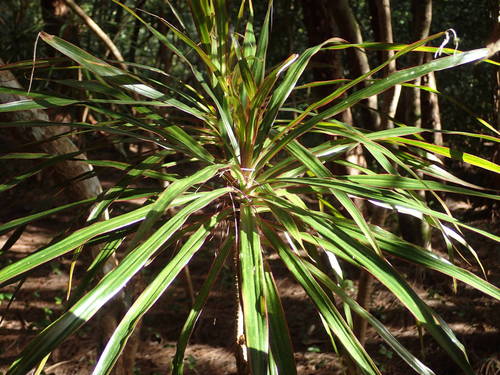
(c) Sylvain Piry, some rights reserved (CC BY-NC), uploaded by Sylvain Piry
Where to Find It
Leaves,
How to Identify
A small branched tree in the Asparagaceae family that grows 3–5 m high (occasionally to 12 m). It has smooth white bark with a papery peel, dark green narrow leaves 16–25 cm long arranged in rosettes near branch tips, and cream-colored nocturnal flowers on 25 cm spikes followed by bright red fleshy berries 2–2.5 cm across.
Nutrition Score: 41/100
| Part | Moisture | kJ | kcal | Protein | Vit A | Vit C | Iron | Zinc |
|---|---|---|---|---|---|---|---|---|
| Leaves | 71.2 | 404 | 97 | 8.7 | — | — | — | — |
| Flowers | 76 | 311 | 74 | 9.8 | — | — | — | — |
How to Grow
It is usually grown from stem cuttings.
Wikipedia
Source ↗Dracaena reflexa (commonly called song of India or song of Jamaica) is a tree native to Mozambique, Madagascar, Mauritius, and other nearby islands of the Indian Ocean. It is widely grown as an ornamental plant and houseplant, valued for its richly coloured, evergreen leaves, and thick, irregular stems.
Other Information
Asparagaceae
Notes
A small tree. It grows 3-5 m high but can be 12 m high. It is much branched. The bark is white and smooth and develops a papery peel. The leaves are narrow and 16-25 cm long by 1-2 cm wide. They are dark green. They tend to be in rosettes near the ends of branches. Flowers are cream in colour in loose spikes. They are at the ends of branches and 25 cm long. The flowers close during the day and open at night. The fruit is berry-like. It is 2-2.5 cm across and fleshy. It is bright red when ripe.
Names & Synonyms
Kosindahy, Mugonda, Mulengelenge, Rajo
References (14)
- Cundall, P., (ed.), 2004, Gardening Australia: flora: the gardener's bible. ABC Books. p 511
- Encycl. 2:324. 1786
- Etherington, K., & Imwold, D., (Eds), 2001, Botanica's Trees & Shrubs. The illustrated A-Z of over 8500 trees and shrubs. Random House, Australia. p 268
- Hibbert, M., 2002, The Aussie Plant Finder 2002, Florilegium. p 89
- Jardin, C., 1970, List of Foods Used In Africa, FAO Nutrition Information Document Series No 2.p 76
- Kachenchart, B., et al, 2008, Phenology of Edible Plants at Sakaerat Forest. In Proceedings of the FORTROP II: Tropical Forestry Change in a Changing World. Bangkok, Thailand.
- Llamas, K.A., 2003, Tropical Flowering Plants. Timber Press. p 336
- Malaisse, F., 1997, Se nourrir en floret claire africaine. Approche ecologique et nutritionnelle. CTA., p 61 (var. nitens)
- Martin, F.W. & Ruberte, R.M., 1979, Edible Leaves of the Tropics. Antillian College Press, Mayaguez, Puerto Rico. p 202
- Palgrave, K.C., 1996, Trees of Southern Africa. Struik Publishers. p 87
- Staples, G.W. and Herbst, D.R., 2005, A tropical Garden Flora. Bishop Museum Press, Honolulu, Hawaii. p 585
- Terra, G.J.A., 1973, Tropical Vegetables. Communication 54e Royal Tropical Institute, Amsterdam, p 45
- World Checklist of Useful Plant Species 2020. Royal Botanic Gardens, Kew
- Young, J., (Ed.), 2001, Botanica's Pocket Trees and Shrubs. Random House. p 329