Dryopteris expansa
(C.Presl.) Fraser-Jenkins & Jermy
Spiny Wood Fern, Shield fern

(c) Samuel Brinker, some rights reserved (CC BY-NC), uploaded by Samuel Brinker
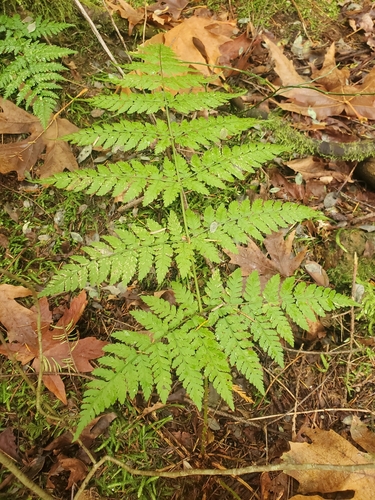
(c) jorpri123, some rights reserved (CC BY-NC)
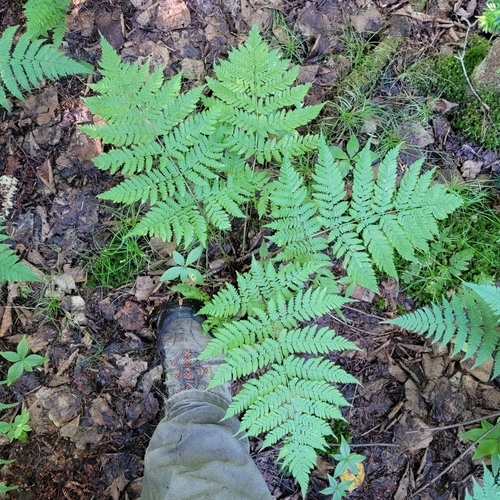
(c) Rob Routledge, some rights reserved (CC BY-NC), uploaded by Rob Routledge
What to Eat
Edible parts: Fronds, Leaves, Root
The root can be eaten raw or cooked. When baked it is peeled before eating; raw it is rather bitter, but cooking develops a sweet flavour that some compare to sweet potatoes. The root is best harvested in early autumn — at this time the rhizomes are surrounded by scaly, finger-like projections. If these projections are flat and dark inside, the rhizomes are not good to eat; if they are round, fleshy, and light-coloured, they are suitable. Young shoots harvested in spring before fully unfurling can be cooked and added to soups.
Known Hazards
Where to Find It
It is a temperate plant. It grows in cool, moist woods. In north China it grows between 700-1,800 m above sea level.
Alaska, Asia, Canada, China, Europe, Japan, Korea, Mongolia, North America, Russia, USA,
How to Identify
A fern. It has stout erect rhizomes. The fronds are erect and delicate. They are 30-40 cm high.
Nutrition Score: 41/100
| Part | Moisture | kJ | kcal | Protein | Vit A | Vit C | Iron | Zinc |
|---|---|---|---|---|---|---|---|---|
| Roots | 68 | 525 | 128 | 2.5 | — | — | 0.8 | 1.5 |
How to Grow
Propagation: Spores can be sown at any time of year in a greenhouse. Surface sow on sterilised compost, keep moist — possibly by placing the pot in a plastic bag. Germinates in 1–3 months at 20°C. Pot up small clumps when large enough to handle and grow on in a shady part of the greenhouse until ready to plant out. Divide in spring; larger clumps can go directly into permanent positions, though smaller clumps are best potted up and grown on in a cold frame until rooting well, then planted out in spring.
Medicinal Uses
A poultice of pounded roots has been applied to cuts. The root contains filicin, a substance that paralyses tapeworms and other internal parasites, and is one of the most effective known treatments for tapeworms. Its use must be immediately followed by a non-oily purgative such as magnesium sulphate to expel the worms. An oily purge such as castor oil increases absorption of the fern root and can be dangerous. The root is harvested in autumn and dried for later use; it should not be stored for longer than 12 months. This remedy should be used with caution and only under the supervision of a qualified practitioner, as the root is toxic and dosage is critical. The root is also used in the treatment of dandruff.
Other Uses
An infusion of the leaves has been used as a hair wash.
Wikipedia
Source ↗Dryopteris expansa, the alpine buckler fern, northern buckler-fern or spreading wood fern, is a species of perennial fern native to cool temperate and subarctic regions of the Northern Hemisphere, south at high altitudes in mountains to Spain and Greece in southern Europe, to Japan in eastern Asia, and to central California in North America. It prefers cool, moist mixed or evergreen forests and rock crevices on alpine slopes, often growing on rotting logs and tree stumps and rocky slopes. It is characteristically riparian in nature, and is especially associated with stream banks.
Notes
There are about 200 Dryopteris species.
Names & Synonyms
Spreading wood fern, Sqw.alm
References (11)
- Bowser, M. 2017, Handout on Edible Plants of the Kenai Peninsula. USFWS Kenai National Wildlife Refuge p 7
- Kuhnlein, H. V. and Turner, N. J., 1991, Traditional Plant Foods of Canadian Indigenous Peoples. Food and Nutrition in History and Anthropology Volume 8. Gordon and Breach. p 31
- Kuhnlein, H. V., et al, 2009, Indigenous Peoples' food systems. FAO Rome p 33
- MacKinnon, A., et al, 2009, Edible & Medicinal Plants of Canada. Lone Pine. p 380
- Plants for a Future database, The Field, Penpol, Lostwithiel, Cornwall, PL22 0NG, UK. http://www.scs.leeds.ac.uk/pfaf/
- Turner, N., 1995, Food Plants of Coastal First Peoples. Royal BC Museum Handbook p 26
- Turner, N., 1997, Food Plants of Interior First Peoples. Royal BC Museum Handbook p 160
- Turner, N. J. et al, 2011, Edible and Tended Wild Plants, Traditional Ecological Knowledge and Agroecology. Critical Reviews in Plant Sciences, 30:198-225
- Turner, N., et al, 2011, "Up on the Mountain": Ethnobotanical Important of Montane Sites in Pacific Coastal North America. Journal of Ethnobiology 31(1): 4-43
- Urgamal, M., et al, 2014, Conspectus of the Vascular Plants of Mongolia. Mongolia Academy of Sciences Institute of Botany and National University of Mongolia Department of Biology. p 34
- www.eFloras.org Flora of China


