Dryopteris sieboldii
(T. Moore) Kuntze
Japanese wood fern
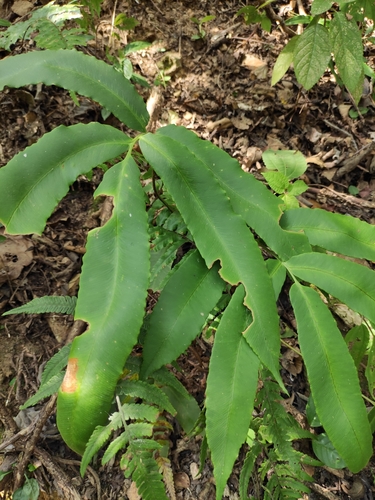
(c) MP Zhou, some rights reserved (CC BY-NC), uploaded by MP Zhou

(c) MP Zhou, some rights reserved (CC BY-NC), uploaded by MP Zhou
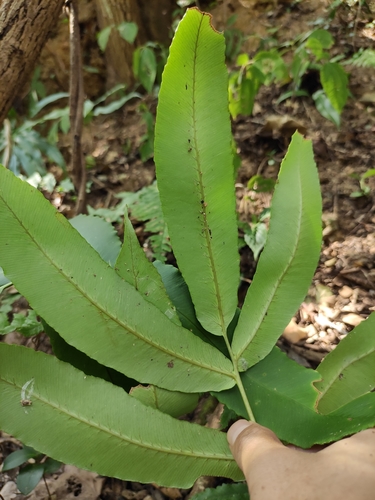
(c) MP Zhou, some rights reserved (CC BY-NC), uploaded by MP Zhou
What to Eat
Edible parts: Roots - flour
The root can be dried and ground into a powder. Some caution is advised given the plant's toxicity.
Where to Find It
A hardy fern. In China it grows between 400-900 m above sea level. It suits hardiness zones 7-10.
Asia, Australia, China, Japan,
How to Identify
A fern. It grows 50 cm high and spreads 50 cm wide. The fronds are large and have leaflets along the stalk. There are 5-7 leaflets. These are blue-green in colour. The leaflets are oblong or sword shaped. The edges are irregular with fine teeth. The fertile fronds are larger.
How to Grow
Propagation: Spores can be sown at any time of year in a greenhouse. Surface sow on sterilised compost and keep moist, for example by placing the pot in a plastic bag. Germination takes 1–3 months at 20°C. Pot up small clumps when large enough to handle and grow on in a shady part of the greenhouse until ready to plant out. Divide in spring — larger clumps can go directly into permanent positions, while smaller clumps are best potted up and grown on in a cold frame until rooting well before planting out in spring.
Medicinal Uses
None known
Other Uses
None known Special Uses
Wikipedia
Source ↗Dryopteris sieboldii is a species of fern in the family Dryopteridaceae, native to Japan and south-central and southeast China. It has gained the Royal Horticultural Society's Award of Garden Merit as an ornamental.
Notes
There are about 200 Dryopteris species. Also put in the family Polypodiaceae.
References (9)
- Burkill, I.H., 1966, A Dictionary of the Economic Products of the Malay Peninsula. Ministry of Agriculture and Cooperatives, Kuala Lumpur, Malaysia. Vol 2 (I-Z) p 1575 (As Nephrodium sieboldii)
- Cundall, P., (ed.), 2004, Gardening Australia: flora: the gardener's bible. ABC Books. p 516
- Goudey, C.J., 1988, A Handbook of Ferns for Australia and New Zealand. Lothian. p 102
- Hibbert, M., 2002, The Aussie Plant Finder 2002, Florilegium. p 90
- Plants for a Future database, The Field, Penpol, Lostwithiel, Cornwall, PL22 0NG, UK. http://www.scs.leeds.ac.uk/pfaf/
- PROSEA handbook Volume 9 Plants yielding non-seed carbohydrates. p 189 (As Nephrodium sieboldii)
- Revis. gen. pl. 2:813. 1891
- World Checklist of Useful Plant Species 2020. Royal Botanic Gardens, Kew
- www.eFloras.org Flora of China


