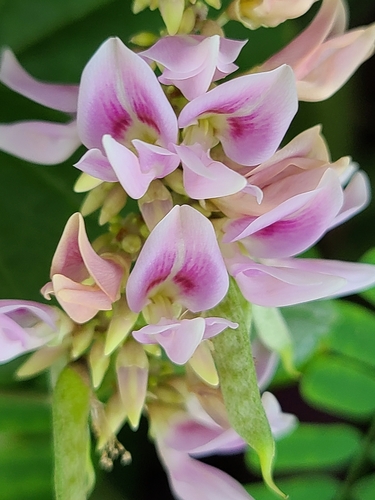
Dumasia truncata
Siebold. & Zucc.
Wild black bean

iNaturalist · cc-by-nc
(c) 登坂久雄, some rights reserved (CC BY-NC), uploaded by 登坂久雄
(c) 登坂久雄, some rights reserved (CC BY-NC), uploaded by 登坂久雄

iNaturalist · cc-by-nc
(c) JODY HSIEH, some rights reserved (CC BY-NC), uploaded by JODY HSIEH
(c) JODY HSIEH, some rights reserved (CC BY-NC), uploaded by JODY HSIEH

iNaturalist · cc-by-nc
(c) JODY HSIEH, some rights reserved (CC BY-NC), uploaded by JODY HSIEH
(c) JODY HSIEH, some rights reserved (CC BY-NC), uploaded by JODY HSIEH
What to Eat
Edible parts: Leaves, Pods, Seeds
The leaves, pods, and seeds are edible.
Where to Find It
It is a temperate plant. In China it grows between 300-2,300 m above sea level.
Asia, China, Japan, Korea,
Countries: United Arab Emirates, Afghanistan, Armenia, Azerbaijan, Bangladesh, Bahrain, Brunei, Bhutan, China, Georgia, Indonesia, Israel, India, Iraq, Iran, Jordan, Japan, Kyrgyzstan, Cambodia, North Korea, South Korea, Kuwait, Kazakhstan, Laos, Lebanon, Sri Lanka, Myanmar, Mongolia, Maldives, Malaysia, Nepal, Oman, Philippines, Pakistan, Qatar, Saudi Arabia, Singapore, Syria, Thailand, Tajikistan, Timor-Leste, Turkmenistan, Turkey, Taiwan, Uzbekistan, Vietnam, Yemen
How to Identify
A climbing and twining herb. It grows 1-3 m long. The stems are slender. It has leaflets that are triangle shaped and 3-6 cm long by 2-4 cm wide. The flowers are in slender groups 1-4 cm long. The flowers are 1-2 cm across. They are yellow. The pod is sword shaped and 4 cm long by 1 cm wide. There is a beak at the tip. There are 2-5 seeds. They are flattened and blue. They are 4-6 mm across.
Notes
There are 6-10 Dumasia species.
References (2)
- Abh. Math.-Phys. Cl. Konigl. Bayer. Akad. Wiss. 4(2):119. 1843
- READ,