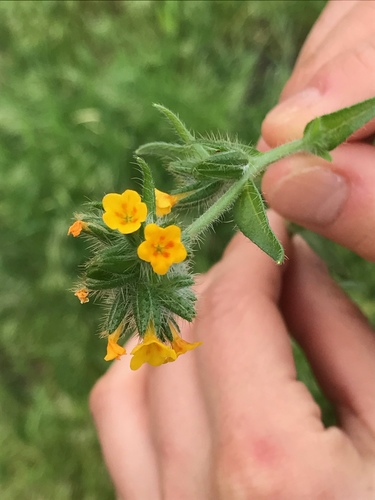
Echium italicum
Bové. ex DC.
Italian Bugloss, Pale bugloss

(c) Veljo Runnel, some rights reserved (CC BY-SA)
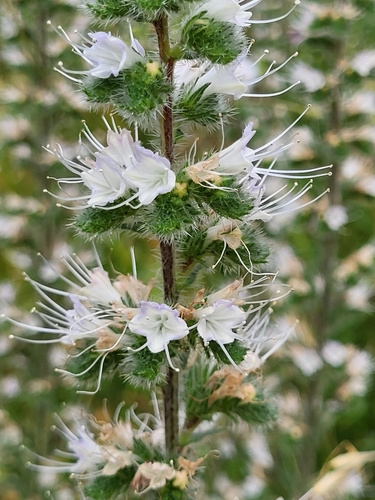
(c) Jacek Pietruszewski, some rights reserved (CC BY)
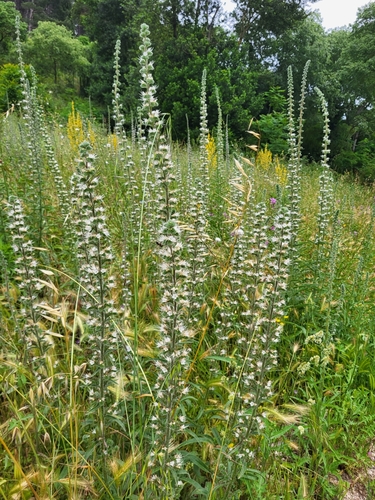
(c) Jacek Pietruszewski, some rights reserved (CC BY)
What to Eat
Edible parts: Leaves, Flower - nectar, Stems
The fresh young leaves are eaten in soup and roasted with meat. The flower nectar is sucked.
Known Hazards
Where to Find It
It is a Mediterranean climate plant. It grows on rocky and grassy habitats.
Africa, Australia, Crete, Europe, France, Greece, Italy, Mediterranean, North Africa, Portugal, Sicily, Spain, Tunisia, Turkey, Türkiye,
How to Identify
A robust herb which keeps growing from year to year. It grows 1 m tall. It has dense white or yellow bristles. In the first year the leaves are in a flat ring near the ground. The leaves are sword shaped or narrowly oval. The flowers are yellow, pink or bluish-white. They are 10-12 mm long. They occur as many together in a pyramid shaped flower arrangement. The stamen are long and protrude.
Wikipedia
Source ↗Echium italicum, the Italian viper's bugloss, Lady Campbell weed, or pale bugloss, is a species of plant from the family Boraginaceae, found in the Mediterranean Basin (especially in Italy, hence the name 'italicum') and, as an introduced species in the United States (for example in the state of Maryland).
Notes
There are about 40-60 Echium species all indigenous to the Mediterranean.
Names & Synonyms
Ayikulagi, Bou chenaf, Engerek itu, Erbo vieio, Guriza top, Halmech, Haricha, Himhim, Lecan et tsour, Lingua di voi, Mijok, Pateroulia, Ouchcham, Sorik, Sorma, Taharadj, Tainast, Voidoglosses, Yaglica, Yakar ot
References (19)
- Blamey, M and Grey-Wilson, C., 2005, Wild flowers of the Mediterranean. A & C Black London. p 190
- BOUQUET,
- Cakir, E. A., 2017, Traditional knowledge of wild edible plants of Iğdır Province (East Anatolia, Turkey). Acta Soc Bot Pol. 2017;86(4):3568.
- Dashorst, G.R.M., and Jessop, J.P., 1998, Plants of the Adelaide Plains & Hills. Botanic Gardens of Adelaide and State Herbarium. p 124
- Demir, I. & Ayaz, N., 2022, Wild edible plants contributing to the traditional foods of Mardin (Turkey) Province. Indian Journal of Traditional Knowledge Vol 21(3), July 2022, pp 569-582
- Dogan, A. & Tuzlaci, E., 2015, Wild Edible Plants of Pertek (Tunceli-Turkey). Marmara Pharmaceutical Journal 19: 126-135
- Dogan, Y., et al, 2004, The Use of Wild Edible Plants in Western and Central Anatolia (Turkey). Economic Botany 58(4) pp. 684-690
- Dogan, Y., 2012, Traditionally used wild edible greens in the Aegean Region of Turkey. Acta Societatis Botanicorum Poloniae 81(4): 329-342
- Dretakis, M. et al, 2012, Flora and Fauna Biodiversity in an ancient olive grove in Crete (Greece) in Calabrese G. (Ed.) Study on Biodiversity in Century-Old Olive Groves. CIHEAM - Mediterranean Agronomic Institute of Bari. p 94
- Ertug, F, Yenen Bitkiler. Resimli Türkiye Florası -I- Flora of Turkey - Ethnobotany supplement
- Etherington, K., & Imwold, D., (Eds), 2001, Botanica's Trees & Shrubs. The illustrated A-Z of over 8500 trees and shrubs. Random House, Australia. p 272
- Lamp, C & Collet F., 1989, Field Guide to Weeds in Australia. Inkata Press. p 109
- Lazarides, M. & Hince, B., 1993, Handbook of Economic Plants of Australia, CSIRO. p 87
- Ozbucak, T. B. et al, 2006, The Contribution of Wild Edible Plants to Human Nutrition in the Black Sea Region of Turkey. Ethnobotanical Leaflets 10: 98-103
- Pieroni, A., 1999, Gathered wild food plants in the Upper Valley of the Serchio River (Garfagnana), Central Italy. Economic Botany 53(3) pp 327-341
- Pieroni, A., 2001, Evaluation of the Cultural Significance of Wild Food Botanicals traditionally Consumed in Northwestern Tuscany, Italy, Journal of Ethnobiology 21(1):89-104
- Pieroni, A.,& Giusti, M. E., 2009, Alpine Ethnobotany in Italy: Journal of Ethnobiology and Ethnomedicine. 5:32
- Senkardes, I & Tuzlaci, E., 2016, Wild Edible Plants of Southern Part of Nevsehir inTurkey. Marmara Pharmaceutical Journal 20:34-43
- Yesil, Y., et al, 2019, Wild edible plants in Yeşilli (Mardin-Turkey), a multicultural area. Journal of Ethnobiology and Ethnomedicine (2019) 15:52