Einadia nutans
(R. Br.) A. J. Scott
Climbing saltbush, Nodding saltbush
(c) Jeannie, some rights reserved (CC BY-NC)
(c) Jeannie, some rights reserved (CC BY-NC)

(c) Ivan Margitta, some rights reserved (CC BY-NC)
What to Eat
Edible parts: Leaves, Fruit
The fruit are sweet and edible raw. The leaves are also edible.
Where to Find It
It can grow in tropical and warm temperate places. It grows in both coastal and inland regions. It can grow along the coast near the sea. It can tolerate salty winds. Geelong Botanical Gardens.
Australia*, Tasmania*,
How to Identify
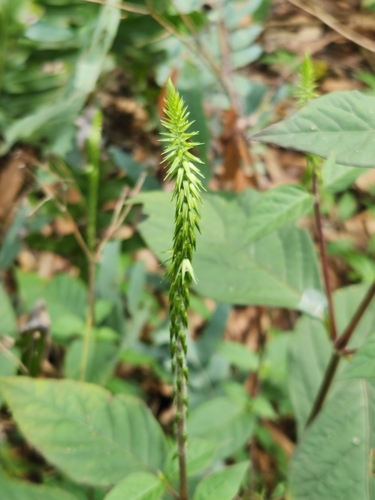
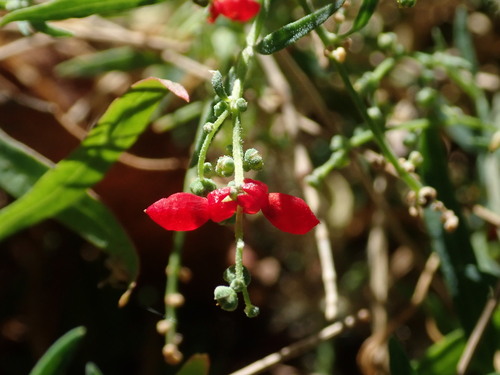
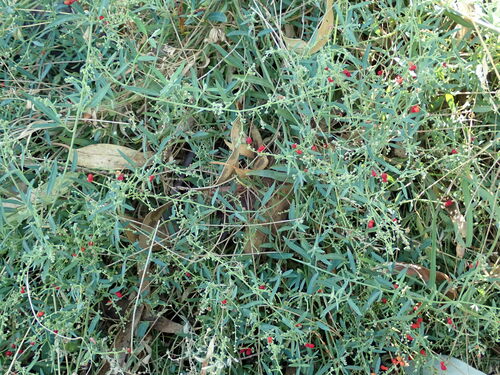
A scrambling plant. It creeps over the ground. It keeps growing from year to year. The branches are tangled and weak. The stems are very slender. They are 30-60 cm long. The plant can be 0.5-1.5 m high and 1-2 m wide. The leaves are often arrowhead shaped. They have an angular base. They can be green or yellow. The flower spikes are at the ends of branches and in the axils of leaves. The flowers are very small and green. They become red. The fruit are orange or red and succulent. They are small and 0.3-0.4 cm across.
How to Grow
Plants can be grown from seed or cuttings.
Notes
It has also been put in the family Chenopodiaceae.
Names & Synonyms
References (23)
- Bodkin, F., 1991, Encyclopedia Botanica. Cornstalk publishing, p 874 (As Rhagodia nutans)
- Cherikoff V. & Isaacs, J., The Bush Food Handbook. How to gather, grow, process and cook Australian Wild Foods. Ti Tree Press, Australia p 196 (As Rhagodia nutans)
- Dashorst, G.R.M., and Jessop, J.P., 1998, Plants of the Adelaide Plains & Hills. Botanic Gardens of Adelaide and State Herbarium. p 60
- Feddes Repert. Spec. Nov. 89:3. 1978
- Ferns, Plants For A Future (As Rhagodia nutans)
- Hall, N. et al, 1972, The Use of Trees and Shrubs in the Dry Country of Australia, AGPS, Canberra. p 289 (As Rhagodia nutans)
- Hibbert, M., 2002, The Aussie Plant Finder 2002, Florilegium. p 91
- Howells, C & Gulline, H., 2003, Coastal Plants of Tasmania. Plant Identikit. Australian Plant Society, Tasmania. p 52
- Hunter, J., 2012, Vegetation and Floristics of Gilwarny and Wingadee Nature Reserves. A Report to the New South Wales National Parks and Wildlife Service p 115
- Hunter, J., 2015, Vegetation and flora of Naree and Yantabulla. A Draft Report to the Bush Heritage Australia
- Hunter, J.T., 2017, Is there a relationship between contemporary high Aboriginal plant resource locations and mapped vegetation communities? Cunninghamia 17:27-34. The Royal Botanic Garden Sydney. ISSN 2200 - 405X
- Lazarides, M. & Hince, B., 1993, Handbook of Economic Plants of Australia, CSIRO. p 204 (As Rhagodia nutans)
- Flora of Australia, Volume 4, Phytolaccaceae to Chenopodiaceae, Australian Government Publishing Service, Canberra (1984) p 161
- Lazarides, M. & Hince, B., 1993, Handbook of Economic Plants of Australia, CSIRO. p 88
- Low, T., 1992, Bush Tucker. Australia’s Wild Food Harvest. Angus & Robertson. p 129
- Paczkowska, G. & Chapman, A.R., 2000, The Western Australian Flora. A Descriptive Catalogue. Western Australian Herbarium. p 203
- Plants for a Future database, The Field, Penpol, Lostwithiel, Cornwall, PL22 0NG, UK. http://www.scs.leeds.ac.uk/pfaf/ (As Rhagodia nutans)
- Tasmanian Herbarium Vascular Plants list p 22
- Wheeler, J.R.(ed.), 1992, Flora of the Kimberley Region. CALM, Western Australian Herbarium, p100
- Whiting, J. et al, 2004, Tasmania's Natural Flora. Tasmania's Natural Flora Editorial Committee PO Box 194, Ulverstone, Tasmania, Australia 7315 p 93
- Williams, K.A.W., 1999, Native Plants of Queensland Volume 4. Keith A.W. Williams North Ipswich, Australia. p 172
- Woolmore, E et al, 2002, King Island Flora: A Field Guide. p 37
- www.ceres.org.au/bushfoodcatalogue