Agave vivipara
L.
Dwarf sisal, Carribean agave
(c) lupis, some rights reserved (CC BY-NC)

(c) Leticia Soriano Flores, some rights reserved (CC BY-NC), uploaded by Leticia Soriano Flores

(c) Carlos Domínguez-Rodríguez, some rights reserved (CC BY-NC), uploaded by Carlos Domínguez-Rodríguez
What to Eat
Edible parts: Leaves, Buds
Many, if not all, reports on the uses of this species likely refer to A. angustifolia. No reports have been found that definitively apply to this species. Given their similarity, both species likely share comparable uses. The following are recorded for A. angustifolia: flower buds, flowers, young flower peduncles, stems, leaf bases, and fruit are all used. Flowering stems are cooked and their juice extracted, then fermented and distilled into alcoholic beverages. The sap can be concentrated into a sweet syrup known as agave nectar or agave syrup.
Known Hazards
Where to Find It
It grows well in the tropics. It suits hardiness zones 9-11. It suits semiarid to seasonally moist and dry climates. It grows well on a gritty, well drained soil. It can grow in full sun or light shade. In Brisbane Botanical Gardens. (As Agave vivipara)
Antigua and Barbuda, Asia, Australia, Canada, Central America*, Costa Rica, India, Indonesia, Mexico*, North America, Panama, SE Asia, Singapore,
How to Identify
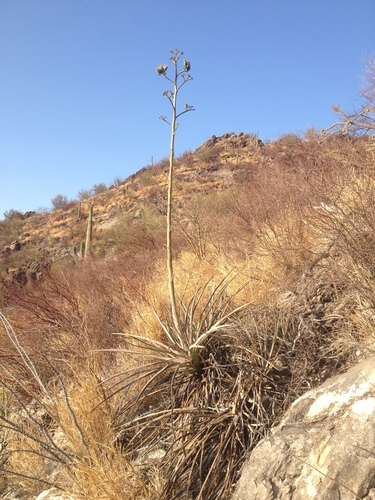
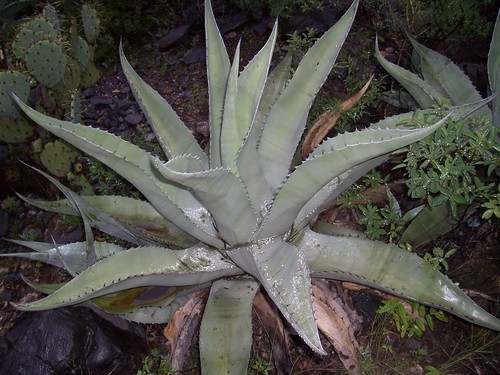
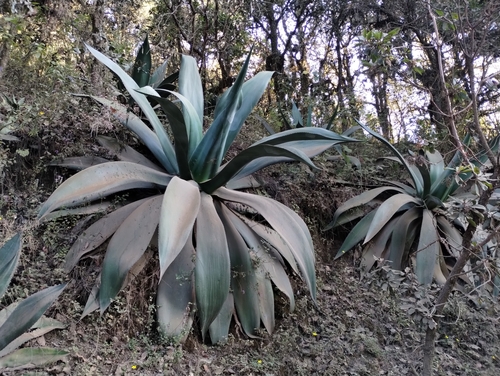
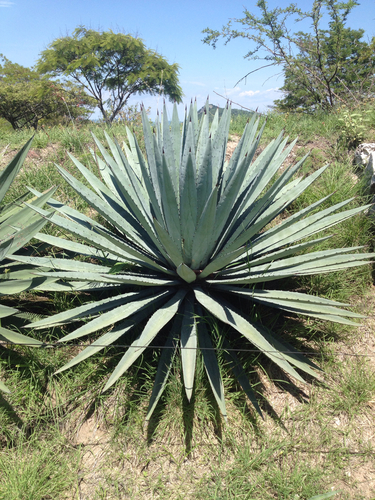
A small leafy agave. It grows 60-300 cm high. It can form suckers. The leaves are sword shaped and fibrous. They can be flat or have a gutter. There are small hooked teeth along the edge. It flowers are maturity. The flowers are trumpet shaped and greenish-yellow. The flowering stalk can be 5 m long. The bracts are purple and triangle shaped.
How to Grow
Requires a sunny position. Requires a well-drained soil. Succeeds in poor soils. Established plants are very drought resistant. A monocarpic species - the plant lives for a number of years without flowering but dies once it does flower. However, it normally produces plenty of suckers during its life and these continue growing, taking about 10 - 15 years in a warm climate, considerably longer in colder ones, before flowering. Climate: subtropical to tropical. Humidity: semi-arid to humid. Carbon Farming - Cultivation: regional crop. Management: standard.
Propagation: Surface sow seed in a container in a light position. Germination usually occurs within 1–3 months at 20°C. Prick out seedlings into individual pots of well-drained soil when large enough to handle, and grow on in a sunny position until at least 20cm tall. Can also be propagated by division of suckers or by bulbils.
Medicinal Uses
Many, if not all, reports on the uses of this species likely refer to A. angustifolia. No reports have been found that definitively apply to this species. Given their similarity, both species likely share comparable uses. The following are recorded for A. angustifolia: juice from the cooked leaves and stems, and a root infusion, are taken internally or applied as poultices for internal and external swelling, bruises, liver and kidney diseases, arthritis, and dysentery. The roots are diaphoretic and diuretic.
Other Uses
Many, if not all, reports on the uses of this species likely refer to A. angustifolia. No reports have been found that definitively apply to this species. Given their similarity, both species likely share comparable uses. The following are recorded for A. angustifolia: the plant is often used in hedges. Fibre from the leaves is used to make rope. The leaves serve as thatching material, and their spines are used as nails or needles. Flowering stems can be used as posts, rafters, and fencing. The root contains saponins and can be used as a soap substitute. The sticky sap of the leaves is added to whitewash to help it adhere to walls. The dried plant is burned for fuel. It is also noted as an industrial fiber crop and living fence in carbon farming agroforestry systems.
Wikipedia
Source ↗Agave vivipara is an evergreen perennial growing to 1 m (3 ft 3 in) tall and wide at medium rate. Hardy to UK zone 10. It grows in light sandy, medium loamy, or heavy clay soils with good drainage, tolerating nutritionally poor soil. Suitable for mildly acidic, neutral, or basic soils. Requires full sun and tolerates both dry and moist conditions with drought hardiness.
Notes
There are about 250 Agave species. The Agavaceae are mostly in the tropics and subtropics.
Names & Synonyms
Agave karibia, Kantala
References (17)
- Ambasta S.P. (Ed.), 2000, The Useful Plants of India. CSIR India. p 20
- Anderson, M., 2002, The World Encyclopedia of Cacti and Succulents. Hermes House, New York. p 125
- Behera, K. K. et al, 2008, Wild Edible Plants of Mayurbhanj District, Orissa, India. J. Econ. Taxon. Bot. Vol. 32 (Suppl,) pp 305-314 (As Agave angustifolia Haw.)
- Bircher, A. G. & Bircher, W. H., 2000, Encyclopedia of Fruit Trees and Edible Flowering Plants in Egypt and the Subtropics. AUC Press. p 13
- Bodkin, F., 1991, Encyclopedia Botanica. Cornstalk publishing, p 57
- Cundall, P., (ed.), 2004, Gardening Australia: flora: the gardener's bible. ABC Books. p 113
- Facciola, S., 1998, Cornucopia 2: a Source Book of Edible Plants. Kampong Publications. p 2
- Jackes, B. R., 2010, Plants of Magnetic Island. 3rd Edition. James Cook University, Australia. p 30
- Llamas, K.A., 2003, Tropical Flowering Plants. Timber Press. p 43
- Purseglove, J.W., 1972, Tropical Crops. Monocotyledons. Longmans p 10
- Nabhan, G.P. & Felger, R.S., Wild desert relatives of crops: their direct uses as food in Wickens, G.E., Goodin, J.R., and Field, D.V.,(Eds.) 1985, Plants for Arid Lands. Unwin Hyman, London, p 19
- Small, E., 2009, Top 100 Food Plants. National Research Council of Canada. p 526 (As Agave angustifolia)
- Sukarya, D. G., (Ed.) 2013, 3,500 Plant Species of the Botanic Gardens of Indonesia. LIPI p 999 (Also as Agave rigida)
- Syn. pl. succ. 72. 1812
- WATT (As Agave vivipara)
- Wienk, J.F. and S’chendellaan, A.,van, Sisal and relatives, in Simmonds, N.W., (Ed.), 1979, Evolution of Crop Plants. Longman. p 3
- World Checklist of Useful Plant Species 2020. Royal Botanic Gardens, Kew