Enhalus acoroides
(L.f.) L.C.Rich.
Sea Fruit

(c) Christian Gloor, some rights reserved (CC BY)

(c) Nina Peck, some rights reserved (CC BY-NC)
What to Eat
Edible parts: Seeds, Fruit
Both the fruit and the seeds (approximately 1 cm across) are eaten.
Where to Find It
A tropical plant. They occur in the Philippines from Luzon to Mindanao and growing in salt water. They are abundant in shallow bays. This grass grows on sandy and muddy shores in sea water up to 4 m deep. It grows in salt water. It does not grow near rivers where fresh water flows into the sea.
Submerged in shallow sea water along the coast. Usually found growing in muddy soils.
How to Identify
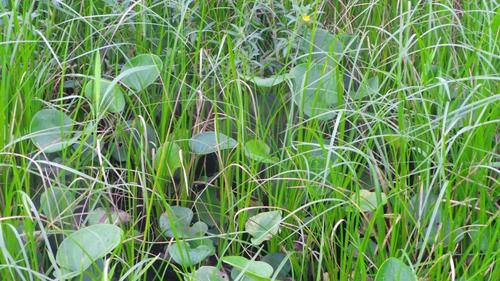
A herb or coarse sea grass with ribbon like leaves that arise from the base of the plant and can be 150 cm x 1 cm. Flowers are borne on long rather slender stalks. Fruit are about 2 to 3 cm across and contain 8 or 9 green seeds. The seeds are about 1 cm across. Underground there is a root-like stem covered with leafy fibres.
Nutrition Score: 2/100
| Part | Moisture | kJ | kcal | Protein | Vit A | Vit C | Iron | Zinc |
|---|---|---|---|---|---|---|---|---|
| Seed | — | — | 9.6 | — | — | — | — | — |
| Fruit | — | — | 9.5 | — | — | — | — | — |
How to Grow
A plant of tropical coasts. Needs to be grown in shallow coastal waters.
Propagation: Seed - when ripe, the seeds fall off the plant. They are able to float in the sea water, but only for about 5 hours before they start to sink, thus they don't travel far. The seed germinates almost immediately and the roots develop rapidly in order to anchor the young plant. Like other seagrasses, this species spreads mostly by vegetative reproduction.
Other Uses
A fibre obtained from the plants is made into nets.
Names & Synonyms
Berak laut, Chaguan-tasi, Deringu laut, Jari ambun, Jari amun, Jelamun, Jerangau laut, Lamon, Lamun, Setul
References (20)
- Ambasta, S.P. (Ed.), 2000, The Useful Plants of India. CSIR India. p 196
- Aston, H.I., 1973, Aquatic Plants of Australia. MUP. (As Enhalus koenigii)
- Borrell, O.W., 1989, An Annotated Checklist of the Flora of Kairiru Island, New Guinea. Marcellin College, Victoria Australia. p 25, 160
- Brown, W.H., 1920, Wild Food Plants of the Philippines. Bureau of Forestry Bulletin No. 21 Manila. p 24
- Burkill, I.H., 1966, A Dictionary of the Economic Products of the Malay Peninsula. Ministry of Agriculture and Cooperatives, Kuala Lumpur, Malaysia. Vol 1 (A-H) p 939
- Cribb, A.B. & J.W., 1976, Wild Food in Australia, Fontana. p 96
- den Hartog, C., 1957, Hydrocharitaceae in Flora Malesiana 5(4) p 402
- French, B.R., 1986, Food Plants of Papua New Guinea, A Compendium. Asia Pacific Science Foundation p 345
- Hedrick, U.P., 1919, (Ed.), Sturtevant's edible plants of the world. p 290 (As Enhalus koenigii)
- Kenneally, K.E., Edinger, D. C., and Willing T., 1996, Broome and Beyond, Plants and People of the Dampier Peninsula, Kimberley, Western Australia. Department of Conservation and Land Management. p 211
- Massal, E. and Barrau, J., 1973, Food Plants of the South Sea Islands. SPC Technical Paper No 94. Nounea, New Caledonia. p 33
- Menninger, E.A., 1977, Edible Nuts of the World. Horticultural Books. Florida p 109 (Also as Enhalus koenigii)
- Monsalud, M.R., Tongacan, A.L., Lopez, F.R., & Lagrimas, M.Q., 1966, Edible Wild Plants in Philippine Forests. Philippine Journal of Science. p 483
- Morley, B.D., & Toelken, H.R., (Eds), 1983, Flowering Plants in Australia. Rigby. p 317 (As Enhalus koenigii)
- Paczkowska, G. & Chapman, A.R., 2000, The Western Australian Flora. A Descriptive Catalogue. Western Australian Herbarium. p 68
- Powell, J.M., Ethnobotany. In Paijmans, K., 1976, New Guinea Vegetation. Australian National University Press. p 109
- Ratwanati, et al, 2019, Fruits of Enhalus acoroides as a source of nutrition for coastal communities. IOP Conf. Ser.: Earth Environ. Sci. 235 012073
- Roth, W.E., 1901, (As Enhalus koenigii)
- Wheeler, J.R.(ed.), 1992, Flora of the Kimberley Region. CALM, Western Australian Herbarium, p 964
- World Checklist of Useful Plant Species 2020. Royal Botanic Gardens, Kew