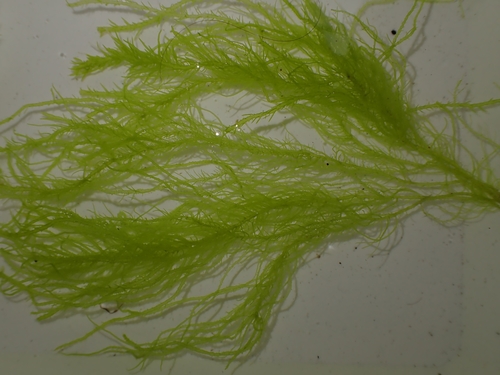
Enteromorpha prolifera
(Mull.) J. Ag.
Green algae

iNaturalist · cc-by-nc
(c) aakritiv, some rights reserved (CC BY-NC)
(c) aakritiv, some rights reserved (CC BY-NC)

iNaturalist · cc-by-nc
(c) aakritiv, some rights reserved (CC BY-NC)
(c) aakritiv, some rights reserved (CC BY-NC)
iNaturalist · cc-by-nc
(c) Оlga Сhernyagina, some rights reserved (CC BY-NC)
(c) Оlga Сhernyagina, some rights reserved (CC BY-NC)
What to Eat
Edible parts: Frond, Seaweed, Frond, Algae
The finely branched fronds are eaten, dressed with salt and allowed to stand until slightly fermented, or eaten in stews or with fish. The dried powder is sprinkled over foods as a seasoning.
Known Hazards
Where to Find It
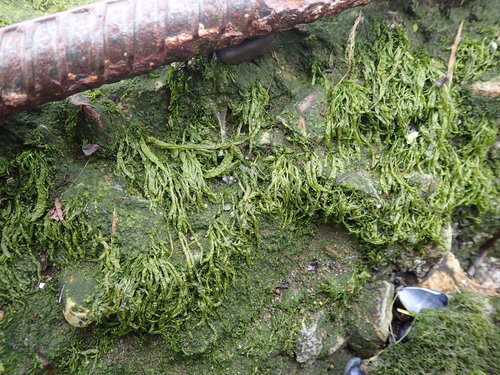
A tropical plant. It grows in tufts on rocks in fine sand.
Asia, China, Hawaii, Indonesia, Japan, Korea, Malaysia, Pacific, Philippines, SE Asia, USA,
Countries: United Arab Emirates, Afghanistan, Armenia, Australia, Azerbaijan, Bangladesh, Bahrain, Brunei, Bhutan, China, Fiji, Micronesia, Georgia, Indonesia, Israel, India, Iraq, Iran, Jordan, Japan, Kyrgyzstan, Cambodia, Kiribati, North Korea, South Korea, Kuwait, Kazakhstan, Laos, Lebanon, Sri Lanka, Marshall Islands, Myanmar, Mongolia, Maldives, Malaysia, Nepal, Nauru, New Zealand, Oman, Papua New Guinea, Philippines, Pakistan, Palau, Qatar, Saudi Arabia, Solomon Islands, Singapore, Syria, Thailand, Tajikistan, Timor-Leste, Turkmenistan, Tonga, Turkey, Tuvalu, Taiwan, United States, Uzbekistan, Vietnam, Vanuatu, Samoa, Yemen
How to Identify
A fine, dark green seaweed in the Ulvaceae family found in tropical regions, growing in tufts on rocks in fine sand. It is cultivated.
Other Information
It is cultivated.
Names & Synonyms
Limu 'ele'ele, Suji-ao-nori
References (7)
- Facciola, S., 1998, Cornucopia 2: a Source Book of Edible Plants. Kampong Publications, p 261
- http://www.hawaii.edu/reefalgae/publications/ediblelimu/
- http://www.seavegetables.com
- Kiple, K.F. & Ornelas, K.C., (eds), 2000, The Cambridge World History of Food. CUP p 234
- Xia, B., and Abbott, I.A., 1987, Edible seaweeds of China and their place in the Chinese diet. Economic Botany 41:341-53
- Zaneveld, J.S., 1950, The economic marine algae of Malaysia and their applications. Proceedings of the Indo-Pacific Fisheries Council, 107-14
- Zemke-White, W. L. & Ohno, M., 1999, World seaweed utilisation: An end-of-century summary. Journal of Applied Phycology 11: 369-376