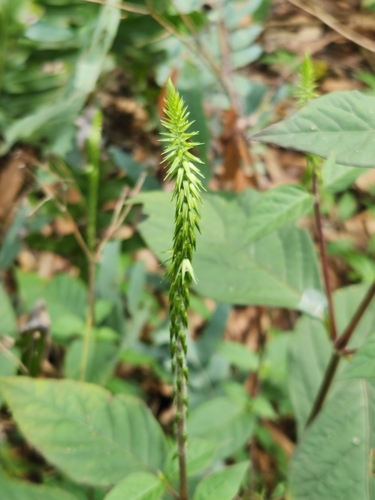
Chenopodium nuttalliae
Saff.
Huauzontle, Nuttall's goosefoot

Pabs004 (via Wikimedia Commons)

Hajor (via Wikimedia Commons)

Stan Shebs (via Wikimedia Commons)
What to Eat
Edible parts: Flowers, Leaves, Seed
Leaves - cooked. A mild flavoured spinach substitute. The raw leaves should only be eaten in small quantities, see the notes above on toxicity. Flower clusters - cooked. Used like broccoli, they are considered a gourmet food. Seed - cooked. A mild flavour, it can be used as a staple food. It can be used in all the ways that rice is used, either as a sweet or as a savoury dish. The seed should be soaked in water overnight and then thoroughly rinsed to wash off the bitter tasting saponins. Very nutritious and sustaining. The seed is fairly small but is easy to harvest.
Known Hazards
Where to Find It
Southern N. America - Mexico.
Coming Soon
How to Identify
Chenopodium nuttalliae is a ANNUAL growing to 0.6 m (2ft). It is in flower from July to October, and the seeds ripen from August to October. The species is hermaphrodite (has both male and female organs) and is pollinated by Wind. Suitable for: light (sandy), medium (loamy) and heavy (clay) soils. Suitable pH: mildly acid, neutral and basic (mildly alkaline) soils. It cannot grow in the shade. It prefers moist soil.
How to Grow
An easily grown plant, succeeding in most soils but disliking shade. It prefers a moderately fertile soil. Huauzontle was formerly commonly cultivated in Mexico for its edible seed and flowering shoots. It is potentially a very productive crop. Although it is said to require a fairly long growing season in order to crop well, plants grown in Cornwall in the cool wet summer of 1992 did very well. Even with all the rain at the end of the summer a reasonable crop was harvested in September. This species is closely related to quinoa, C. quinoa, and both might have originated from the same wild species. Whilst that species has been widely cultivated as a seed crop, though, this species was grown more for its edible flowering stem. Some modern works now see this species as no more than a sub-species of C. berlandieri.
Propagation: Seed - sow spring in situ. Germination is normally very rapid, but be careful not to weed out the seedlings because they look rather like the garden weed fat hen (C. album).
Other Uses
Dye. Gold/green dyes can be obtained from the whole plant.