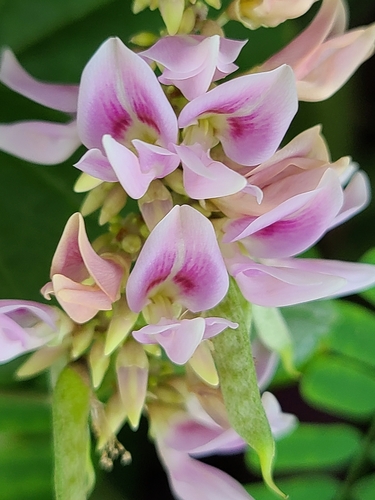
Glycine spp.
Various
Perennial Soybean

sgrove

sgrove

sgrove
What to Eat
Edible parts: Leaves, Oil, Seed, Seedpod
Carbon Farming Solutions - Staple Crop: protein-oil (The term staple crop typically refers to a food that is eaten routinely and accounts for a dominant part of people's diets in a particular region of the world). Research at the University of Illinois has crossed Glycine max (annual soybean) with Glycine tomentella (perennial) which could lead to the production of a perennial edible soybean.
Known Hazards
Where to Find It
Cultivated origin.
Coming Soon
How to Identify
Glycine spp. is a PERENNIAL growing to 0.6 m (2ft) by 0.3 m (1ft in) at a fast rate. See above for USDA hardiness. It is hardy to UK zone 7. It can fix Nitrogen. Suitable for: light (sandy) and medium (loamy) soils and prefers well-drained soil. Suitable pH: mildly acid, neutral and basic (mildly alkaline) soils. It can grow in semi-shade (light woodland). It prefers moist soil.
How to Grow
Hypothetical Crop Management: Standard Staple Crop: Protein-oil. Climate: hypothetical. Humidity: semi-arid to humid. Carbon Farming Solutions - Cultivation: hypothetical. Management: standard (Describes the non-destructive management systems that are used in cultivation).
Propagation: See individual plant entries.
Medicinal Uses
See individual species.
Other Uses
Oil. See individual plant entries.
Names & Synonyms
Glycine spp. Glycine species. Perennial Glycine. Perennial Soybean