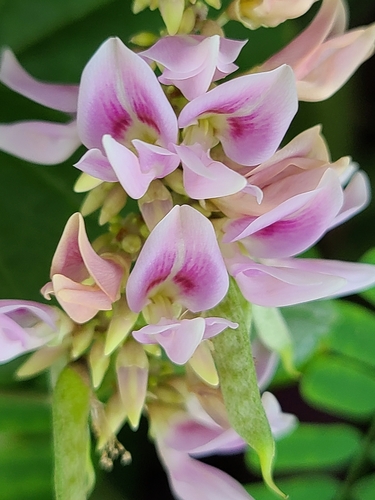
Inga edulis
Mart.
Ice Cream Bean, Monkey Tamarind

(c) Randall Jiménez, some rights reserved (CC BY-NC), uploaded by Randall Jiménez

(c) adrabkin, some rights reserved (CC BY-NC)

(c) Isabel Ortiz Monsalve, some rights reserved (CC BY-NC), uploaded by Isabel Ortiz Monsalve
What to Eat
Edible parts: Seedpod
The pulp surrounding the seeds in the seedpod is white, translucent and jelly-like with a sweet, perfumed flavour. Much esteemed in Ecuador, some forms have a slight cinnamon flavour. The seedpod is up to 100cm long. The seedpod can vary considerably in size and in the quantity of pulp it contains. The best forms are found in S. America.
Where to Find It
Northern and western S. America - Brazil, Bolivia, Peru, Ecuador, Colombia, Venezuela, the Guyanas.
SOUTHERN AMERICA: French Guiana, Guyana, Suriname, Venezuela, Brazil, Bolivia, Colombia (east), Ecuador, Peru (east),
How to Identify
Inga edulis is an evergreen Tree growing to 18 m (59ft) by 18 m (59ft) at a fast rate. See above for USDA hardiness. It is hardy to UK zone 10. It can fix Nitrogen. Suitable for: light (sandy), medium (loamy) and heavy (clay) soils. Suitable pH: mildly acid and neutral soils and can grow in very acid soils. It can grow in semi-shade (light woodland) or no shade. It prefers dry moist or wet soil and can tolerate drought.
How to Grow
It grows best in areas where annual daytime temperatures are within the range 23 - 30°c, but can tolerate 18 - 35°c. Mature plants can be killed by temperatures of -2°c or lower, whilst new growth is damaged at 0°c. It prefers a mean annual rainfall in the range 1,200 - 2,500mm, but tolerates 640 - 4,000mm. Prefers a sunny position, but also succeeds in dappled shade. Tolerant of a range of soil conditions, including limestone. It can succeed on floodplains that are waterlogged for 2 - 3 months each year, and is also remarkably resistant to drought, occurring in regions with a 6-month dry season. Prefers a pH in the range 5 - 6.5, tolerating 4.5 - 8. The tree can grow rapidly, even on the poorest nutrient-depleted soils. Seedling trees can commence fruiting when only two years old. Trees can flower and fruit all year round. The tree responds well to coppicing. A highly variable species, forms with the best quality seedpods are seldom found in Central America, where it is quite likely that all the trees are relics of former cultivation. This species has a symbiotic relationship with certain soil bacteria, these bacteria form nodules on the roots and fix atmospheric nitrogen. Some of this nitrogen is utilized by the growing plant but some can also be used by other plants growing nearby. Flowering Time: Blooms repeatedly. Bloom Color: White/Near White.
Propagation: Seed - best sown as soon as it is ripe. Sow in a lightly shaded position in a nursery seedbed. A high rate of germination can be expected, with the seeds sprouting within a few days. Transplant the seedlings to individual containers when they have 4 - 6 leaves and they should be ready for planting out 4 - 5 months later. Greenwood cuttings.
Medicinal Uses
Antitussive SkinA decoction of the crushed leaves is taken to relieve coughing. A decoction of the leaves is applied to sores of the lips (perhaps herpes).
Other Uses
Containers Fencing Fuel Hedge Soil conditioner Soil stabilization Wood. Agroforestry Uses: Commonly planted as a shade tree in coffee and cacao plantations, since it is fast-growing, fixes atmospheric nitrogen, has a well spreading crown and produces large quantities of leaves which cover the ground and add considerable quantities of organic matter to the soil. In trial experiments on cultivated slopes, a mulch from this tree reduced soil erosion to levels almost equal to those in secondary forests. The leaf litter is high in nitrogen, lignins and polyphenols. It is slow to decompose, but provides a long-term build up of organic nitrogen and effective weed control. Weed biomass decreased considerably in all agroforestry trials with this species, much more than with other leguminous species. Existing trials are too new to ascertain whether the species can maintain or improve soil fertility on acid sites in the long term, but results so far are promising. Other Uses: The heartwood is light brown with dark stripes; the sapwood is pale yellow or almost white. The texture is coarse; the grain straight to interlocked; lustre is medium; there is no distinctive taste or aroma. The wood is not very heavy; hard to moderately hard. It is said to be very durable, even in water, though another report says it has low durability and is susceptible to blue stain. It is easy to cut, saws slightly woolly and is liable to split in drying. It is used for making packing cases, and especially for making piles. The wood is used for fuel. A popular source of firewood, the wood has a high calorific value and burns with little smoke.
Names & Synonyms
Ice-cream-bean, pois doux - French, inga-cipó - Portuguese, chalaite - Spanish, cuajiniquil - Spanish, guaba - Spanish, pacay - Spanish. Bribri, Copocoqui, Food Inga, Geli-weko, Guaba, Guama, Guamo, Guavo-bejuco, Huaba, Inga macarrao, Inga-Cipo, Inga-de-macaco, Inga-rabo-de-mico, Krepu uhi, Machete, Pacay, Tite-weko, Warako-sa, guava, wampaa.