Agave parryi
Engelm.
Century plant, Parry's Agave
(c) debcushman, some rights reserved (CC BY-NC), uploaded by debcushman
(c) Michael J. Papay, some rights reserved (CC BY), uploaded by Michael J. Papay

(c) ronsavage, some rights reserved (CC BY-NC-SA)
What to Eat
Edible parts: Young shoot, Seeds, Flower stalks, Leaves, Sap
The heart of the plant is very rich in saccharine matter — sweet and nutritious, though rather fibrous — and can be eaten after baking. It sits partly below ground. Seeds can be ground into flour and used as a thickener in soups or combined with cereal flours for bread. Young flower stalks are eaten raw or cooked, though they were traditionally roasted. Tender young leaves are also roasted. Sap drawn from cut flowering stems is used as a syrup, and nectar from the flowering stems can likewise be made into a sweet syrup. Sap can be tapped by boring a hole into the middle of the plant at the base of the flowering stem and can be fermented into 'Mescal', a very potent alcoholic drink. The usable parts include crowns (caudices/heads/hearts), flower stalks, flower buds, flowers, and seeds, though extensive preparation is often required. Cooking reduces saponins, the irritating soap-like compounds present in the plant. Crowns can be gathered at any time, though traditionally harvesting begins when flower stalks emerge. Flower stalks are best gathered when they first appear (April to June), while still soft. Native Americans traditionally baked agave flower stalks and crowns in fire pits overnight; baked parts can be consumed immediately or stored for future use. Agave syrup is made by boiling baked crowns with water.
Known Hazards
Where to Find It
It occurs naturally in South-western North America from Arizona to New Mexico in semiarid land between 1300-2400 metres, often experiencing snow in winter with temperatures as low as -18°C for short periods. It suits hardiness zones 7-11. It suits gritty, well drained soils.
Australia, Central America, Mexico, North America, USA,
How to Identify
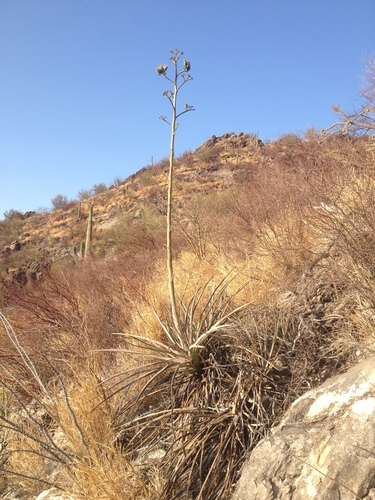
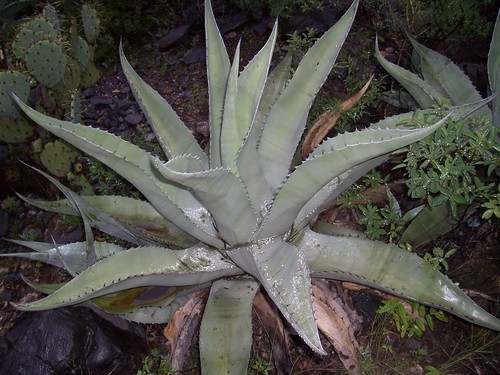
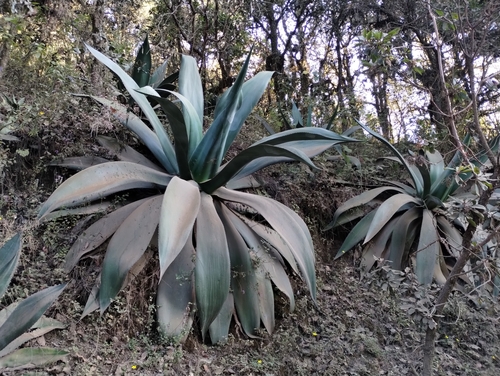
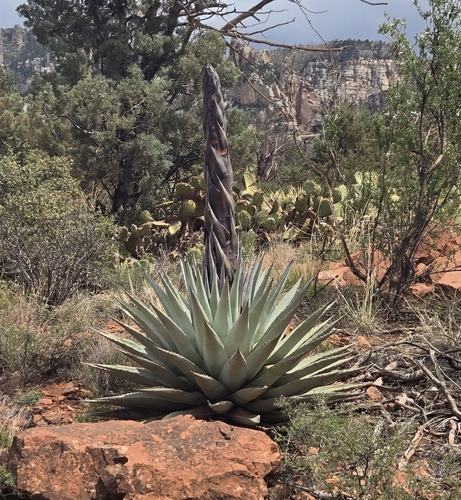
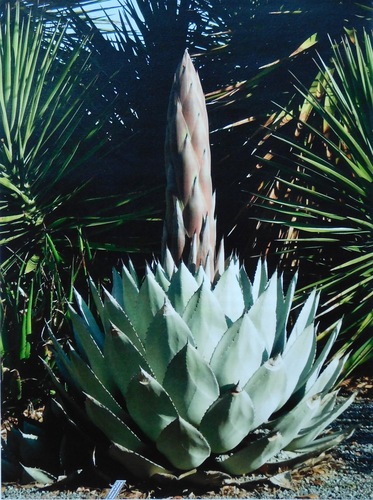
A perennial plant which grows to 50 cm high and spreads to 1 m wide. The plants have a very sharp and tough spine at the tip of each leaf. The leaves are fattened sword shape and 25 cm long. They are light waxy grey in colour. The plants form flowers after about 20-30 years. The flower buds are reddish and the flowers are yellow. The flower stalk is 5 or more m tall.
How to Grow
Historic Crop Management: Standard Staple Crop: Basic Starch. Requires a very well-drained soil and a sunny position. This species is probably the hardiest member of the genus, it survives outdoors grown against a warm wall at Kew. In the wild, plants often experience snow during the winter with temperatures as low as -18°c for short periods. A monocarpic species, the plant lives for a number of years without flowering but dies once it does flower. However, it normally produces plenty of suckers during its life and these take about 10 - 15 years in a warm climate, considerably longer in colder ones, before flowering. This plant is widely used by the native people in its wild habitat, it has a wide range of uses. Members of this genus are rarely if ever troubled by browsing deer. Bloom Time: Late spring to early summer. Wildlife: Flowers are better left for wildlife as they contain acrid compounds, making them unpalatable for human consumption. Environmental Impact: Some species are protected, so gathering may be restricted in certain areas. Challenges: Dislodging an agave is difficult and requires tools like a sharp axe. Preparation: Removing leaves to access crowns is challenging due to their toughness and spines. The main harvest of the agave hearts (piñas) occurs after about 7 to 10 years, typically in late winter to early spring (January to April), depending on the climate and growing conditions. Agave usually flowers once it reaches maturity, which can be after 7 to 10 years, and the flowering period generally occurs in late spring to summer.
Propagation: Surface sow seed in a light position in April in a warm greenhouse. Germination usually occurs within 1–3 months at 20°C. Prick out seedlings into individual pots of well-drained soil once large enough to handle, and grow on in a sunny greenhouse position until at least 20cm tall. Plant out in late spring or early summer after the last expected frosts, and provide cold protection for at least the first few winters. Offsets can be potted up whenever available and kept in a warm greenhouse until well established.
Medicinal Uses
The sap is antiseptic, diuretic, and laxative.
Other Uses
The leaves contain saponins, and an extract can be used as a soap — best obtained by chopping the leaves and simmering them in water, taking care not to boil too long as this begins to break down the saponins. A very strong fibre from the leaves is used to make rope and coarse fabrics, and a paper can also be made from this leaf fibre. The thorns on the leaves serve as pins and needles. The dried flowering stems are used as waterproof thatching and as a razor strop. The flowers are rich in nectar and pollen and attract pollinators including bees and butterflies.
Wikipedia
Source ↗Agave parryi, known as Parry's agave or mescal agave, is a flowering plant in the family Asparagaceae, subfamily Agavoideae. It is a slow-growing succulent perennial native to Arizona, New Mexico, and northern Mexico. The leaves are grey green and have a spine at the tip. One of the distinguishing features is that the point on the tip, which is typically dark tan, brown, or black, is darker than the leaf. Indentations of previous leaves show on the back of each leaf. The Huachuca variety grows in a rosette pattern as large as 2½ feet in diameter. Because of its compact size, plus its low water use and low maintenance, Huachuca agave is considered a good landscaping plant for desert residential landscaping. It requires full sun. It is hardy to roughly −5 °F (−21 °C), though there are reports of specimens surviving temperatures at −20 °F (−29 °C). Parry's agave is evergreen and monocarpic—i.e., mature agaves produce a twelve-foot stalk studded with bright, yellow blooms before the plant then dies, as all energetic resources are put into the inflorescence, flowering, and pollination. Nonetheless, A. parryi is known as one of the most prolific species of Agave and can be easily propagated by removing the side shoots with a sterile, sharp knife, or by digging up any rhizomatous plantlets that have grown further away from the main plant. This plant has gained the Royal Horticultural Society's Award of Garden Merit.
Production
The flower lives for a number of years without flowering but dies once it does flower. Suckers however continue to grow. Suckers flower after 15 years in warm climates. Plants are very slow growing.
Other Information
It has been an important food of some groups of people.
Notes
There are about 250 Agave species. The Agavaceae are mostly in the tropics and subtropics.
Names & Synonyms
Parry's Century-plant
References (13)
- Anderson, M., 2002, The World Encyclopedia of Cacti and Succulents. Hermes House, New York. p 126
- Beckstrom-Sternberg, Stephen M., and James A. Duke. "The Foodplant Database." http://probe.nalusda.gov:8300/cgi-bin/browse/foodplantdb.(ACEDB version 4.0 - data version July 1994)
- Brickell, C. (Ed.), 1999, The Royal Horticultural Society A-Z Encyclopedia of Garden Plants. Convent Garden Books. p 89
- CASTETTER,
- Cundall, P., (ed.), 2004, Gardening Australia: flora: the gardener's bible. ABC Books. p 115
- Etkin, N.L. (Ed.), 1994, Eating on the Wild Side, Univ. of Arizona. p 70
- Facciola, S., 1998, Cornucopia 2: a Source Book of Edible Plants. Kampong Publications. p 3
- Hedrick, U.P., 1919, (Ed.), Sturtevant's edible plants of the world. p 29
- MINNIS
- Nugent, J., 1999, Agaves and cacti., Permaculture plants. Sustainable Agriculture Research Institute. PO Box 10, Nanup, WA, 6275 (As Agave patonii)
- Plants for a Future database, The Field, Penpol, Lostwithiel, Cornwall, PL22 0NG, UK. http://www.scs.leeds.ac.uk/pfaf/
- Trans. Acad. Sci. St. Louis 3:310. 1875
- World Checklist of Useful Plant Species 2020. Royal Botanic Gardens, Kew