Epipremnum pinnatum
(L.) Engler
False Monsteriosa, Native Monstera
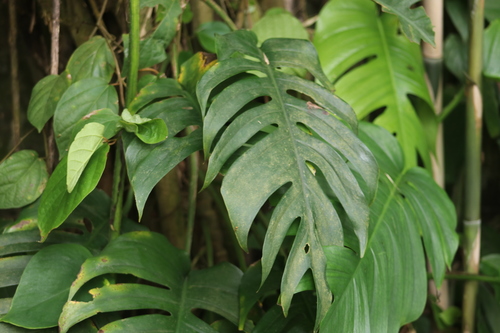
(c) rizkirojabi31, some rights reserved (CC BY-NC)
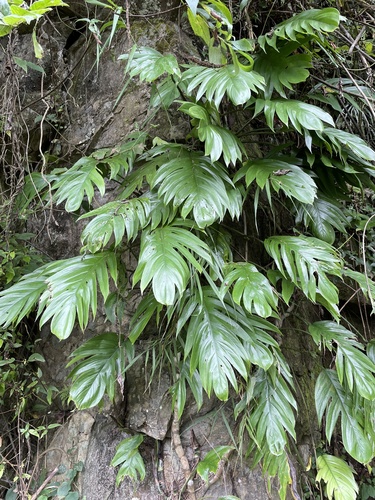
(c) mu9400, some rights reserved (CC BY-NC)

(c) hcl, some rights reserved (CC BY-NC), uploaded by hcl
What to Eat
Edible parts: Leaf stalk starch, Fruit
Starch is extracted from the leaf stalk. The fruit is also eaten.
Known Hazards
Where to Find It
A tropical and subtropical plant. It grows best with warm conditions and high humidity. It is best with light shade. It is damaged by drought and frost. They need good drainage. It suits hardiness zones 10-12. In Yunnan. It occurs in the Western Ghats in India.
Amazon, Asia, Australia, Bangladesh, Belize, Bolivia, Brazil, Brunei, Cambodia, Central America, China, Colombia, Cook Islands, Costa Rica*, Dominican Republic, East Timor, Fiji, Hawaii, Guatemala, Honduras, India, Indochina, Indonesia, Laos, Malaysia, Marquesas, Myanmar, Nauru, Nicaragua, Pacific, Panama, Papua New Guinea, PNG, Peru, Philippines, Puerto Rico, Samoa, SE Asia, Singapore, Solomon Islands, South America, Taiwan, Thailand, Timor-Leste, Tonga, Tuvalu, USA, Vanuatu, Venezuela, Vietnam, West Indies,
How to Identify
An evergreen vine. It climbs to 6 -50 m high. The stem is slender and fibrous but fleshy. The leaves are green and shiny. They are oval or sword shaped. The leaves can be 70 cm long by 40 cm wide and hang downwards. The form a point towards the tip. The leaves are deeply divided, although forms occur with entire leaves. The leaf stalk is about the same length as the leaf. The flowers are dense fleshy spikes. This is 15-20 cm long. The flower is surrounded by a large green boat shaped bract. The flower spikes contain both sexes where the female flowers are lower. These are followed by fruit. The berry is united into a composite red fruit.
How to Grow
It is grown from runners which are put in water to form roots. Plants need then to be put in shady humid situations and can be trained to climb up trees. Plants can be grown from fresh seed or from stem cuttings.
Propagation: Seed - Cuttings Air layering
Medicinal Uses
The leaves are antirheumatic, tonic. They have a high reputation in Chinese communities in the treatment of rheumatism and fractures and dysentery.. An infusion of the leaves is taken as an effective treatment of rheumatism, as a general tonic and anticancer agent. A decoction of the leaves is taken as a treatment for malaria, chest pain and diabetes, and to alleviate toothache. Four cups of a tea made from the leaves combined with Premna taitensis is said to have brought about a permanent cure of a migraine. The young leaves, combined with those of Imperata cylindrica, are crushed, mixed with water or coconut juice, and drunk as a treatment for gonorrhoea. A decoction of the leaves is used as gargle and mouth wash to treat gum inflammations and tooth abscesses. The sap is used in the treatment of snake bites. A juice obtained from the crushed inner part of the stem is mixed with water and drunk as a treatment for joint problems, dislocation and broken bones. The spadix of plant is used as emmenagogue. A recent study has revealed that extracts from the leaves exhibit cytotoxicity toward cancer cells in vitro, and the hot-water-soluble fraction of the extract produces immuno-stimulation in laboratory animals.
Wikipedia
Source ↗Epipremnum pinnatum is a species of flowering plant in the family Araceae. It has many common names, including centipede tongavine, taro vine, silver vine and dragon-tail plant. In the Philippines, it is known in Tagalog as tibatib. Epipremnum pinnatum starts life on the ground and climbs up trees in its natural forest environment, transitioning to an epiphytic lifestyle over time. It exhibits foliage dimorphism, where juvenile leaves look different from mature leaves of the same plant.
Production
In Australia it flowers in December to March.
Other Information
It is used on Pentecost Island, Vanuatu.
Notes
There are 15-18 Epipremnum species. It can be invasive.
Names & Synonyms
Devil's ivy, Dragon tail, Ekor naga, Fue laufao, Galgalut, Jalu mampang, Lolo munding, Lolo tali, Pothos, Rawalu, Sulang, Taro vine, Yalu
References (33)
- Barrau, J., 1976, Subsistence Agriculture in Melanesia. Bernice P. Bishop Museu, Bulletin 219 Honolulu Hawaii. Kraus reprint. p 50
- Bodkin, F., 1991, Encyclopedia Botanica. Cornstalk publishing, p 385
- Burkill, I.H., 1966, A Dictionary of the Economic Products of the Malay Peninsula. Ministry of Agriculture and Cooperatives, Kuala Lumpur, Malaysia. Vol 1 (A-H) p 946
- Cabalion, P. and Morat, P., 1983, Introduction le vegetation, la flore et aux noms vernaculaires de l'ile de Pentcoste (Vanuatu), In: Journal d'agriculture traditionnelle et de botanique appliquee JATBA Vol. 30, 3-4
- Cooper, W. and Cooper, W., 2004, Fruits of the Australian Tropical Rainforest. Nokomis Editions, Victoria, Australia. p 60
- Cowie, I, 2006, A Survey of Flora and vegetation of the proposed Jaco-Tutuala-Lore National Park. Timor-Lests (East Timor) www.territorystories.nt/gov.au p 43
- Cundall, P., (ed.), 2004, Gardening Australia: flora: the gardener's bible. ABC Books. p 543
- Flora of Pakistan.
- Fouqué, A. 1972. Espèces fruitières d'Amérique tropicale. Institut français de recherches fruitierès outre-mer (ifac) (As Monstera dilacerata)
- Franklin, J., Keppel, G., & Whistler, W., 2008, The vegetation and flora of Lakeba, Nayau and Aiwa Islands, Central Lau Group, Fiji. Micronesica 40(1/2): 169–225, 2008
- French, B.R., 2010, Food Plants of Solomon Islands. A Compendium. Food Plants International Inc. p 328
- Gillaumin, R., 1954, Les Plantes utiles des Nouvelles-Hebrides (fin et complement) In: Journal d'agriculture tropicale et de botanique appliquee Vol. 1, No. 10-12 pp 453-460
- Hiddins, L., 1999, Explore Wild Australia with the Bush Tucker Man. Penguin Books/ABC Books. p 154 (As Rhaphidophora pinnata)
- Hibbert, M., 2002, The Aussie Plant Finder 2002, Florilegium. p 93
- Jackes, B.R., 2001, Plants of the Tropics. Rainforest to Heath. An Identification Guide. James Cook University. p 41
- Jones D, L, 1986, Ornamental Rainforest Plants in Australia, Reed Books, p 287
- Kermath, B. M., et al, 2014, Food Plants in the Americas: A survey of the domesticated, cultivated and wild plants used for Human food in North, Central and South America and the Caribbean. On line draft. p 545 (As Monstera dilacerata)
- Leiper, G & Houser, J., Mutooroo. Plant Use by Australian Aboriginal People. Assembly press, Queensland. (As Rhaphidophora pinnata)
- Liefting, A., et al, Samoan plant names. http://en.wikipedia.org
- Llamas, K.A., 2003, Tropical Flowering Plants. Timber Press. p 83
- Marinelli, J. (Ed), 2004, Plant. DK. p 453
- Massal, E. and Barrau, J., 1973, Food Plants of the South Sea Islands. SPC Technical Paper No 94. Noumea, New Caledonia. p 40
- Nicholson, N & H., 1994, Australian Rainforest Plants 4, Terania Rainforest Publishing. NSW. p 32
- Peekel, P.G., 1984, (Translation E.E.Henty), Flora of the Bismarck Archipelago for Naturalists, Division of Botany, Lae, PNG. p 68, 69
- Pflanzenr. IV. 23B(Heft 37):60. 1908
- Ratcliffe D & P., 1987, Australian Native Plants for Indoors. Little Hills press. p 125 (As Rhaphidophora pinnata)
- Staples, G.W. and Herbst, D.R., 2005, A tropical Garden Flora. Bishop Museum Press, Honolulu, Hawaii. p 604 (Drawing)
- Sukarya, D. G., (Ed.) 2013, 3,500 Plant Species of the Botanic Gardens of Indonesia. LIPI p 925
- Thaman, R. R., et al, 1994, The Flora of Nauru. Atoll Research Bulletin No. 392. Smithsonian Institute p 42 (As Epipremnum aureum)
- Thaman, R. R, 2016, The flora of Tuvalu. Atoll Research Bulletin No. 611. Smithsonian Institute p 40
- Townsend, K., 1994, Across the Top. Gardening with Australian Plants in the tropics. Society for Growing Australian Plants, Townsville Branch Inc. p 181
- World Checklist of Useful Plant Species 2020. Royal Botanic Gardens, Kew
- Yuncker, T.G., 1959, Plants of Tonga, Bernice P. Bishop Museum, Hawaii, Bulletin 220. p 75


