Citrus glauca
(Lindl.) Burkill
Australian Desert Lime, Native Cumquat, Australian desert kumquat
(c) coenobita, some rights reserved (CC BY), uploaded by coenobita

(c) Martin Bennett, some rights reserved (CC BY-NC), uploaded by Martin Bennett
(c) Greg Spearritt, some rights reserved (CC BY-NC), uploaded by Greg Spearritt
What to Eat
Edible parts: Fruit
The fruit can be used whole in cooking, and is also used for drinks, jams, preserves, marmalade, sauces, and dressings.
Where to Find It
A tropical plant. It occurs naturally in the semi arid regions of Queensland, New South Wales and South Australia in Australia. It is very drought tolerant. It can stand extremes of temperature from 45°C to -24°C. It grows on a wide range of soil types. The soils need to be well drained. It suits hardiness zones 9-12.
Australia*, Pacific,
How to Identify
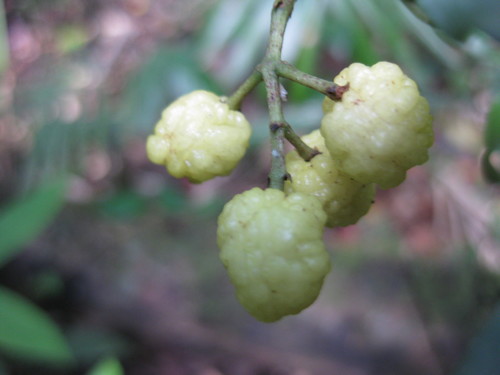
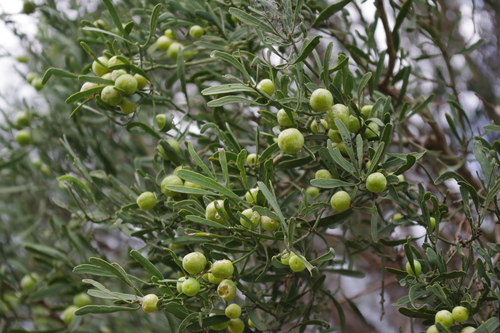
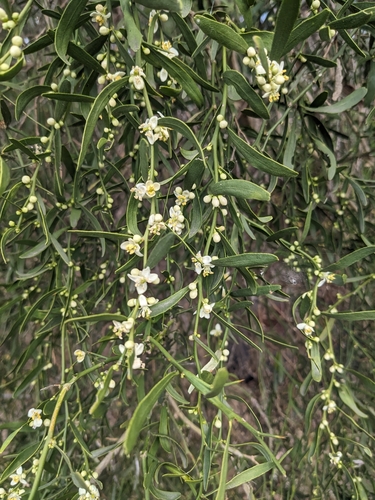
A medium sized shrub or small tree. It often has several stems and grows up to 2-3 m high. It can be up to 12 m high and 1-3 m across. The bark is brown and cracked. The new shoots are angular. The stems are spiny. The leaves are 1-5 cm long by 0.2-0.4 cm wide. They are narrow and spoon shaped. The leaves have a blue-grey colour. The flowers are 1-1.3 cm across. They are white or green and have a sweet scent. The fruit is round to oval and about 2 cm across. The skin of the fruit is light yellow green. It contains large oil glands. The fruit are often seedless. The seeds have furrows along them.
How to Grow
Plants can be grown from seed, stem cuttings, root cuttings, suckers or budding. If trees are disturbed they easily form suckers that can be removed and planted.
Wikipedia
Source ↗Citrus glauca, commonly known as the desert lime, is a thorny shrub or small tree native to Queensland, New South Wales, and South Australia. The 1889 book The Useful Native Plants of Australia records the common names native kumquat and desert lemon.
Production
It is 10-12 weeks between flowering and fruit maturity. A fruit weighs 1-3 g. Trees flower mostly in spring and fruit is ripe in summer.
Other Information
It is now cultivated commercially.
Names & Synonyms
Lime bush
References (30)
- Alice, L. & O'Quinn, T., Australian Bush Superfoods. Explore Australia p 50
- Anon., 2003, Native Plants for the Fitzroy basin. Society for Growing Australian Plants Inc. (Rockhampton Branch)
- Arora, R. K., 2014, Diversity in Underutilized Plant Species - An Asia-Pacific Perspective. Bioversity International. p 70 (As Eremocitrus glauca)
- Birmingham, E. , 1998, Australian native citrus: wild limes from the rainforest to the desert.. in The Australian New crops Newsletter No 10, p 21.1
- Bodkin, F., 1991, Encyclopedia Botanica. Cornstalk publishing, p 387
- Bonney, N., 1997, Economic Native Trees and Shrubs for South Australia. Greening Australia (SA) inc. Campbelltown SA 5074 p 72
- Bonney, N., 2012, Edible Wild Native Plants for Southern Australia. p 30
- Boomsma, C.D., 1972, Native Tree of South Australia. Woods & Forests Department South Australia, Bulletin No.19. p 74
- Cribb, A.B. & J.W., 1976, Wild Food in Australia, Fontana. p 31 (As Eremocitrus glauca)
- Cundall, P., (ed.), 2004, Gardening Australia: flora: the gardener's bible. ABC Books. p 383
- Eddie, C., 2007, Field Guide to Trees and Shrubs of Eastern Queensland Oil and Gas Fields. Santos p 120
- Elliot, W.R., & Jones, D.L., 1984, Encyclopedia of Australian Plants suitable for cultivation. Vol 3. Lothian. p 428 (Drawing)
- Etherington, K., & Imwold, D., (Eds), 2001, Botanica's Trees & Shrubs. The illustrated A-Z of over 8500 trees and shrubs. Random House, Australia. p 214 (As Citrus glauca)
- Facciola, S., 1998, Cornucopia 2: a Source Book of Edible Plants. Kampong Publications, p 220
- Gard. Bull. Straits Settlem. ser. 3, 5(index):3. 1932
- Hall, N. et al, 1972, The Use of Trees and Shrubs in the Dry Country of Australia, AGPS, Canberra. p 362
- Hardwick, G., 2001, Economically Useful Plants for Northern Australia: Master Species List. Crusader eBooks. (As Eremocitrus glauca)
- Kiple, K.F. & Ornelas, K.C., (eds), 2000, The Cambridge World History of Food. CUP p 1724
- Lazarides, M. & Hince, B., 1993, Handbook of Economic Plants of Australia, CSIRO. p 93
- Lord, E.E., & Willis, J.H., 1999, Shrubs and Trees for Australian gardens. Lothian. p 163
- Low, T., 1991, Wild Food Plants of Australia. Australian Nature FieldGuide, Angus & Robertson. p 170
- Low, T., 1992, Bush Tucker. Australia’s Wild Food Harvest. Angus & Robertson. p 70
- Lyle, S., 2006, Discovering fruit and nuts. Land Links. p 126
- Maiden, J. H., 1889, The Useful Native Plants of Australia (including Tasmania). The Technology Museum of NSW, Sydney. p 8 (As Atalantia glauca)
- Martin, F. W., et al, 1987, Perennial Edible Fruits of the Tropics. USDA Handbook 642 p 74 (As Eremocitrus glauca)
- McKerney, M. & White, H., 2011, Bush Tucker, Boomerangs & Bandages. Border River-Gwyder Catchment Management Authority p 125
- Morley, B.D., & Toelken, H.R., (Eds), 1983, Flowering Plants in Australia. Rigby. p 194
- Robins, J., 1996, Wild Lime. Cooking from the Bush food garden. Allen & Unwin p 8
- Smith, K & I., 1999, Grow your own bushfoods. New Holland. Australia. p 52
- World Checklist of Useful Plant Species 2020. Royal Botanic Gardens, Kew