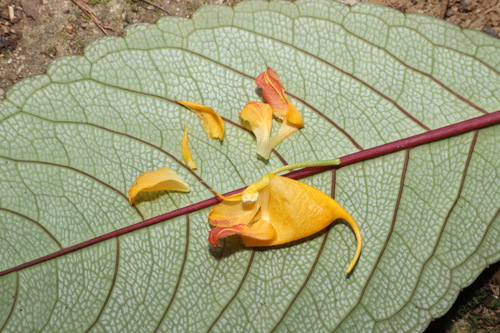
Impatiens pallida
Nutt.
Pale Jewelweed, Pale touch-me-not

(c) Jason Hollinger, some rights reserved (CC BY-ND)

(c) Andrew Gray, some rights reserved (CC BY-NC), uploaded by Andrew Gray

(c) sci_fam, some rights reserved (CC BY-NC), uploaded by sci_fam
What to Eat
Edible parts: Leaves, Seed, Shoots
Young leaves and shoots - cooked. Added to sukiyaki, chow mein and other oriental dishes. When used as a vegetable on their own the cooking water should be changed once or twice during the cooking. Some caution is advised, see the notes on toxicity at the top of the record. Seed. No more details are given but the seeds are difficult to harvest in quantity, mainly because of their exploding seed capsules which scatter the ripe seed at the slightest touch.
Known Hazards
Where to Find It
Eastern N. America - Newfoundland to Saskatchewan, south to Georgia.
NORTHERN AMERICA: Canada (Québec (south), Nova Scotia, Ontario (south), New Brunswick, Newfoundland and Labrador (southwest)), United States (Connecticut, Indiana, Maine, Massachusetts, Michigan, New Hampshire, New Jersey, New York, Ohio, Pennsylvania, Vermont, West Virginia, Illinois, Iowa, Kansas (east), Minnesota, Missouri, Nebraska, North Dakota (east), Oklahoma (northeast), South Dakota (east), Wisconsin, Colorado, Arkansas, Georgia (north), Kentucky, Maryland, North Carolina (west), Tennessee, Virginia)
How to Identify
Impatiens pallida is a ANNUAL growing to 1.5 m (5ft) by 0.6 m (2ft in). See above for USDA hardiness. It is hardy to UK zone 8. The species is hermaphrodite (has both male and female organs) and is pollinated by Insects. Suitable for: light (sandy), medium (loamy) and heavy (clay) soils, prefers well-drained soil and can grow in heavy clay soil. Suitable pH: mildly acid, neutral and basic (mildly alkaline) soils and can grow in very alkaline soils. It can grow in semi-shade (light woodland) or no shade. It prefers moist soil.
How to Grow
Succeeds in any reasonably good soil. Grows well in heavy clay soils. Prefers a moist well-drained humus rich soil in a cool site. The plant is hardy to about -5°c. It should be possible to grow it as a spring-sown annual in most parts of Britain. This plant has seed capsules that spring open forcibly as the seed ripens to eject the seed a considerable distance. The capsules are sensitive to touch even before the seed is ripe, making seed collection difficult but fun.
Propagation: Seed - sow spring in a greenhouse. When they are large enough to handle, prick the seedlings out into individual pots and plant them out in the summer.
Medicinal Uses
Skin Stings. The whole plant is diuretic, emetic and purgative. It is only used externally, the soothing and medicinal sap is a proven remedy for nettle stings and poison ivy rash[62, 207, 222, 238, 257] and is also used in the treatment of warts, corns, ringworm and haemorrhoids.
Other Uses
FungicideA fungicide is obtained from the plant. It is used to treat skin diseases. There are no more details but it is probably obtained from the fresh juice of the plant and can be concentrated by boiling up the juice.