Agave tequilana
F. A. C. Weber
Mescal, Tequila

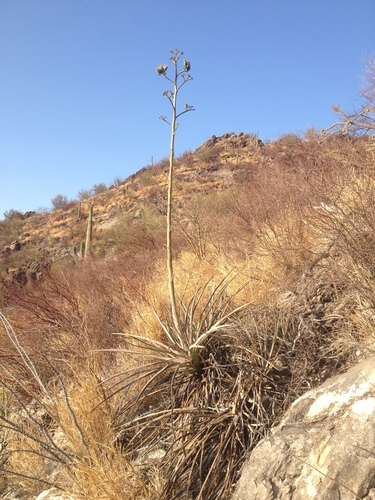
(c) Stan Shebs, some rights reserved (CC BY-SA)

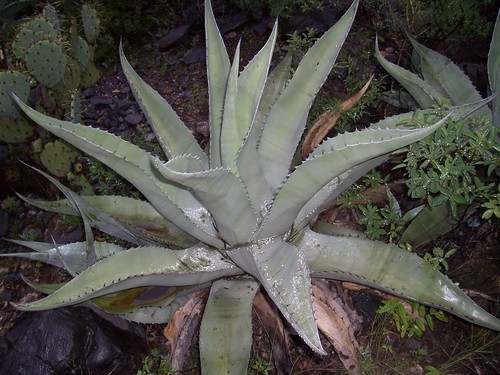
(c) larryosan, some rights reserved (CC BY-NC-SA)

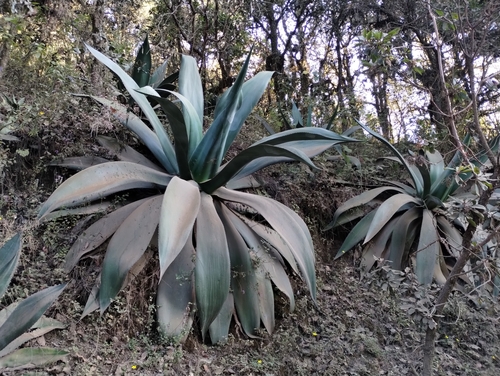
(c) sergio niebla, some rights reserved (CC BY-SA)
What to Eat
Edible parts: Plant heart, Flowers, Drink
The sap of the plant is concentrated to make a sugar-rich syrup known as agave syrup or agave nectar. Sugar-rich sap is also extracted from the roasted bases of defoliated flowering stems shortly before flowering, then fermented and distilled into mescal and tequila. Tequila is a distilled alcoholic beverage similar to mezcal but produced only in a specific region of Mexico and from a limited number of species. For tequila production, mature plants are harvested, their leaves and roots removed, and the remaining 'hearts' baked — often in an earth oven — then mashed, with the resulting liquid fermented for a few days before distillation.
Known Hazards
Where to Find It
In Brisbane Botanical Gardens.
Australia, Central America, Mexico, North America,
How to Identify
A succulent plant. The leaves are bluish with narrow white edges. It flowers after 10-20 years. It has a very large flower stalk and then the plant dies.
How to Grow
Requires a sunny position. Requires a well-drained soil. Succeeds in poor soils. Established plants are very drought tolerant. The plant favours altitudes of more than 1,500 metres (5,000 ft) and grows in rich and sandy soils. A monocarpic species - the plant lives for a number of years without flowering but dies once it does flower. However, it normally produces plenty of suckers during its life and these continue growing, taking about 10 - 15 years in a warm climate, considerably longer in colder ones, before flowering. The cultivar 'Azul', or blue agave, is preferred for tequila production. Specimens have been recorded living up to 50 years in gardens. Blue agaves sprout a stalk (quiote) when about five years old that can grow an additional 5 metres (16ft); they are topped with yellow flowers. The stalk is cut off from commercial plants so the plant will put more energy into the heart. The main harvest of the agave hearts (piñas) occurs after about 7 to 10 years, typically in late winter to early spring (January to April), depending on the climate and growing conditions. Agave tequilana usually flowers once it reaches maturity, which can be after 7 to 10 years, and the flowering period generally occurs in late spring to summer.
Propagation: Surface sow seed in a container in a light position. Germination usually occurs within 1–3 months at 20°C. Prick out seedlings into pots of well-drained soil once large enough to handle, and grow on in a sunny position until at least 20cm tall. Mature plants produce 'pups' — outgrowths at the base — which can be used for propagation.
Medicinal Uses
None known
Other Uses
Agave can be used for erosion control and as a drought-resistant crop in agroforestry systems, and is often used as a hedge or boundary plant owing to its size and spines. Fibre obtained from the leaves, known as 'Jarsia', is soft enough for yarn production. Squeezed shoot axes are used to stabilise loam bricks. Blue agave has also been proposed as a potential source of ethanol for biofuel. The flowers are rich in nectar and pollen, attracting pollinators including bees and butterflies.
Wikipedia
Source ↗Agave tequilana is an evergreen perennial reaching 2 m (6 ft) tall and wide at a medium growth rate. Hardy to UK zone 10. The plant produces bat-pollinated flowers and is self-fertile. It grows in light sandy, medium loamy, or heavy clay soils with good drainage, tolerating nutritionally poor soil. Suitable for mildly acidic, neutral, or basic soils. Requires full sun and prefers dry conditions, with good drought tolerance.
Production
The sap is fermented to make a drink called tequila.
Notes
There are about 250 Agave species. The Agavaceae are mostly in the tropics and subtropics.
Names & Synonyms
Blue agave, Chino azul
References (9)
- Bircher, A. G. & Bircher, W. H., 2000, Encyclopedia of Fruit Trees and Edible Flowering Plants in Egypt and the Subtropics. AUC Press. p 13
- Bull. Mus. Hist. Nat. (Paris) 8:220. 1902
- Facciola, S., 1998, Cornucopia 2: a Source Book of Edible Plants. Kampong Publications. p 3
- Kiple, K.F. & Ornelas, K.C., (eds), 2000, The Cambridge World History of Food. CUP p 1715
- Llamas, K.A., 2003, Tropical Flowering Plants. Timber Press. p 46
- Marinelli, J. (Ed), 2004, Plant. DK. p 330
- van Wyk, B., 2005, Food Plants of the World. An illustrated guide. Timber press. p 45
- Wiersema, J. H. & Leon, B., 2013, World Economic Plants. A Standard Reference CRC Press. 2nd Ed. p 25
- World Checklist of Useful Plant Species 2020. Royal Botanic Gardens, Kew