Agave utahensis
Engelm.
Desert Agave, Utah Aloe, Utah Agave

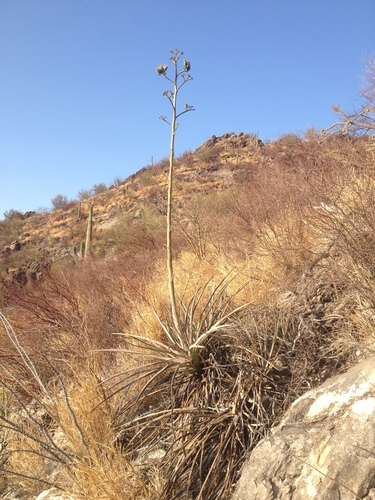
(c) pleistocene, some rights reserved (CC BY-NC), uploaded by pleistocene

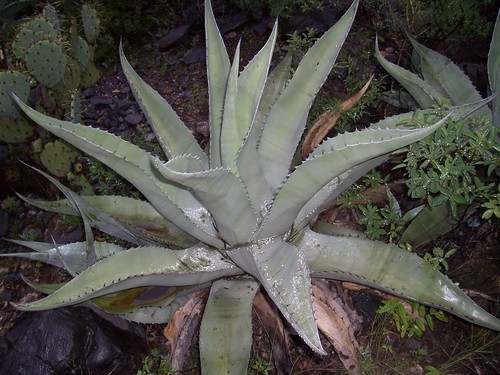
(c) J Brew, some rights reserved (CC BY-SA), uploaded by J Brew

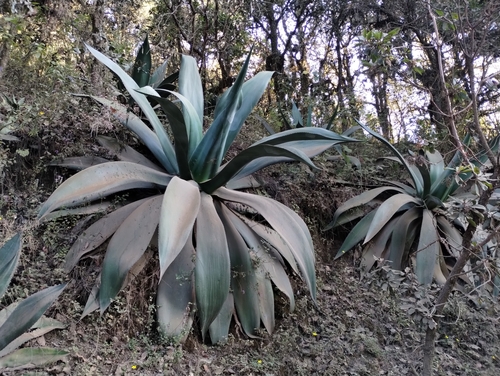
(c) J Brew, some rights reserved (CC BY-SA), uploaded by J Brew
What to Eat
Edible parts: Seeds, Bulb, Flower stalks, Leaf bases
The plant's heart is rich in saccharine matter, sweet and delicious though rather fibrous, and can be eaten when baked. It sits partly below ground and can be dried for future use or soaked in water to make a flavourful beverage. Seeds can be ground into flour. Flower stalks are roasted. Roots are cooked. Sap from cut flowering stems is used as a syrup and can also be tapped by boring a hole into the middle of the plant at the base of the flowering stem. This sap can be fermented into 'Mezcal', a potent distilled alcoholic drink made from the baked hearts of the agave. The fermented sap is more commonly called 'pulque' in Mexico, where it is produced from several agave species and has a much lower alcohol content. WARNING: Some species of this genus may be protected. Agave crowns and flower stalks are the most valued edible parts and are traditionally baked to reduce bitterness and improve flavour; harvest when flower stalks emerge. Some species contain excessive saponins — soap-like compounds — and harvesting and processing require caution regarding potential toxicity. Agave flowers and seeds have limited edibility and are often unpleasant in taste. Traditionally, Native Americans baked agave flower stalks and crowns overnight in fire pits before consumption.
Known Hazards
Where to Find It
It is a temperate to subtropical plant. It grows naturally in south-western North America in the Grand Canyon on dry stony limestone slopes between 1000 - 1500 metres. It suits hardiness zones 7-11.
Australia, North America, Slovenia, USA,
How to Identify
A succulent plant. It is usually small and clumping. It grows 4 m tall. It spreads 25-40 cm across. The leaves are grey-green. They are 15-30 cm long. There are teeth along the edge. These are hooked and grey. The flowering stalk is 1.5-2.4 m tall. The flowers are yellow.
How to Grow
Agave utahensis is a native of arid and semi-arid climates. Plants are only hardy in the milder areas of the temperate zone, and even then, need to be sited carefully to prevent rot from excessive moisture. They generally grow well in Mediterranean climates. Plants from northern and/or high-elevation populations of ssp. utahensis, ssp. kaibabensis and var. eborispina may tolerate temperatures between -21 to -29°c and survive outdoors in central Europe nearly without rain protection. Plants also experience snow in their native environment, though this can have the effect of insulating their base and roots from the cold. Requires very well-drained soil and a sunny position. Agave species are monocarpic, individual plants living for several years without flowering, sending up an often very large stem, and dying after flowering and setting seed. The plants of most species, however, normally produce several new plants from suckers during their lifespan, and these new plants will continue the life cycle. Over time, some plants can form extensive clonal colonies by this means. Individual plants take about 7 - 15 years in their native habitat, considerably longer in colder climates, before flowering. This plant is widely used by native people in its wild habitat and has many uses. Members of this genus are rarely troubled by browsing deer. Harvesting involves dislodging the plants, often requiring significant effort and sharp tools. Agave crowns can be gathered anytime but were traditionally collected when flower stalks emerged. Harvesting emerging flower stalks indicates the ideal time for collection. Agave leaves are tough and spiny, making extraction of crowns challenging. Baked crowns can be consumed immediately or stored for future use. Additionally, agave syrup can be made by adding water to baked crowns and boiling them down. Harvesting and processing agave seeds is relatively easy, but caution is advised due to limited safety data and the potential for acrid compounds. The main harvest of the agave hearts (piñas) occurs after about 7 to 10 years, typically in late winter to early spring, depending on the climate and growing conditions. Agave usually flowers once it reaches maturity, which can be after 7 to 10 years, and the flowering period generally occurs in late spring to summer.
Propagation: Surface sow seed in a light position in mid-spring in a warm greenhouse. Germination usually occurs within 1–3 months at 15–20°C. Prick out seedlings into individual pots of well-drained soil once large enough to handle, and grow on in a sunny greenhouse position until at least 15cm tall. Plant out at the beginning of the growing season and provide cold protection for at least the first few winters. Offsets and suckers can be potted up whenever available and kept in a warm greenhouse until well established. Where bulbils are produced, they offer an easy propagation method — simply pot them up and plant out at the beginning of a growing season once they are 10cm or more tall.
Medicinal Uses
The sap is antiseptic, diuretic, and laxative. The plant contains steroidal saponins that are under research for use in the treatment of certain cancers.
Other Uses
The leaves contain saponins and an extract can be used as soap, best obtained by chopping the leaves and simmering them in water — taking care not to boil too long, as this begins to break down the saponins. A very strong fibre from the leaves is used for rope and coarse fabrics. Hair brushes and cleaning brushes were also made from the leaves: the dried matter of a dead, rotten leaf was knocked free from the fibres, which were then bent in two, with the upper end wrapped in cord and the bent portion covered with cloth; the loose fibres were cut to the right length and their ends hardened by burning. Paper can also be made from the leaf fibre. Leaf thorns serve as pins and needles. Dried flowering stems are used as waterproof thatching and as a razor strop. The flowers are rich in nectar and pollen, attracting pollinators including bees and butterflies.
Wikipedia
Source ↗Agave utahensis is a species of agave known by the common name Utah agave. Varieties of the species include the Nevada agave and Kaibab agave. It is an uncommon plant of the United States' desert southwest, in the states of Utah, Nevada, Arizona, and California. Although plants in some areas are threatened, overall the species is stable and is considered to be of Least Concern by the IUCN.
Notes
There are about 250 Agave species. The Agavaceae are mostly in the tropics and subtropics.
Names & Synonyms
Utaška agava
References (11)
- Anderson, B. A., (Rev.) 1996, Desert Plants of Utah. Utah State University Extension p 49
- Beckstrom-Sternberg, Stephen M., and James A. Duke. "The Foodplant Database." http://probe.nalusda.gov:8300/cgi-bin/browse/foodplantdb.(ACEDB version 4.0 - data version July 1994)
- Bircher, A. G. & Bircher, W. H., 2000, Encyclopedia of Fruit Trees and Edible Flowering Plants in Egypt and the Subtropics. AUC Press. p 13
- Cundall, P., (ed.), 2004, Gardening Australia: flora: the gardener's bible. ABC Books. p 116
- Facciola, S., 1998, Cornucopia 2: a Source Book of Edible Plants. Kampong Publications. p 3
- Hedrick, U.P., 1919, (Ed.), Sturtevant's edible plants of the world. p 30
- Lim, T. K., 2015, Edible Medicinal and Non Medicinal Plants. Volume 9, Modified Stems, Roots, Bulbs. Springer p 3
- Nugent, J., 1999, Agaves and cacti., Permaculture plants. Sustainable Agriculture Research Institute. PO Box 10, Nanup, WA, 6275
- Plants for a Future database, The Field, Penpol, Lostwithiel, Cornwall, PL22 0NG, UK. http://www.scs.leeds.ac.uk/pfaf/ (As Agave utahensis var. discreta)
- S. Watson et al., Botany [fortieth parallel] 497. 1871 "utahense" (in C. King, U.S. geol. explor. 40th Parallel vol. 5)
- World Checklist of Useful Plant Species 2020. Royal Botanic Gardens, Kew