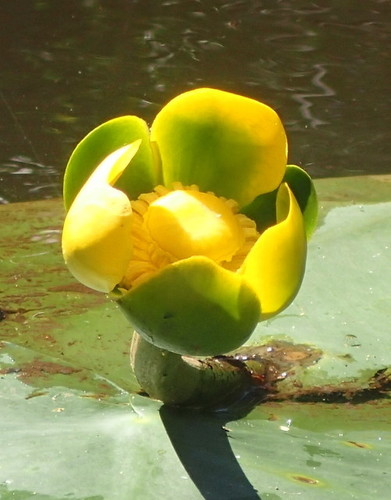
Nuphar polysepala
Engelm.
Spatterdock, Rocky Mountain pond-lily

(c) Eolaiocht, some rights reserved (CC BY-NC), uploaded by Eolaiocht

(c) melissarijkers, some rights reserved (CC BY-NC)

(c) Alex Abair, some rights reserved (CC BY), uploaded by Alex Abair
What to Eat
Edible parts: Root, Seed
Root - raw or cooked. Boiled or baked. The root can also be dried and ground into a flour. The rather strong taste can be removed by soaking the root in water prior to use. The N. American Indians used the roots in times of famine. Seed - raw or cooked. The fairly large seed can be dried and ground into a powder and then be used for making porridge or mixed with other flours for making bread. When roasted it resembles popcorn in flavour.
Where to Find It
Western N. America - Alaska to California.
NORTHERN AMERICA: Canada (Northwest Territories (west), Yukon, British Columbia), United States (Alaska, Colorado (w. & c.), Idaho, Montana (w. & s.), Oregon, Washington, Wyoming, New Mexico (north), Arizona (Coconino & Navajo Cos.), California (north & central), Nevada (west), Utah (northeast))
How to Identify
Nuphar polysepala is a PERENNIAL growing to 1.8 m (6ft). See above for USDA hardiness. It is hardy to UK zone 4. It is in flower from July to August. The species is hermaphrodite (has both male and female organs) and is pollinated by Flies, beetles. Suitable for: light (sandy), medium (loamy) and heavy (clay) soils. Suitable pH: mildly acid, neutral and basic (mildly alkaline) soils. It can grow in semi-shade (light woodland) or no shade. It can grow in water.
How to Grow
A water plant requiring a rich soil and a sunny position. It is best grown in still water up to 75cm deep but it also tolerates slow moving water. Succeeds in light shade. Plants are hardy to about -20°c.
Propagation: Seed - sow as soon as it is ripe in a greenhouse in pots submerged under 25mm of water. Prick out into individual pots as soon as the first true leaf appears and grow them on in water in a greenhouse for at least two years before planting them out in late spring. The seed is collected by wrapping the developing seed head in a muslin bag to avoid the seed being lost. Harvest it 10 days after it sinks below the soil surface or as soon as it reappears. Division in May. Each portion must have at least one eye. Submerge in pots in shallow water until established.
Medicinal Uses
Analgesic Haemostatic Poultice. The root is analgesic and antihaemorrhagic. A decoction is taken in the treatment of pain in any part of the body, and for lung haemorrhages, TB etc. A poultice made from the root is used in the treatment of any pain, rheumatic joints, sores etc.