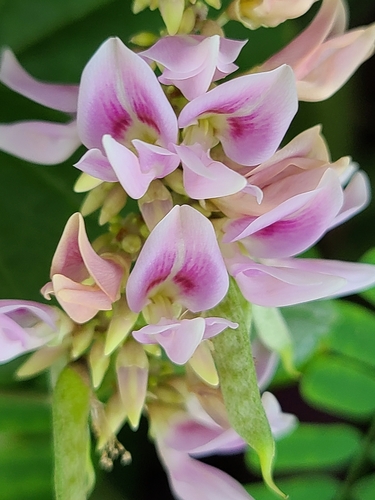
Eriosema psoraleoides
(Lam.) G. Don.
Shrubby yellow eriosema, Canary pea

(c) maddyo, some rights reserved (CC BY-NC)

(c) Kate Braun, some rights reserved (CC BY-NC), uploaded by Kate Braun

(c) Mark Hyde, Bart Wursten and Petra Ballings, some rights reserved (CC BY-NC)
What to Eat
Edible parts: Seeds, Fruit, Roots
The mature pods are picked after starting to shrivel, and the seeds are lightly boiled before eating. The seeds are also cooked with maize meal.
Where to Find It
A tropical plant. It grows below 1,950 m above sea level. It can grow in arid places.
Africa, Angola, Benin, Botswana, Burkina Faso, Burundi, Cameroon, Central Africa, Chad, Congo DR, Côte d'Ivoire, East Africa, Equatorial-Guinea, Eswatini, Ethiopia, Gambia, Ghana, Guinea, Guinée, Guinea-Bissau, Ivory Coast, Kenya, Madagascar, Malawi, Mali, Mozambique, Nigeria, Rwanda, Senegal, Sierra Leone, South Africa, Southern Africa, Sudan, Swaziland, Tanzania, Togo, Uganda, West Africa, Zambia, Zimbabwe,
How to Identify
A herb or shrub. It is tall and erect. It can be 2 m tall. There are dense grey hairs on the stems and under the leaves. The leaves have 3 leaflets. These are sword shaped and 6 cm long by 1.2 cm wide. They have a small tip. There are many flowers. These are close together on short flower shoots. They are yellow. The fruit are rough pods. They are 1.5 cm long by 8 mm wide.
Names & Synonyms
Gwandu ya nseke, Inhlaba, Inhlula, Kiwandu ki nseke, Madoda, Mutunga-knomo, Uhangwa, Umupfunyantpke, Wontobum, Yellow seed
References (12)
- CROSS-UPCOTT,
- Fowler, D. G., 2007, Zambian Plants: Their Vernacular Names and Uses. Kew. p 37
- Fox, F. W. & Young, M. E. N., 1982, Food from the Veld. Delta Books. p 210
- Gen. hist. 2:348. 1832
- Latham, P., 2004, Useful Plants of Bas-Congo province. Salvation Army & DFID p 124
- Long, C., 2005, Swaziland's Flora - siSwati names and Uses http://www.sntc.org.sz/flora/
- Royal Botanic Gardens, Kew (1999). Survey of Economic Plants for Arid and Semi-Arid Lands (SEPASAL) database. Published on the Internet; http://www.rbgkew.org.uk/ceb/sepasal/internet [Accessed 28th April 2011]
- Ruiters-Welcome, A. K., 2019, Food plants of southern Africa. Ph.D. thesis. Univ. of Johannesburg p 57
- Schmidt, E., Lotter, M., & McCleland, W., 2007, Trees and shrubs of Mpumalanga and Kruger National Park. Jacana Media p 204
- van Wyk, Ben-Erik, 2019, The diversity and multiple uses of southern African legumes. Australian Systematic Botany, 2019, 32, 519–546
- Welcome, A. K. & Van Wyk, B.-E., 2019, An inventory and analysis of the food plants of southern Africa. South African Journal of Botany 122 (2019) 136–179
- World Checklist of Useful Plant Species 2020. Royal Botanic Gardens, Kew