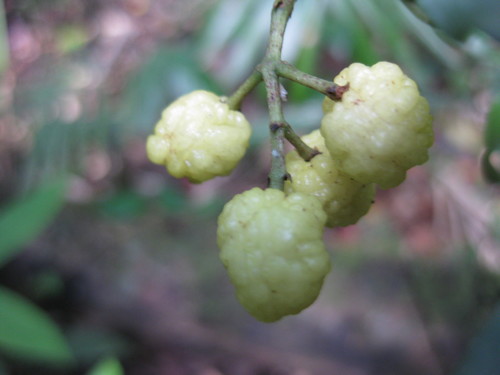
Zanthoxylum alatum
Roxb.
Winged Prickly Ash

Vince Hale

Vince Hale

Paul McAfee
What to Eat
Condiment. The seed is ground into a powder and used as a condiment. A pepper substitute, it is widely used in the Orient. A light roasting brings out more of the flavour. The seed is an ingredient of the famous Chinese 'five spice' mixture. The fruit is rather small but is produced in clusters which makes harvesting easy. Each fruit contains a single seed. Young leaves are used as a condiment.
Where to Find It
E. Asia - China to the Himalayas.
TEMPERATE ASIA: China (Anhui Sheng, Zhejiang Sheng, Fujian Sheng, Henan Sheng (south), Hunan Sheng, Hubei Sheng, Gansu Sheng (south), Jiangxi Sheng, Jiangsu Sheng, Guangdong Sheng, Guizhou Sheng, Shanxi Sheng (south), Shandong Sheng, Shaanxi Sheng, Sichuan Sheng, Yunnan Sheng, Guangxi Zhuangzu Zizhiqu, Xizang Zizhiqu), Korea, Japan (Honshu (west), Kyushu, Ryukyu Islands, Shikoku), Taiwan (north) TROPICAL ASIA: Bangladesh, Bhutan, India (Himachal Pradesh, Jammu and Kashmir, Meghalaya, Nagaland, Odisha, Uttar Pradesh, Andhra Pradesh, Manipur), Nepal, Pakistan (north), Laos, Myanmar (north), Thailand (north), Vietnam (north), Indonesia (Lesser Sunda Islands), Philippines
How to Identify
Zanthoxylum alatum is a deciduous Shrub growing to 4 m (13ft 1in). See above for USDA hardiness. It is hardy to UK zone 6. The species is dioecious (individual flowers are either male or female, but only one sex is to be found on any one plant so both male and female plants must be grown if seed is required). . The plant is not self-fertile. Suitable for: light (sandy), medium (loamy) and heavy (clay) soils and prefers well-drained soil. Suitable pH: mildly acid, neutral and basic (mildly alkaline) soils. It can grow in semi-shade (light woodland) or no shade. It prefers moist soil.
How to Grow
Prefers a good deep well-drained moisture retentive soil in full sun or semi-shade. This species is closely related to Z. planispinum. Flowers are formed on the old wood. Dioecious. Male and female plants must be grown if seed is required.
Propagation: Seed - best sown in a greenhouse as soon as it is ripe in the autumn. Stored seed may requires up to 3 months cold stratification, though scarification may also help. Sow stored seed in a cold frame as early in the year as possible. Germination should take place in late spring, though it might take another 12 months. Prick out the seedlings into individual pots when they are large enough to handle and grow them on in a cold frame for their first winter. Plant them out in early summer. Cuttings of half-ripe wood, July/August in a frame. Root cuttings, 3cm long, planted horizontally in pots in a greenhouse. Good percentage. Suckers, removed in late winter and planted into their permanent positions.
Medicinal Uses
Cholera Miscellany Odontalgic Stimulant Stomachic Tonic. The seeds and the bark are used as an aromatic tonic in the treatment of fevers, dyspepsia and cholera. The fruits, branches and thorns are considered to be carminative and stomachic[46, 61, 146, 158, 240]. They are used as a remedy for toothache.
Other Uses
Miscellany Teeth Wood. The fruit contains 1.5% essential oil. The fruit is used to purify water. Toothbrushes are made from the branches. Wood - heavy, hard, close grained. Used for walking sticks.