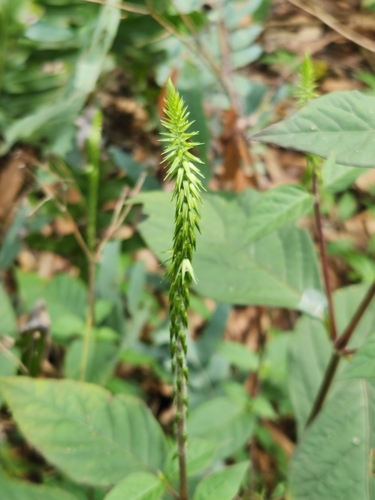
Atriplex rosea
L.
Tumbling or redscale saltweed

(c) Norbert Sauberer, some rights reserved (CC BY-NC), uploaded by Norbert Sauberer

(c) Don Rideout, some rights reserved (CC BY-NC), uploaded by Don Rideout

(c) Сергей, some rights reserved (CC BY-NC), uploaded by Сергей
What to Eat
Young shoots - pickled and used as a caper substitute. Tumbling or redscale saltweed (Atriplex rosea), an annual of the amaranth family (Amaranthaceae), is an introduced species in North America, originally native to Europe and western Asia. Within the genus Atriplex, the plants are known to accumulate oxalates, nitrates, saponins, and other potentially harmful compounds, so all edible use requires caution and avoidance of raw consumption. Among its parts, only the seeds are reported as edible. The Navajo Indians of northeastern Arizona ground these seeds into a porridge after the plant became established in their region. The leaves are not reported as edible, which aligns with their harsh, unpleasant taste even after boiling; while they resemble spinach in flavor, they retain an acrid bite that makes them unsuitable for food. The seeds themselves were not sampled in your notes, but they may be less objectionable than the foliage. Flowering occurs in summer, with seeds ripening in autumn. Traditional uses. Navajo porridge from seeds.
Where to Find It
Eurasia - Lithuania to Portugal, east to the Caucasus, Turkey and the Levant; N. Africa - Morocco to Egypt. The native range of this species is Europe to Medit. and Central Asia.
Native to: Albania, Algeria, Austria, Baleares, Baltic States, Belarus, Bulgaria, Corse, Cyprus, Czechoslovakia, East Aegean Is., East European Russia, Egypt, France, Germany, Greece, Hungary, Italy, Kazakhstan, Kriti, Krym, Lebanon-Syria, Libya, Morocco, North Caucasus, Palestine, Poland, Portugal, Romania, Sardegna, Sicilia, Sinai, South European Russi, Spain, Transcaucasus, Tunisia, Turkey, Turkey-in-Europe, Ukraine, Yugoslavia Introduced into: Alabama, Alberta, Argentina Northeast, Argentina Northwest, Argentina South, Arizona, Bolivia, British Columbia, California, Cape Provinces, Chile Central, Colorado, Florida, Free State, Idaho, Illinois, Kansas, Madeira, Maryland, Massachusetts, Mexico Northwest, Michigan, Missouri, Montana, Nebraska, Nevada, New Jersey, New Mexico, New York, New Zealand South, North Carolina, North Dakota, Nova Scotia, Ohio, Ontario, Oregon, Pennsylvania, Rhode I., Saskatchewan, South Carolina, South Dakota, Sweden, Texas, Utah, Washington, Wisconsin, Wyoming.
How to Identify
Atriplex rosea is a ANNUAL growing to 0.6 m (2ft) by 0.2 m (0ft 8in) at a fast rate. See above for USDA hardiness. It is hardy to UK zone 4 and is not frost tender. The flowers are pollinated by Wind. It is noted for attracting wildlife. Suitable for: light (sandy) and medium (loamy) soils, prefers well-drained soil and can grow in nutritionally poor soil. Suitable pH: neutral and basic (mildly alkaline) soils and can grow in very alkaline and saline soils. It cannot grow in the shade. It prefers dry or moist soil and can tolerate drought.
How to Grow
Species in this genus generally succeed in full sun in any well-drained but not too fertile soil. Most species in this genus tolerate saline and very alkaline soils. Atriplex rosea is adapted to dry, disturbed, and saline soils. Based on its ecology and distribution in the western United States, it is best suited to USDA Hardiness Zones 6–10, tolerating arid and semi-arid conditions. As a non-native annual that spreads by tumbling seed-bearing plants across open ground, it is considered weedy or invasive in some areas of its introduced range, especially in western North America.
Propagation: Seed - sow mid spring in situ. Germination is usually rapid.
Medicinal Uses
Used in the treatment of scrofula and scurvy. This probably refers to the leaves.
Other Uses
The plant is used as a source of potash. Widespread in saline roadsides, field margins, vacant lots; introduced from Eurasia.
Names & Synonyms
Tumbling or redscale saltweed (Atriplex rosea)