Erythrina herbacea
L.
Eastern coral bean
(c) Dwight Bohlmeyer, some rights reserved (CC BY-NC), uploaded by Dwight Bohlmeyer

(c) Mary Keim, some rights reserved (CC BY-NC-SA)

(c) Mary Keim, some rights reserved (CC BY-NC-SA)
What to Eat
Edible parts: Leaves, Flowers
Flowers can be cooked and make an acceptable vegetable when boiled — some caution is advised given the plant's noted toxicity. Young leaves are occasionally cooked and eaten.
Known Hazards
Where to Find It
It is a warm temperate plant. It needs sandy, well drained soil. It needs full sun. It suits hardiness zones 8-10.
Australia, Central America, Hawaii, Mexico, North America, Pacific, Pakistan, Tasmania, USA*,
How to Identify
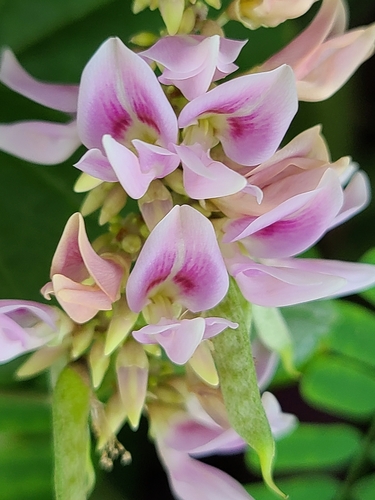
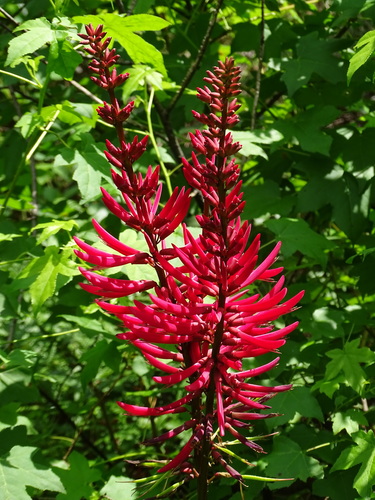
A deciduous shrub which keeps growing from year to year. It grows 1.2-6 m high. The leaves have 3 leaflets. The leaves are triangle shaped and 12 cm long. The leaf stalks have prickles. The flowers are bright red. The standard of the flower can be 5 cm long. The flowers clusters are 60 cm long. The fruit are leathery pods. They are 10-20 cm long. The seeds are bright red.
How to Grow
Requires a moderately fertile well-drained soil in a very sunny position. Best if given the protection of an east, south or south-west facing wall. Becoming a tree in the south of its range, this species is shrubby or even herbaceous towards the limits of its northerly range. It is not very hardy outdoors in Britain though the rootstock can tolerate temperatures down to about -10°c provided the stem bases are thickly mulched with organic matter such as leaf litter or sawdust and covered with bracken. Alternatively, the roots can be lifted in the autumn and stored in a cool frost-free place, replanting in the spring. Plants take 3 - 4 years to flower from seed. This species has a symbiotic relationship with certain soil bacteria, these bacteria form nodules on the roots and fix atmospheric nitrogen. Some of this nitrogen is utilized by the growing plant but some can also be used by other plants growing nearby.
Propagation: Seed should be pre-soaked for 12 hours in warm water, then sown in spring in a greenhouse. Once large enough to handle, prick seedlings out into individual pots and grow them on in the greenhouse for at least their first winter, then plant out into permanent positions in late spring or early summer after the last expected frosts. Half-ripe wood cuttings can be taken in July or August in a frame; overwinter in a greenhouse and plant out the following late spring or early summer. Heeled cuttings of young growth taken in spring in a frame can also be used; overwinter in a greenhouse and plant out in late spring or early summer.
Medicinal Uses
The plant is narcotic and purgative. A cold infusion of the root has been used to treat bowel pain in women. A decoction of the roots or berries has been used to treat nausea, constipation, and blocked urination. A decoction of the beans or inner bark has been used as a body rub and steam treatment for numb, painful limbs and joints. A decoction of the leaves has been used as a general tonic.
Other Uses
None known.
Wikipedia
Source ↗Erythrina herbacea, commonly known as the Eastern Coralbean, Cherokee Bean, Mamou in South Louisiana, Red Cardinal, or Cardinal Spear is a flowering shrub or small tree found throughout the southeastern United States and northeastern Mexico; it has also been reported from parts of Central America and, as an introduced species, from Pakistan. Various other systematic names have been used for this plant in the past, including Erythrina arborea, Erythrina hederifolia, Erythrina humilis, Erythrina rubicunda, Corallodendron herbaceum and Xyphanthus hederifolius.
Notes
There are 108 Erythrina species.
Names & Synonyms
Coral Bean, Cardinal spear, Cherokee bean, Southeastern coralbean, Red cardinal
References (15)
- Brickell, C. (Ed.), 1999, The Royal Horticultural Society A-Z Encyclopedia of Garden Plants. Convent Garden Books. p 417
- Cundall, P., (ed.), 2004, Gardening Australia: flora: the gardener's bible. ABC Books. p 563
- Etherington, K., & Imwold, D., (Eds), 2001, Botanica's Trees & Shrubs. The illustrated A-Z of over 8500 trees and shrubs. Random House, Australia. p 291
- Facciola, S., 1998, Cornucopia 2: a Source Book of Edible Plants. Kampong Publications, p 104
- Hibbert, M., 2002, The Aussie Plant Finder 2002, Florilegium. p 95
- Kermath, B. M., et al, 2014, Food Plants in the Americas: A survey of the domesticated, cultivated and wild plants used for Human food in North, Central and South America and the Caribbean. On line draft. p 345
- Little, E.L., 1980, National Audubon Society Field Guide to North American Trees. Alfred A. Knopf. p 521
- Llamas, K.A., 2003, Tropical Flowering Plants. Timber Press. p 219
- Loughmiller, C & L., 1985, Texas Wildflowers. A Field Guide. University of Texas, Austin. p 128
- Martin, F.W. & Ruberte, R.M., 1979, Edible Leaves of the Tropics. Antillian College Press, Mayaguez, Puerto Rico. p 199
- Piedra-Malagón, E. M., et al, 2022, Edible native plants of the Gulf of Mexico Province. Biodiversity Data Journal 10: e80565 p 21
- Plants for a Future database, The Field, Penpol, Lostwithiel, Cornwall, PL22 0NG, UK. http://www.scs.leeds.ac.uk/pfaf/
- Sp. pl. 2:706. 1753
- Staples, G.W. and Herbst, D.R., 2005, A tropical Garden Flora. Bishop Museum Press, Honolulu, Hawaii. p 317
- World Checklist of Useful Plant Species 2020. Royal Botanic Gardens, Kew