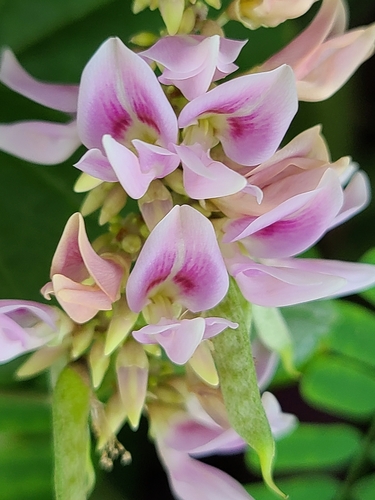
Indigofera arrecta
Hochst. ex A.Rich.
Bengal Indigo, Java indigo, Natal indigo

(c) graemewolfaard, some rights reserved (CC BY-NC), uploaded by graemewolfaard

(c) Alison Young, some rights reserved (CC BY-NC), uploaded by Alison Young
What to Eat
Edible parts: Leaves, Root
Young leaves - cooked and eaten as a vegetable. The root may be edible.
Where to Find It
Tropical Africa - widely distributed throughout the continent from Senegal to Somalia, south to S. Africa. Also extending into Arabia.
TEMPERATE ASIA: Saudi Arabia, Yemen AFRICA: Eritrea, Ethiopia, Sudan, Somalia, Kenya, Tanzania, Uganda, Burundi, Cameroon, Democratic Republic of the Congo, Gabon, Rwanda, Benin, Ghana, Guinea, Gambia, Guinea-Bissau, Mali, Niger, Nigeria, Senegal, Togo, Angola, Mozambique, Malawi, Zambia, Zimbabwe, Eswatini, South Africa (Kwa. Zulu-Natal, Transvaal), Madagascar
How to Identify
Indigofera arrecta is a PERENNIAL growing to 2 m (6ft) by 2 m (6ft) at a medium rate. See above for USDA hardiness. It is hardy to UK zone 10. It can fix Nitrogen. Suitable for: light (sandy), medium (loamy) and heavy (clay) soils and prefers well-drained soil. Suitable pH: mildly acid and neutral soils and can grow in very acid soils. It cannot grow in the shade. It prefers moist soil.
How to Grow
A plant of the moist tropics, where it is found at elevations from 300 - 2,700 metres. It grows best in areas where annual daytime temperatures are within the range 22 - 30c, but can tolerate 16 - 36c. It can be killed by temperatures of c or lower. It prefers a mean annual rainfall in the range 1,700 - 2,200mm, but tolerates 400 - 4,300mm. Prefers a hot, moist climate and a position in full sun. Succeeds in a range of soils. Prefers a pH in the range 5 - 6, tolerating 4.5 - 6.5. Plants can tolerate up to two months of waterlogging. Plants can commence flowering 3 months after sowing the seed. Branches are harvested, usually early in the morning, when the plants are 4 - 5 months old and the crop has made a closed stand. This is usually also the flowering stage. About 3 - 4 months later the plants can be cut again; a crop can be harvested three times a year. The total life span for dye crops is 2 - 3 years, whilst for cover crops it is 1.5 - 2 years. Indigo is harvested only once when grown on paddy soils because the plants must give way for the next rice crop. The yield of this species is higher than from any other species of Indigofera. Annuals yields of 22 - 100 tonnes green matter per ha have been reported in India; the recorded output of indigo cake is 137 - 325 kg/ha per year. Natural hybridizations between I. Arrecta and I. Tinctoria do occur and especially in W Africa plants are often difficult to be assigned to one of the two taxa. This species has a symbiotic relationship with certain soil bacteria, these bacteria form nodules on the roots and fix atmospheric nitrogen. Some of this nitrogen is utilized by the growing plant but some can also be used by other plants growing nearby.
Propagation: Seed - it possess a hard seed-coat and must be scarified. This can usually be done by pouring a small amount of nearly boiling water on the seeds (being careful not to cook them!) and then soaking them for 12 - 24 hours in warm water. By this time they should have imbibed moisture and swollen - if they have not, then carefully make a nick in the seedcoat (being careful not to damage the embryo) and soak for a further 12 hours before sowing. Sowing is done either on seed-beds or directly into the field, 3 - 4 seeds per hole, 60 cm apart within rows and 45 - 60 cm between rows. Germination takes about 4 days. When seed-beds are used, seedlings are transplanted at 4 - 6 weeks. Cuttings are made by dividing well-developed branches into pieces 30 cm long, which are kept for 2 - 3 days in a cool place before planting. Cuttings, 2-3 per hole, start rooting by the second week.
Medicinal Uses
Abortifacient Antispasmodic Diuretic Epilepsy Febrifuge Ophthalmic Purgative Sedative Skin Stomachic Vermifuge. The leaves are used in traditional medicines for treating epilepsy and nervous disorders. An aqueous extract of the leaves from immature shoots is administered orally to patients with diabetes mellitus. A medicine for the management of peptic ulcer and methods of its preparation and use have been patented. The leaves are applied externally to heal sores and ulcers. An infusion or decoction of the leaves and roots is abortifacient, antispasmodic, diuretic, febrifuge, purgative, sedative, stomachic and vermifuge. It is used to treat conditions such as gum infections, snakebites, gonorrhoea, epilepsy and jaundice. The leaves and roots are used externally to treat itching. The fruits and seeds are used to treat ophthalmia. In several regions in Africa it is believed that the indigo dye in clothes prevents skin complaints
Other Uses
Compost Dye Green manure Mulch Soil conditioner Teeth. Agroforestry Uses: The plant has potential as a cover-crop and green manure, especially in tea, coffee and rubber plantations. It gives shade and protection, suppresses weeds and improves the soil. The residue remaining after indigo extraction is also applied as manure. Other Uses: The plant is a major source of the blue dye 'indigo'. The leaves and twigs do not actually contain indigo but colourless precursors that must be extracted and then processed in order to produce the indigo dye. The harvested leafy branches are placed in a tank containing water to which some lime has been added, and are weighted down with planks. After some hours of fermentation, during which enzymic hydrolysis leads to the formation of indoxyl, the liquid is drained off and then stirred continuously for several hours to stimulate oxidation of the indoxyl. Afterwards the solution is left to rest and the insoluble indigo settles to the bottom as a bluish sludge. The water is drained and after the indigo has dried, it is cut into cubes or made into balls. To dye textiles, indigo is reduced to a soluble form by a fermentation process under alkaline conditions. In traditional preparations of the dye, various reducing agents such as molasses are used, together with coconut-milk, bananas and the leaves of Psidium guajava. The alkalinity is maintained by adding lime. After the textile has been dipped into solution it turns blue when exposed to the air. The twigs are used for cleaning teeth.
Names & Synonyms
Bengal indigo, Java indigo, Natal indigo, Natalindigo - German, añil de Java - Spanish. Baludo, Banhepe, Bno, Caro, Carodim-o, Caromessem-o, Carre, El badaba, Gara, Garatchendo, anileira de java, añil de java, baba, baba tamau, bengal indigo, java indigo, lademadui, natal indigo, natal indigo leaf, natalindigo, umusororo