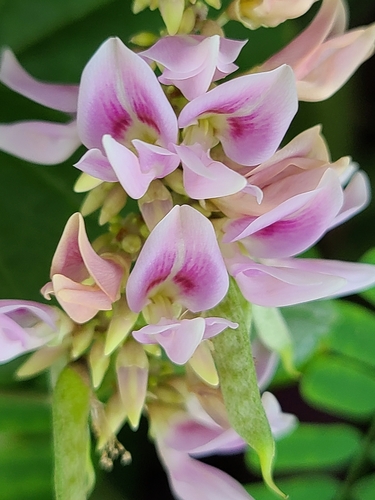
Indigofera decora
Lindl.
Chinese indigo

(c) ckozlosky, some rights reserved (CC BY-NC)

(c) Nicholas de Jong, some rights reserved (CC BY-NC), uploaded by Nicholas de Jong

(c) Joan Knapp, some rights reserved (CC BY-ND), uploaded by Joan Knapp
What to Eat
Edible parts: Seed
Seed - cooked. It can also be dried and ground into a powder then mixed with wheat flour or other cereals when making bread, cakes etc.
Where to Find It
E. Asia - China, Japan.
TEMPERATE ASIA: Anhui Sheng, Fujian Sheng, Guangdong Sheng, Guangxi Zhuangzu Zizhiqu, Guizhou Sheng, Hong Kong, Honshu, Hubei Sheng, Hunan Sheng, Japan, Jiangxi Sheng, Kyushu, Zhejiang Sheng,China. TROPICAL ASIA: Philippines, Luzon (probably introd.),
How to Identify
Indigofera decora is a deciduous Shrub growing to 1 m (3ft 3in) by 1 m (3ft 3in) at a medium rate. See above for USDA hardiness. It is hardy to UK zone 5 and is not frost tender. It is in flower from June to August. The species is hermaphrodite (has both male and female organs) and is pollinated by Insects. It can fix Nitrogen. Suitable for: light (sandy) and medium (loamy) soils and prefers well-drained soil. Suitable pH: mildly acid, neutral and basic (mildly alkaline) soils and can grow in very alkaline soils. It cannot grow in the shade. It prefers moist soil.
How to Grow
Requires a light or medium well-drained soil and a warm sunny position. Succeeds on chalk. Prefers growing in areas with warm summers. Plants are hardy to about -10°c. The top-growth is not very winter-hardy however, the stems are often cut back by cold weather but new shoots are produced in spring and these flower in late summer. A very ornamental plant, it is closely related to I. fortunei. The flowers, which are borne over a period of about 20 weeks, have a vanilla scent. Plants in this genus are notably resistant to honey fungus. This species has a symbiotic relationship with certain soil bacteria, these bacteria form nodules on the roots and fix atmospheric nitrogen. Some of this nitrogen is utilized by the growing plant but some can also be used by other plants growing nearby.
Propagation: Pre-soak the seed for 12 hours in warm water and sow February in a warm greenhouse. The germination can be variable. Prick out the seedlings when large enough to handle and overwinter the young plants in a greenhouse for the first winter, planting out in late spring or early summer after the last expected frosts. Cuttings of half-ripe wood, 5 - 8cm with a heel if possible, July/August in individual pots in a frame. Good percentage. Overwinter the young plants in a greenhouse for the first winter and plant out in late spring or early summer. Root cuttings 3cm long in December. Good percentage. Suckers. Remove them in the dormant season, preferably towards the end of winter, and plant out into their permanent positions.
Medicinal Uses
MiscellanyA broth made from the leafy shoots is used in the treatment of cough, dyspepsia, haemorrhage and poisoning.
Other Uses
Miscellany. Nitrogen Fixer.