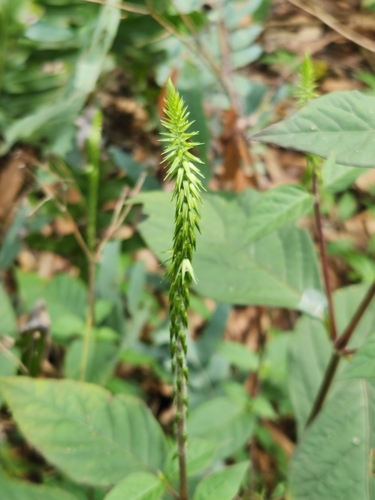
Milium effusum
L.
Wood Millet, American milletgrass

(c) Jeremy Barker, some rights reserved (CC BY-NC), uploaded by Jeremy Barker

(c) benconnorbarrie, some rights reserved (CC BY-NC)

(c) Almantas Kulbis, some rights reserved (CC BY-NC), uploaded by Almantas Kulbis
What to Eat
Edible parts: Seed
Seed - cooked. Ground into a powder and used as a flour for making bread.
Where to Find It
Europe, including Britain but excluding the Mediterranean, east to Siberia and the Himalayas..
TEMPERATE ASIA: Afghanistan, Cyprus, Turkey, Russian Federation-Ciscaucasia (Ciscaucasia), Armenia, Azerbaijan, Georgia, Russian Federation (Dagestan), Russian Federation-Western Siberia (Western Siberia), Russian Federation-Eastern Siberia (Eastern Siberia), Kazakhstan (southeast), Kyrgyzstan, Tajikistan, Russian Federation-Far East (Far East), China (n. & w.), Japan TROPICAL ASIA: Pakistan NORTHERN AMERICA: Canada (Québec, Nova Scotia, Ontario, New Brunswick), United States (Connecticut, Indiana, Maine, Massachusetts, Michigan, New Hampshire, New York, Ohio, Pennsylvania, Vermont, West Virginia, Minnesota, Illinois, Wisconsin, Maryland, North Carolina (west)) EUROPE: Denmark, Finland, United Kingdom, Ireland, Iceland, Norway, Sweden, Austria, Belgium, Switzerland, Czech Republic, Hungary, Netherlands, Poland, Slovakia, Russian Federation (European part), Belarus, Estonia, Lithuania, Latvia, Moldova, Russian Federation (Astrakhan, Saratov, Volgogradskaja oblast), Ukraine (incl. Krym), Albania, Bulgaria, Croatia, Italy (incl. Sicily), Romania, Serbia, Slovenia, Spain, France (incl. Corsica)
How to Identify
Milium effusum is an evergreen Perennial growing to 1 m (3ft 3in) by 0.5 m (1ft 8in). See above for USDA hardiness. It is hardy to UK zone 6. It is in leaf all year, in flower from May to July, and the seeds ripen from July to August. The species is hermaphrodite (has both male and female organs) and is pollinated by Wind. Suitable for: light (sandy), medium (loamy) and heavy (clay) soils, prefers well-drained soil and can grow in heavy clay soil. Suitable pH: mildly acid, neutral and basic (mildly alkaline) soils. It can grow in full shade (deep woodland) or semi-shade (light woodland). It prefers dry or moist soil and can tolerate drought.
How to Grow
Requires a fertile moist but well-drained soil in a shady position. Succeeds in dry shade, tolerating drought when established. Plants are hardy to about -20°c. Plants are tufted with a short rootstock and are short-lived. They often self-sow. At least one named form has been selected for its ornamental value.
Propagation: Seed - sow spring in situ. Division in spring. Very easy, large divisions can be planted out direct into their permanent positions. We have found that it is better to pot up the smaller divisions and grow them on in light shade in a cold frame until they are well established before planting them out in late spring or early summer.
Other Uses
Weaving. Leaves (straw) are used for weaving hats etc. Plants have a running root system and can be used for ground cover. They should be mown 2 - 3 times in their first 2 - 3 years in order to encourage thick growth. Plants should be spaced about 30cm apart each way.