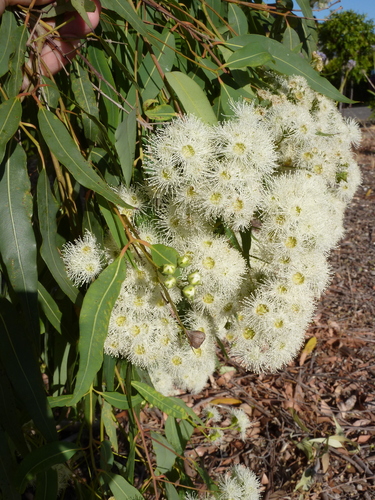
Eucalyptus dumosa
A. Cunn. ex Schau. in Walp.
White Mallee, Water mallee
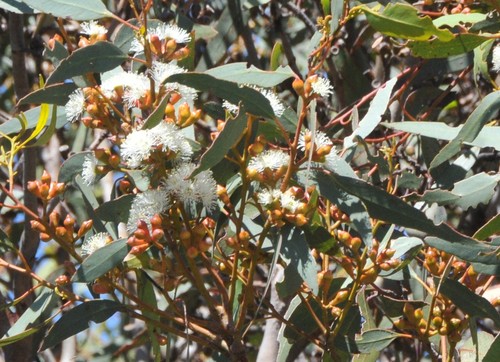
(c) davidsando, some rights reserved (CC BY-NC), uploaded by davidsando
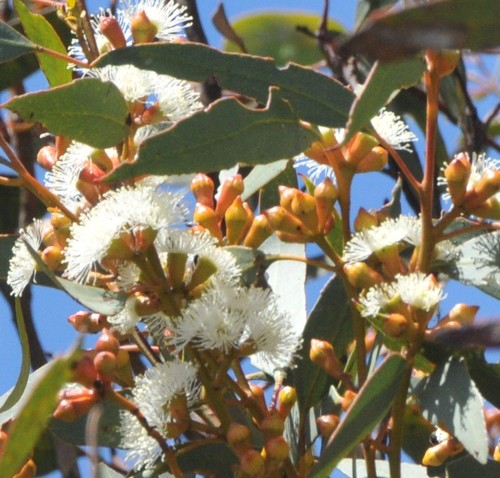
(c) davidsando, some rights reserved (CC BY-NC), uploaded by davidsando
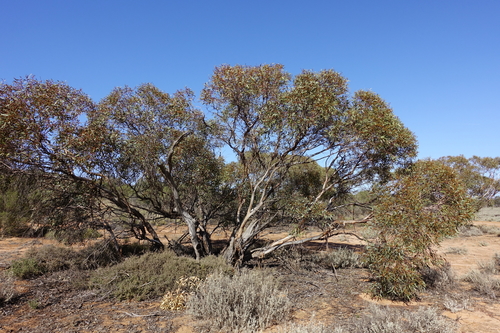
(c) Wayne Martin, some rights reserved (CC BY-NC)
What to Eat
Edible parts: Root water, Leaf exudate, Bark, Manna, Lerp
A sweet, manna-like substance is produced on the leaves and can be made into a delicious drink; one source suggests it is secreted by an insect, which would make it unlikely to be produced in Britain. The bark of young roots is baked and eaten; it is described as somewhat sweet, with a flavour resembling malt.
Known Hazards
Where to Find It
It grows in warm temperate regions. It can grow in the subtropics. It suits semiarid locations. It needs well drained soils. It can grow in full sun or light shade and can stand light frosts.
Australia*,
How to Identify
A medium sized tree. It grows 2.5-12 m high. It spreads 3-10 m wide. The bark is mostly smooth. The leaves are grey-green. The flowers are cream.
How to Grow
Prefers a sunny position in a moderately fertile well-drained moisture retentive circum-neutral soil. Tolerates poor and dry soils, especially those low in mineral elements. A drought tolerant plant once it is established, it succeeds in pure sand. This species is unlikely to be very cold-tolerant, though it might succeed outdoors in the mildest areas of Britain. Eucalyptus species have not adopted a deciduous habit and continue to grow until it is too cold for them to do so. This makes them more susceptible to damage from sudden cold snaps. If temperature fluctuations are more gradual, as in a woodland for example, the plants have the opportunity to stop growing and become dormant, thus making them more cold resistant. A deep mulch around the roots to prevent the soil from freezing also helps the trees to survive cold conditions. The members of this genus are remarkably adaptable however, there can be a dramatic increase in the hardiness of subsequent generations from the seed of survivors growing in temperate zones. Eucalyptus monocultures are an environmental disaster, they are voracious, allelopathic and encourage the worst possible attitudes to land use and conservation. Plants are shallow-rooting and, especially in windy areas, should be planted out into their permanent positions when small to ensure that they do not suffer from wind-rock. They strongly resent root disturbance and should be container grown before planting out into their permanent position. The flowers are rich in nectar and are a good bee crop. The bruised leaves have a strong smell of camphor.
Propagation: Surface sow seed in February or March in a sunny greenhouse position. Species from high altitudes benefit from 6–8 weeks of cold stratification at 2°C. Pot seedlings into individual containers as soon as the second set of true leaves develops — leaving them longer risks poor establishment. Plant out into permanent positions in early summer with some cold protection through the first winter. Alternatively, sow in June and plant into final positions the following late spring. Seed remains viable for a long time.
Medicinal Uses
None known
Other Uses
The leaves contain over 1% essential oil, which has a strong camphor scent and is considered purer than that of most other eucalyptus species. The wood is too small for commercial use but serves well as fuel.
Wikipedia
Source ↗Eucalyptus dumosa, commonly known as the white mallee, dumosa mallee, or Congoo mallee, is a species of mallee that is endemic to south eastern Australia. It usually has rough, flaky grey bark on the lower trunk, smooth bark above, lance-shaped to curved adult leaves, flower buds in groups of seven, white flowers and cup-shaped, cylindrical or barrel-shaped fruit.
Notes
There are at least 500 Eucalyptus species mostly originally in Australia. Chemical composition: Water = 14%. A threadlike substance = 33%. Sugar = 53%. The threads swell slightly when the sugar is dissolved in water. Thus freed from sugar, the threads consist of Lerp-amylum C6H10O5-----44.4C and 6.24H. This, on digestion with dilute sulphuric acid, etc. [sic], forms a crystallisable carbohydrate which agrees in its properties with dextrin.
Names & Synonyms
Bunurduk, Congoo Mallee, Weir Mallee
References (17)
- Bodkin, F., 1991, Encyclopedia Botanica. Cornstalk publishing, p 421
- Bonney, N., 1997, Economic Native Trees and Shrubs for South Australia. Greening Australia (SA) inc. Campbelltown SA 5074 p 91
- Boomsma, C.D., 1972, Native Tree of South Australia. Woods & Forests Department South Australia, Bulletin No.19. p 104
- Cherikoff V. & Isaacs, J., The Bush Food Handbook. How to gather, grow, process and cook Australian Wild Foods. Ti Tree Press, Australia p 189
- Clarke, P. A., 2013, The Aboriginal Ethnobotany of the Adelaide Region, South Australia. Transactions of the Royal Society of South Australia. (2013), 137(1): 97-126
- Elliot, W.R., & Jones, D.L., 1992, Encyclopedia of Australian Plants suitable for cultivation. Vol 4. Lothian. p 82
- Facciola, S., 1998, Cornucopia 2: a Source Book of Edible Plants. Kampong Publications, p 140
- Hall, N. et al, 1972, The Use of Trees and Shrubs in the Dry Country of Australia, AGPS, Canberra. p 368
- Hedrick, U.P., 1919, (Ed.), Sturtevant's edible plants of the world. p 294
- Hibbert, M., 2002, The Aussie Plant Finder 2002, Florilegium. p 96
- IRVINE,
- J. two exped. int. New South Wales 63. 1820 (Schauer in Walp., Repert. bot. syst. 2:925. 1843)
- Lazarides, M. & Hince, B., 1993, Handbook of Economic Plants of Australia, CSIRO. p 100
- Lim, T. K., 2015, Edible Medicinal and Non Medicinal Plants. Volume 9, Modified Stems, Roots, Bulbs. Springer p 41
- Maiden, JH (1889) The Useful Native Plants of Australia. Compendium. Melbourne. Reprinted 1975.
- Molyneux, B. and Forrester, S., 1997, The Austraflora A-Z of Australian Plants. Reed. p 84
- Plants for a Future database, The Field, Penpol, Lostwithiel, Cornwall, PL22 0NG, UK. http://www.scs.leeds.ac.uk/pfaf/