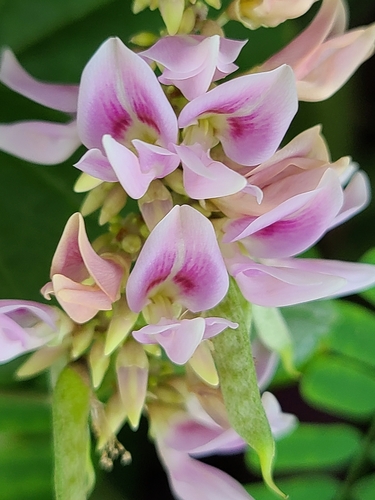
Acacia concinna
(Willd.) DC
Soap-Pod

(c) Dinesh Valke, some rights reserved (CC BY-SA)

(c) Dinesh Valke, some rights reserved (CC BY-SA)

(c) Dinesh Valke, some rights reserved (CC BY-SA)
What to Eat
Edible parts: Seeds, Leaves, Flowers, Vegetable
Young leaves, flowers, fruit, seeds, and shoots are all edible. The acid-flavoured young leaves can substitute for tamarinds in chutneys, and are added to soups to create a hot, sour flavour or curried with salted fish and coconut milk. Flowers are cooked and eaten as a vegetable. The acid fruit is used in Philippine cooking to add sourness; it can also be roasted and eaten. Seeds are edible after roasting. Young shoots can be made into pickles or cooked as a vegetable.
Known Hazards
Where to Find It
A tropical plant. In Papua New Guinea it grows from 500-1050 m altitude. It occurs naturally in rainforest and grassland. It is a tropical plant. It needs a frost free location. It requires good drainage. It prefers dry conditions and tolerates drought. It is found in dry forests. It grows in Yunnan in China.
Asia, Cambodia, China, Himalayas, India, Indochina, Indonesia, Laos, Malaysia, Myanmar, Nepal, Pacific, Papua New Guinea, PNG, Philippines, SE Asia, Thailand, Vietnam,
How to Identify
A shrub or small tree. It grows 5 m tall. There are prickles along the stem. The leaves are twice divided and there are 8-18 pairs of pinnae. There are up to 50 pairs of pinnules on each pinnae. The flowers are yellow. They are in large clusters at the ends of branches. The pods are flattened.
How to Grow
It can be grown from seeds. The seedlings can be transplanted.
Propagation: Acacia concinna can be grown from seed, with seedlings transplanted once established. Like most members of this genus, the seed has a hard coat that benefits from scarification before sowing. Pour a small amount of nearly boiling water over the seeds — taking care not to cook them — then soak in warm water for 12–24 hours. Seeds that have swollen have absorbed enough moisture and are ready to sow. If seeds remain unswollen after this period, carefully nick the seedcoat without damaging the embryo and soak for a further 12 hours before sowing.
Medicinal Uses
This plant is used medicinally in a number of ways. It is a well-known traditional remedy for dandruff and lice in both humans and animals. It is used to treat parasite-caused diseases such as malaria and visceral leishmaniasis. Chewing the pods is used to address mouth and throat problems including pharyngitis and mouth sores, as well as tooth decay and plaque reduction. The fruit pods or a leaf tea are used to relieve constipation, indigestion, and other digestive complaints. It is considered a natural cleanser, laxative, and diuretic. Recent research has confirmed antidermatophytic properties that combat fungi responsible for skin diseases, along with antimicrobial and antibacterial activity and phytochemicals with potential antioxidant ability.
Other Uses
The bark is a source of tannins, making this plant significant as a tannin crop. The pods are rich in saponins and are widely used in India as a detergent for washing silk and woollen goods, and are very commonly used as a hair wash. They are also effective for cleaning tarnished silver. Yarn washed with the pods before dyeing is said to produce superior results. To prepare the cleansing material, the fruit pods, leaves, and bark are dried, ground into a powder, and made into a paste.
Wikipedia
Evergreen tree reaching 10m tall and wide at medium growth rate. Hardy to UK zone 10 but frost tender. Flowers attract bees, beetles, butterflies, and wasps. Fixes nitrogen in soil. Prefers light sandy or medium loamy, well-drained soil and tolerates nutritionally poor conditions. Grows in neutral pH soils. Requires full sun and cannot tolerate shade. Drought tolerant but not wind resistant. Prefers dry soil.
Production
Plants flower throughout the year. Fruit are on trees from February to March.
Other Information
It is not known if it is used for food in Papua New Guinea. It is sold in local markets in Cambodia and Laos.
Notes
There are about 1,350 Acacia species. Over 1,000 occur in Australia. The pods of this one are used for soap. Also as Mimosaceae.
Names & Synonyms
Aila, Atouqie, Banritha, Chikaka, Chikakai, Kate-kate kecil, Keo dep, Kin-mon-chin, Kochi, Lahiur, Nemukazura, Phitaogiap, Ritha, Shikai, Shikakai, Shikaya, Sige, Sikakai, Soap-pod tree, Som poi, Song bai
References (39)
- Altschul, S.V.R., 1973, Drugs and Foods from Little-known Plants. Notes in Harvard University Herbaria. Harvard Univ. Press. Massachusetts. no. 1600
- Ambasta S.P. (Ed.), 2000, The Useful Plants of India. CSIR India. p 5
- Anderson, E. F., 1993, Plants and people of the Golden Triangle. Dioscorides Press. p
- Badwar, R. R., & Fernandez, R. R., 2011, Edible Wild Plants of the Himachal Pradesh State by IHBT, Himalayas, Daya Publishing House,. Delhi, India
- Bircher, A. G. & Bircher, W. H., 2000, Encyclopedia of Fruit Trees and Edible Flowering Plants in Egypt and the Subtropics. AUC Press. p 4
- Cao, Y., et al, 2020, Ethnobotanical study on wild edible plants used by three trans-boundary ethnic groups in Jiangcheng County, Pu’er, Southwest China. Journal of Ethnobiology and Ethnomedicine (2020) 16:66
- Dobriyal, M. J. R. & Dobriyal, R., 2014, Non Wood Forest Produce an Option for Ethnic Food and Nutritional Security in India. Int. J. of Usuf. Mngt. 15(1):17-37
- Eiadthong, W., et al, 2010, Management of the Emerald Triangle Protected Forests Complex. Botanical Colsultant Technical Report. p 22
- Facciola, S., 1998, Cornucopia 2: a Source Book of Edible Plants. Kampong Publications, p 151
- Ghorbani, A., et al, 2012, A comparison of the wild food plant use knowledge of ethnic minorities in Naban River Watershed Nature Reserve, Yunnan, SW China. Journal of Ethnobiology and Ethnomedicine; 8:17
- Gouldstone, S., 1983, Growing your own Food-bearing Plants in Australia. Macmillan p 179
- Hedrick, U.P., 1919, (Ed.), Sturtevant's edible plants of the world. p 18
- Jacquat, C., 1990, Plants from the Markets of Thailand. D.K. Book House p 39 (As Acacia rugata)
- Japanese International Research Centre for Agricultural Science www.jircas.affrc.go.jp/project/value_addition/Vegetables
- Kachenchart, B., et al, 2008, Phenology of Edible Plants at Sakaerat Forest. In Proceedings of the FORTROP II: Tropical Forestry Change in a Changing World. Bangkok, Thailand.
- Khumgratok, S., Edible Plants in Cultural Forests of Northeastern Thailand. Mahasarakham University Thailand.
- Kiran, K. C., et al, 2019, Diversity and Seasonal Availability of Potential Wild Edible Plants from Vidarbha Region of Maharashtra State, India. Int.J.Curr.Microbiol.App.Sci (2019) 8(2): 1434-1446
- London J. Bot. 1:514. 1842 (As Acacia rugata)
- Luczaj, L., et al, 2021, Wild food plants and fungi sold in the markets of Luang Prabang, Lao PDR. Journal of Ethnobiology and Ethnomedicine (2021) 17:6
- Manandhar, N.P., 2002, Plants and People of Nepal. Timber Press. Portland, Oregon. p 67 (As Acacia rugata)
- Martin, F.W. & Ruberte, R.M., 1979, Edible Leaves of the Tropics. Antillian College Press, Mayaguez, Puerto Rico. p 197
- Menninger, E.A., 1977, Edible Nuts of the World. Horticultural Books. Florida p 88
- Nielsen , 1992, Mimosaceae, Flora Malesiana ser 1 Vol 11(1) p 48
- Pham-Hoang Ho, 1999, An Illustrated Flora of Vietnam. Nha Xuat Ban Tre. p 825
- Plant Resources Of South East Asia PROSEA Vol 8 p 311 (Also as Acacia rugata)
- Prodr. 2:464. 1825
- Reis, S. V. and Lipp, F. L., 1982, New Plant Sources for Drugs and Foods from the New York Botanical Garden herbarium. Harvard. p 112
- Rajkalkshmi, P. et al, 2001, Total carotenoid and beta-carotene contents of forest green leafy vegetables consumed by tribals of south India. Plant Foods for Human Nutrition 56:225-238
- Shin, T., et al, 2018, Traditional knowledge of wild edible plants with special emphasis on medicinal uses in Southern Shan State, Myanmar. Journal of Ethnobiology and Ethnomedicine (2018) 14:48
- Singh, H.B., Arora R.K.,1978, Wild edible Plants of India. Indian Council of Agricultural Research, New Delhi. p16
- Srichaiwong, P., et al, 2014, A Study of the Biodiversity of Natural Food Production to Support Community Upstream of Chi Basin, Thailand. Asian Social Science 10 (2):
- Sukarya, D. G., (Ed.) 2013, 3,500 Plant Species of the Botanic Gardens of Indonesia. LIPI p 888
- Suksri, S., et al, 2005, Ethnobotany in Bung Khong Long Non-Hunting Area, Northeast Thailand. Kasetsart J., (Nat. Sci) 39: 519-533
- Swaminathan, M.S., and Kochnar, S.L., 2007, An Atlas of Major Flowering Trees in India. Macmillan. p 130 (As Acacia rugata)
- Thitiprasert, W., et al, 2007, Country report on the State of Plant Genetic Resources for Food and Agriculture in Thailand (1997-2004). FAO
- Uprety, Y., et al, 2012, Diversity of use and local knowledge of wild edible plant resources in Nepal. Journal of Ethnobotany and Ethnomedicine 8:16 (As Acacia rugata)
- Verdcourt, B., 1979, Manual of New Guinea Legumes. Botany Bulletin No 11, Division of Botany, Lae, Papua New Guinea. p 164
- Wild edible plants of Himachal Pradesh
- Xu, You-Kai, et al, 2004, Wild Vegetable Resources and Market Survey in Xishuangbanna, Southwest China. Economic Botany. 58(4): 647-667.