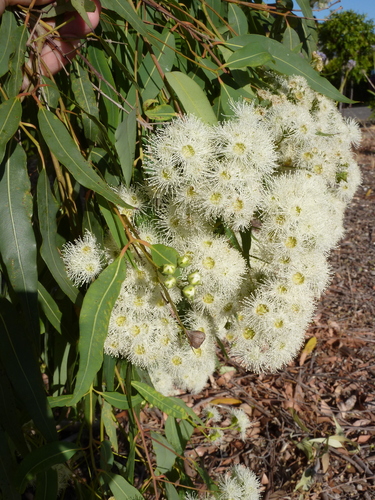
Eucalyptus largiflorens
F. Muell.
Black Box, Flooded Box, River Box
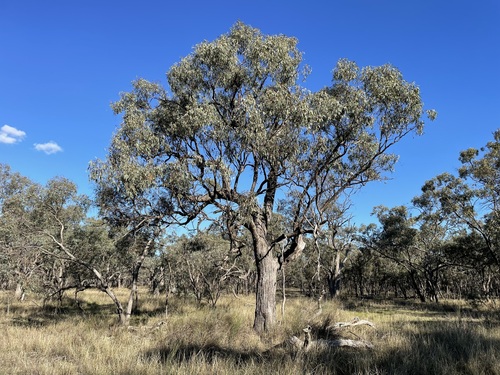
(c) Dean Nicolle, some rights reserved (CC BY-NC), uploaded by Dean Nicolle
(c) Dr Manfred Jusaitis, some rights reserved (CC BY-NC)

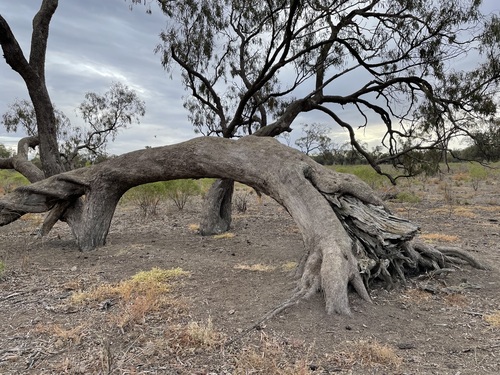
(c) Nigel Marsh, some rights reserved (CC BY-NC), uploaded by Nigel Marsh
What to Eat
Edible parts: Seeds
The seeds are soaked for a couple of hours in several changes of water, then dried and ground into a meal that is eaten raw.
Known Hazards
Where to Find It
It grows in warm temperate regions and semiarid locations. It can tolerate salt. It can grow on limestone soils. It grows on low lying depressions and river flats. It grows in areas where underground water is present. It grows in areas with an annual rainfall between 250-380 mm. It can grow in arid places.
Africa, Australia*, Caribbean, East Africa, Egypt, Europe, France, North Africa, St Lucia, Zimbabwe,
How to Identify
A medium to large tree. It grows 8-20 m high and spreads 6-15 m wide. It has low branches and a wide-spreading crown. The trunk can be 1 m across. The bark is dark and rough. The leaves are grey-green. They are narrow and pointed. They can be 12 cm long. The flowers are small and white or pink.
How to Grow
Prefers a sunny position in a moderately fertile well-drained moisture retentive circum-neutral soil. Tolerates poor and dry soils, especially those low in mineral elements. A drought tolerant plant once established, it succeeds in limestone soils and tolerates saline soils. One report says that this species resists frost, whilst another suggests that it is in zone 10 which is not frost hardy. Plants obtained from the colder provenances of its range might succeed outdoors in the mildest areas of Britain. Eucalyptus species have not adopted a deciduous habit and continue to grow until it is too cold for them to do so. This makes them more susceptible to damage from sudden cold snaps. If temperature fluctuations are more gradual, as in a woodland for example, the plants have the opportunity to stop growing and become dormant, thus making them more cold resistant. A deep mulch around the roots to prevent the soil from freezing also helps the trees to survive cold conditions. The members of this genus are remarkably adaptable however, there can be a dramatic increase in the hardiness of subsequent generations from the seed of survivors growing in temperate zones. Eucalyptus monocultures are an environmental disaster, they are voracious, allelopathic and encourage the worst possible attitudes to land use and conservation. A slow growing tree. Plants are shallow-rooting and, especially in windy areas, should be planted out into their permanent positions when small to ensure that they do not suffer from wind-rock. They strongly resent root disturbance and should be container grown before planting out into their permanent position. The flowers are rich in nectar and are a good bee crop.
Propagation: Surface sow seed in February or March in a sunny greenhouse position. Species from high altitudes benefit from 6–8 weeks of cold stratification at 2°C. Pot seedlings into individual containers as soon as the second set of true leaves develops — leaving them longer risks poor establishment. Plant out into permanent positions in early summer with some cold protection through the first winter. Alternatively, sow in June and plant into final positions the following late spring. Seed remains viable for a long time.
Medicinal Uses
None known
Other Uses
An essential oil is obtained from this plant, likely from the leaves, with yields of up to 0.5%. The wood is hard, tough, strong, very durable and heavy, with a pink or reddish-brown colour, making it an excellent timber.
Wikipedia
Source ↗Eucalyptus largiflorens, or black box or river box, is a tree that is endemic to Australia. It has rough, fibrous or flaky bark, dull greenish-grey, lance-shaped leaves, oval to club-shaped green to yellow flower buds, white flowers and hemispherical, cup-shaped or barrel-shaped fruit.
Notes
There are at least 500 Eucalyptus species mostly originally in Australia.
Names & Synonyms
References (17)
- Bodkin, F., 1991, Encyclopedia Botanica. Cornstalk publishing, p 431
- Bonney, N., 1997, Economic Native Trees and Shrubs for South Australia. Greening Australia (SA) inc. Campbelltown SA 5074 p 104
- Boomsma, C.D., 1972, Native Tree of South Australia. Woods & Forests Department South Australia, Bulletin No.19. p 132
- Cherikoff V. & Isaacs, J., The Bush Food Handbook. How to gather, grow, process and cook Australian Wild Foods. Ti Tree Press, Australia p 189
- Cribb, A.B. & J.W., 1976, Wild Food in Australia, Fontana. p 86
- Cronin, L., 1989, The Concise Australian Flora. Reed. p 192
- Elliot, W.R., & Jones, D.L., 1992, Encyclopedia of Australian Plants suitable for cultivation. Vol 4. Lothian. p 127
- Hall, N. et al, 1972, The Use of Trees and Shrubs in the Dry Country of Australia, AGPS, Canberra. p 371
- Hibbert, M., 2002, The Aussie Plant Finder 2002, Florilegium. p 97
- Holliday, I., 1989, A Field Guide to Australian Trees. Hamlyn. p 152
- Hunter, J.T., 2017, Is there a relationship between contemporary high Aboriginal plant resource locations and mapped vegetation communities? Cunninghamia 17:27-34. The Royal Botanic Garden Sydney. ISSN 2200 - 405X
- Lazarides, M. & Hince, B., 1993, Handbook of Economic Plants of Australia, CSIRO. p 103
- Leiper, G & Houser, J., Mutooroo. Plant Use by Australian Aboriginal People. Assembly press, Queensland.
- Molyneux, B. and Forrester, S., 1997, The Austraflora A-Z of Australian Plants. Reed. p 87
- Plants for a Future, The Field, Penpol, Lostwithiel, Cornwall, PL22 0NG, UK. http://www.scs.leeds.ac.uk/pfaf/
- Royal Botanic Gardens, Kew (1999). Survey of Economic Plants for Arid and Semi-Arid Lands (SEPASAL) database. Published on the Internet; http://www.rbgkew.org.uk/ceb/sepasal/internet [Accessed 4th May 2011]
- Trans. & Proc. Victorian Inst. Advancem. Sci. 1854-1855:34. 1855