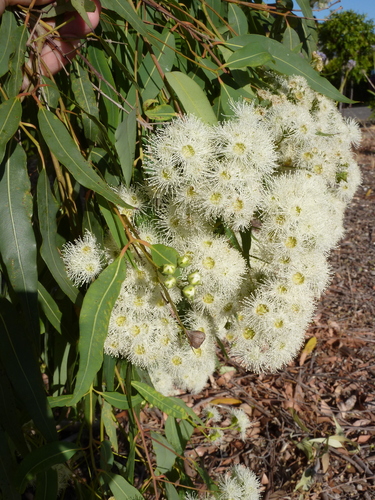
Eucalyptus oleosa
F. Muell. ex Miq.
Giant Mallee, Great Mallee, Red Mallee
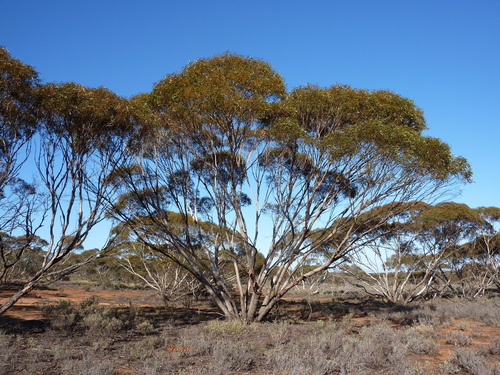
(c) Dean Nicolle, some rights reserved (CC BY-NC), uploaded by Dean Nicolle

(c) Dean Nicolle, some rights reserved (CC BY-NC), uploaded by Dean Nicolle

(c) Dean Nicolle, some rights reserved (CC BY-NC), uploaded by Dean Nicolle
What to Eat
Edible parts: Roots - water, Lerp
Water drained from the roots is consumed as drinking water, and lerp (insect-produced secretions on the plant) is eaten.
Where to Find It
It grows in warm temperate regions. It suits arid and semiarid locations. It needs well drained soil and can grow in full sun or light shade. It can stand light frosts. It grows in areas with a rainfall between 200-450 mm. It can grow in arid places. It suits hardiness zones 9-11.
Africa, Australia*, Cyprus, Mediterranean, Morocco, North Africa, USA,
How to Identify
A medium to tall tree. It grows 5-12 m high. It spreads 4-8 m wide. The bark is rough lower down and smooth higher up. It has many stems. The bark is usually grey and smooth but can be rough on the trunk. The leaves are narrow and glossy. They are blue-green. The flowers are pale yellow-green. The fruit are smooth and round with a narrow rim. The valves have needle like points.
Wikipedia
Source ↗Eucalyptus oleosa, commonly known as the red mallee, glossy-leaved red mallee, acorn mallee, oil mallee or giant mallee, is a tree or mallee that is native to Australia. The leaves were once harvested for the production of cineole based eucalyptus oil. Eucalyptus cneorifolia is now the predominant strain used in production due to a higher oil content in new growth.
Notes
There are at least 500 Eucalyptus species mostly originally in Australia.
Names & Synonyms
Glossy-leaved Mallee, Oily Mallee
References (15)
- Bodkin, F., 1991, Encyclopedia Botanica. Cornstalk publishing, p 439
- Bonney, N., 1997, Economic Native Trees and Shrubs for South Australia. Greening Australia (SA) inc. Campbelltown SA 5074 p 112
- Clarke, P. A., 2013, The Aboriginal Ethnobotany of the Adelaide Region, South Australia. Transactions of the Royal Society of South Australia. (2013), 137(1): 97-126
- Cronin, L., 1989, The Concise Australian Flora. Reed. p 187
- Dashorst, G.R.M., and Jessop, J.P., 1998, Plants of the Adelaide Plains & Hills. Botanic Gardens of Adelaide and State Herbarium. p 108
- Elliot, W.R., & Jones, D.L., 1992, Encyclopedia of Australian Plants suitable for cultivation. Vol 4. Lothian. p 161
- Etherington, K., & Imwold, D., (Eds), 2001, Botanica's Trees & Shrubs. The illustrated A-Z of over 8500 trees and shrubs. Random House, Australia. p 302
- Hedrick, U.P., 1919, (Ed.), Sturtevant's edible plants of the world. p 295
- Hibbert, M., 2002, The Aussie Plant Finder 2002, Florilegium. p 97
- Holliday, I., 1989, A Field Guide to Australian Trees. Hamlyn. p 168
- Lazarides, M. & Hince, B., 1993, Handbook of Economic Plants of Australia, CSIRO. p 105
- Molyneux, B. and Forrester, S., 1997, The Austraflora A-Z of Australian Plants. Reed. p 89
- Ned. Kruidk. Arch. 4:127. 1856 (Fragm. 2:56. 1860)
- Paczkowska, G . & Chapman, A.R., 2000, The Western Australian Flora. A Descriptive Calatogue. Western Australian Herbarium. p 377
- Royal Botanic Gardens, Kew (1999). Survey of Economic Plants for Arid and Semi-Arid Lands (SEPASAL) database. Published on the Internet; http://www.rbgkew.org.uk/ceb/sepasal/internet [Accessed 4th May 2011]