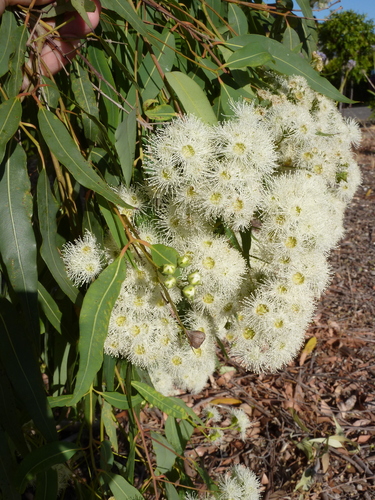
Eucalyptus oxymitra
Blakely
Sharp-capped Mallee, Blue Mallee

(c) Dean Nicolle, some rights reserved (CC BY-NC), uploaded by Dean Nicolle
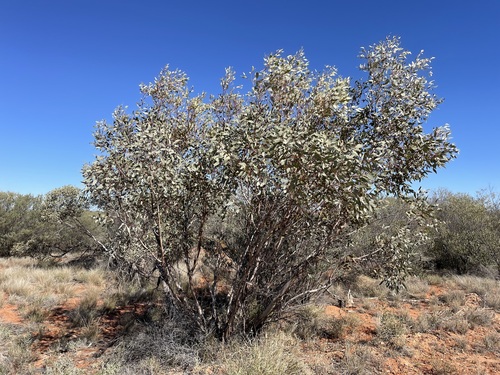
(c) Dean Nicolle, some rights reserved (CC BY-NC), uploaded by Dean Nicolle
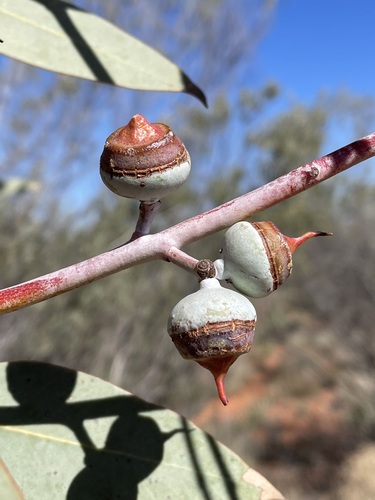
(c) Dean Nicolle, some rights reserved (CC BY-NC), uploaded by Dean Nicolle
What to Eat
Edible parts: Honey
Honey is produced from the flowers.
Where to Find It
It grows in warm arid regions. It can tolerate fire and drought. It can grow in arid places.
Australia*,
How to Identify
A small tree. It has several stems. It grows 1-6 m tall. The bark peels off in long strips. The leaves are alternate. They are broadly sword shaped. The flowers occur as 7 together in groups. The buds have a beaked cap. The fruit is half round. The seeds are grey-brown.
Wikipedia
Source ↗Eucalyptus oxymitra, commonly known as the sharp-capped mallee, is a species of mallee that is endemic to remote parts of Central Australia. It has rough bark on the trunk, smooth greyish bark above, lance-shaped to egg-shaped adult leaves, flower buds in groups of seven, white to pale yellow flowers and hemispherical fruit.
Notes
There are at least 500 Eucalyptus species mostly originally in Australia.
References (7)
- Bodkin, F., 1991, Encyclopedia Botanica. Cornstalk publishing, p 440
- Boomsma, C.D., 1972, Native Tree of South Australia. Woods & Forests Department South Australia, Bulletin No.19. p 154
- Doran, J.C., & Turnbull, J.W. (Eds), 1997, Australian Trees and Shrubs: species for land rehabilitation and farm plantings in the tropics. ACIAR Monograph No 24. p 354
- Elliot, W.R., & Jones, D.L., 1992, Encyclopedia of Australian Plants suitable for cultivation. Vol 4. Lothian. p 166
- Latz, P.K., 1996, Bushfires and Bushtucker: Aboriginal plant use in Central Australia. IAD Press Alice Springs p 191
- Paczkowska, G . & Chapman, A.R., 2000, The Western Australian Flora. A Descriptive Calatogue. Western Australian Herbarium. p 378
- Trans. & Proc. Roy. Soc. S. Australia 61:155. 1936