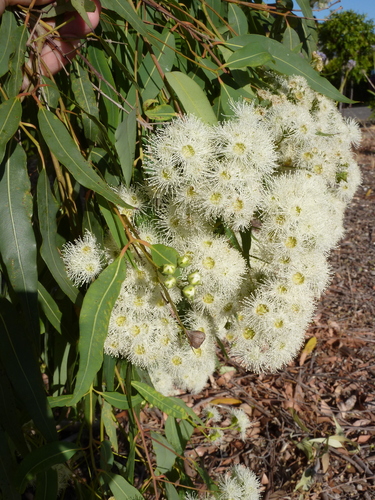
Eucalyptus pachyphylla
F. Muell.
Red-budded Mallee, Thick-leaved Mallee
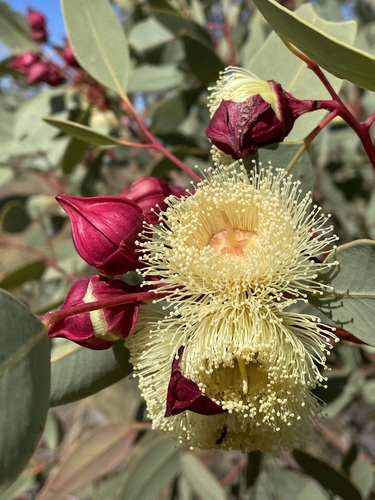
(c) Dean Nicolle, some rights reserved (CC BY-NC), uploaded by Dean Nicolle
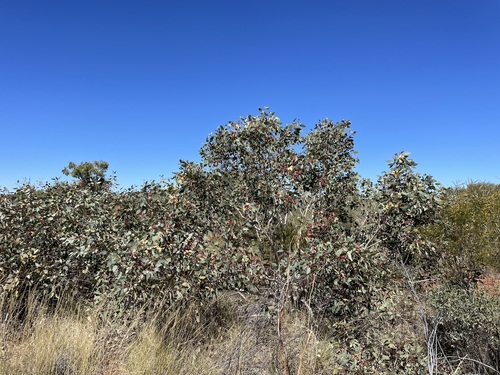
(c) Dean Nicolle, some rights reserved (CC BY-NC), uploaded by Dean Nicolle
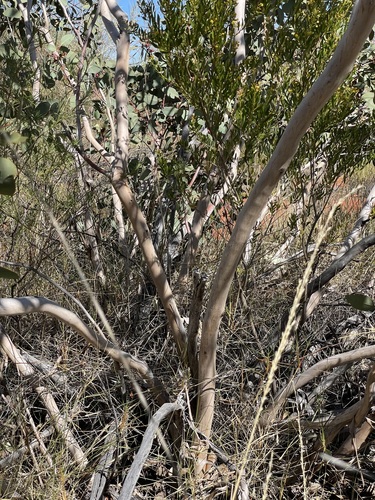
(c) Dean Nicolle, some rights reserved (CC BY-NC), uploaded by Dean Nicolle
What to Eat
Edible parts: Honey, Nectar, Seeds
The nectar from the flowers can be eaten fresh or added to water to make a drink. The seeds are also edible.
Where to Find It
It grows in warm temperate regions. It suits arid or semiarid locations. It needs well drained soil. It can grow in full sun or light shade. It can stand light frosts. It grows in the Gibson and Tanami deserts in Australia. It grows in areas with an annual rainfall above 300 mm. It can grow in arid places. It suits hardiness zones 9-11.
Africa, Australia*, East Africa, Tanzania,
How to Identify
A shrub. It grows 1-5 m high. It spreads 2-6 m wide. The bark is grey and peels off in long strips. The adult leaves are egg-shaped or broadly sword shaped. They have a long drawn out tip. They are grey-green. The leaves are 9-16 cm long by 3-4 cm wide. The buds are round or cone shaped. They are 6-7 mm long by 14-17 mm wide. The flowers are cream and 4 cm across. They occur in clusters of 3. The capsules are half round and strongly ribbed. They are 15-17 mm long by 20-30 mm wide.
How to Grow
Plants are grown from seed.
Propagation: Seed - surface sow in a sunny position and make sure the compost is not allowed to dry out. Species that come from high altitudes appreciate 6 - 8 weeks cold stratification at 2°c. Pot up the seedlings into individual pots as soon as the second set of seed leaves has developed, if left longer than this they might not move well. The seedlings are ready for planting in the field when they are 25 - 30 cm tall, usually after 3 - 4 months. The seed has a long viability.
Other Uses
An essential oil is obtained from the leaves. Total quantity of the oil, and its composition, can vary widely from plant to plant, but we have reports that the fresh leaves contain around 0.3 - 0.6% (dry weight) essential oil. The main components include pinene, limonene, 1,8-cineole (up to 60% in some forms), aromadendrene.
Wikipedia
Source ↗Eucalyptus pachyphylla, commonly known as thick-leaved mallee or the red-budded mallee, is a species of mallee that is native to inland Australia. It has smooth bark, egg-shaped to lance-shaped adult leaves, flower buds in groups of three with five prominent ribs on each bud, and broad, shallow, conical to hemispherical fruit.
Notes
There are at least 500 Eucalyptus species mostly originally in Australia.
Names & Synonyms
References (14)
- Bodkin, F., 1991, Encyclopedia Botanica. Cornstalk publishing, p 440
- Boomsma, C.D., 1972, Native Tree of South Australia. Woods & Forests Department South Australia, Bulletin No.19. p 156
- Cancilla, D., 2018, Ethnobotanical and Ethnozoological Values Desktop Assessment - Eliwana Project. p 41
- Elliot, W.R., & Jones, D.L., 1992, Encyclopedia of Australian Plants suitable for cultivation. Vol 4. Lothian. p 168
- Etherington, K., & Imwold, D., (Eds), 2001, Botanica's Trees & Shrubs. The illustrated A-Z of over 8500 trees and shrubs. Random House, Australia. p 305
- Facciola, S., 1998, Cornucopia 2: a Source Book of Edible Plants. Kampong Publications, p 141
- J. Proc. Linn. Soc., Bot. 3:98. 1859
- Latz, P.K., 1996, Bushfires and Bushtucker: Aboriginal plant use in Central Australia. IAD Press Alice Springs p 192
- Lazarides, M. & Hince, B., 1993, Handbook of Economic Plants of Australia, CSIRO. p 105
- Molyneux, B. and Forrester, S., 1997, The Austraflora A-Z of Australian Plants. Reed. p 89
- Paczkowska, G . & Chapman, A.R., 2000, The Western Australian Flora. A Descriptive Calatogue. Western Australian Herbarium. p 378
- Royal Botanic Gardens, Kew (1999). Survey of Economic Plants for Arid and Semi-Arid Lands (SEPASAL) database. Published on the Internet; http://www.rbgkew.org.uk/ceb/sepasal/internet [Accessed 4th May 2011]
- Townsend, K., 1994, Across the Top. Gardening with Australian Plants in the tropics. Society for Growing Australian Plants, Townsville Branch Inc. p 197
- World Checklist of Useful Plant Species 2020. Royal Botanic Gardens, Kew