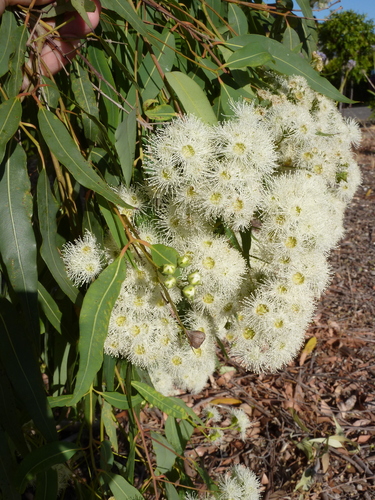
Eucalyptus paniculata
Smith
Grey Ironbark

(c) Colin Ogle, some rights reserved (CC BY-NC), uploaded by Colin Ogle

(c) Thomas Mesaglio, some rights reserved (CC BY), uploaded by Thomas Mesaglio

(c) Thomas Mesaglio, some rights reserved (CC BY), uploaded by Thomas Mesaglio
What to Eat
Edible parts: Honey
Honey produced by bees visiting the flowers is harvested.
Where to Find It
It grows naturally in coastal areas of Eastern Australia. It suits hardiness zones 9-11.
Africa, Australia*, East Africa, Zimbabwe,
How to Identify
A tall straight tree. It grows 36 m high. The bark is deeply furrowed and grey. The leaves are dark green and glossy. They are paler underneath. The flowers are white. They are in small groups.
Wikipedia
Source ↗Eucalyptus paniculata, commonly known as grey ironbark, is a species of tree that is endemic to New South Wales. It has dark-coloured, deeply furrowed ironbark on the trunk and branches, lance-shaped to curved adult leaves, flower buds in groups of seven on a branched peduncle, white flowers and conical, hemispherical or cup-shaped fruit.
Notes
There are at least 500 Eucalyptus species mostly originally in Australia.