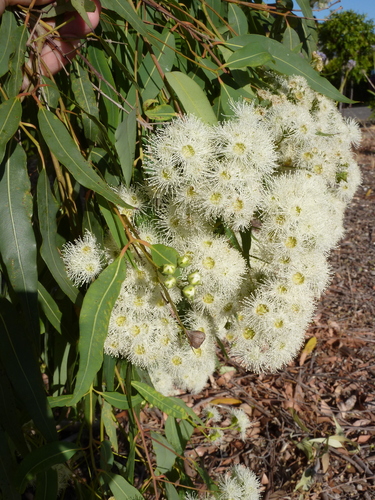
Eucalyptus phoenicea
F. Muell
Hill Woollybutt, Fiery Gum, Scarlet Gum
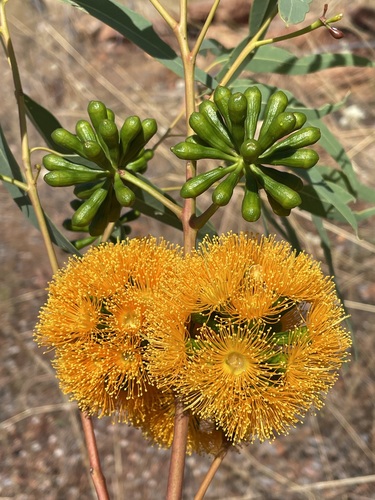
(c) Dean Nicolle, some rights reserved (CC BY-NC), uploaded by Dean Nicolle
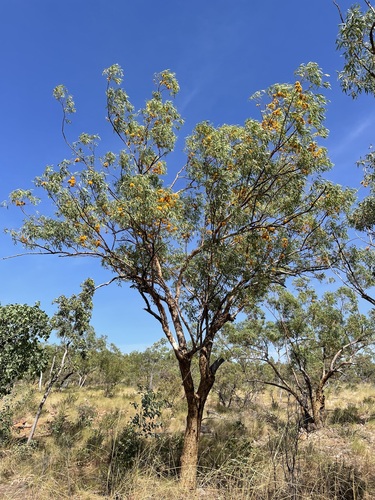
(c) Dean Nicolle, some rights reserved (CC BY-NC), uploaded by Dean Nicolle
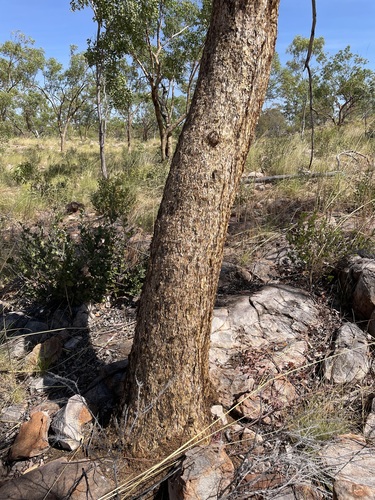
(c) Dean Nicolle, some rights reserved (CC BY-NC), uploaded by Dean Nicolle
What to Eat
Edible parts: Leaves - flavouring
The leaves are used as a flavouring.
Where to Find It
It grows in warm temperate regions. It can grow in the tropics. It needs well drained soil. It needs full sun.
Australia*,
How to Identify
A small tree. It grows 6-12 m high. It spreads 3-10 m wide. The trunk has yellow-brown flaky bark. Often there are several trunks. The crown is open. The leaves are greyish-green and shiny. They are narrow and 15 cm long. The flowers are bright orange. They are produced in large round heads. The fruit are capsules with a long and urn shaped. They are woody and have ribs along the side. They are 19-30 mm long by 9-13 mm wide.
Wikipedia
Source ↗Eucalyptus phoenicea , commonly known as scarlet gum or gnaingar or ngainggar, is a tree of the family Myrtaceae from Northern Australia.
Notes
There are at least 500 Eucalyptus species mostly originally in Australia.
Names & Synonyms
Gnaingar, Martba, Ngainggar
References (16)
- Barwick, M., 2004, Tropical and Subtropical Trees. A Worldwide Encyclopedic Guide. Thames and Hudson p 173
- Bodkin, F., 1991, Encyclopedia Botanica. Cornstalk publishing, p 443
- Elliot, W.R., & Jones, D.L., 1992, Encyclopedia of Australian Plants suitable for cultivation. Vol 4. Lothian. p 176
- Hearne, D.A., & Rance, S.J., 1975, Trees for Darwin and Northern Australia. AGPS, Canberra p 62
- Hibbert, M., 2002, The Aussie Plant Finder 2002, Florilegium. p 98
- J. Proc. Linn. Soc., Bot. 3:91. 1859
- Lazarides, M. & Hince, B., 1993, Handbook of Economic Plants of Australia, CSIRO. p 106
- Lord, E.E., & Willis, J.H., 1999, Shrubs and Trees for Australian gardens. Lothian. p 31
- Molyneux, B. and Forrester, S., 1997, The Austraflora A-Z of Australian Plants. Reed. p 90
- Paczkowska, G . & Chapman, A.R., 2000, The Western Australian Flora. A Descriptive Calatogue. Western Australian Herbarium. p 379
- Petheram, R. J. and Kok, B., 2003, Plants of the Kimberley Region of Western Australia. UWA Press p 459
- Scarth-Johnson, V., 2000, National Treasures. Flowering Plants of Cooktown and Northern Australia. Vera Scarth-Johnson Gallery Association. Cooktown, Australia. p 81
- Townsend, K., 1994, Across the Top. Gardening with Australian Plants in the tropics. Society for Growing Australian Plants, Townsville Branch Inc. p 199
- Townsend, K., 1999, Field Guide to Plants of the Dry Tropics. Society for Growing Australian Plants, Townsville Branch Inc. p 48
- Wheeler, J.R.(ed.), 1992, Flora of the Kimberley Region. CALM, Western Australian Herbarium, p 523
- Wightman, G. & Brown, J., 1994, Jawoyn Plant Identikit, Common Useful Plants in the Katherine Area of Northern Australia. Concervation Commission Northern Territory. p 23