Eucalyptus rubida
Deane & Maiden
Candlebark, Candlebark gum

(c) Tony Rodd, some rights reserved (CC BY-NC-SA)

(c) martinkopp, some rights reserved (CC BY-NC)

(c) martinkopp, some rights reserved (CC BY-NC)
What to Eat
Edible parts: Manna, Lerp
The tree produces an edible manna and lerp that can be harvested and eaten.
Where to Find It
It grows in temperate regions. It can grow in the subtropics. It needs well drained soils. It can grow in full sun or light shade. It can stand heavy frosts. It grows on grassy forests and woodland on poor mudstone soils in drier areas of Tasmania. It suits hardiness zones 8-9. Tasmania Herbarium. Arboretum Tasmania.
Australia*, Tasmania*,
How to Identify
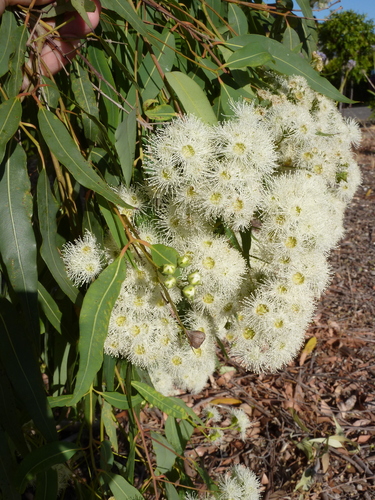
A medium to tall tree. It grows 12-30 m tall. It spreads 10-20 m across. It has an open crown. The bark is red and the old bark is greyish brown. It may turn pink in winter before revealing the new cream bark. The bark peels in strips and flakes off. Young leaves are in pairs and without stalks. The adult leaves are narrow and 15 cm long. They are alternate and have stalks. They are grey-green. The buds are diamond shaped and in threes. They often have a waxy coating. The flowers are small and cream. The capsule is cone shaped or round with valves that stick out.
Wikipedia
Source ↗Eucalyptus rubida, commonly known as candlebark, ribbon gum or white gum, is a species of small to medium-sized tree that is endemic to south-eastern Australia. It has smooth bark, sometimes with rough bark at the base, lance-shaped or curved adult leaves, flower buds in groups of three, white flowers and cup-shaped, hemispherical or bell-shaped fruit.
Production
A tree can produce 9 kg of manna during a year.
Notes
There are at least 500 Eucalyptus species mostly originally in Australia.
References (19)
- Boomsma, C.D., 1972, Native Tree of South Australia. Woods & Forests Department South Australia, Bulletin No.19. p 168
- Cribb, A.B. & J.W., 1976, Wild Food in Australia, Fontana. p 187
- Cundall, P., (ed.), 2004, Gardening Australia: flora: the gardener's bible. ABC Books. p 576
- Curtis, W.M., 1956, The Students Flora of Tasmania Vol 1 p 210, 211
- Donkin,
- Elliot, W.R., & Jones, D.L., 1992, Encyclopedia of Australian Plants suitable for cultivation. Vol 4. Lothian. p 199
- Etherington, K., & Imwold, D., (Eds), 2001, Botanica's Trees & Shrubs. The illustrated A-Z of over 8500 trees and shrubs. Random House, Australia. p 307
- Facciola, S., 1998, Cornucopia 2: a Source Book of Edible Plants. Kampong Publications, p 141
- Gilfedder, L et al, 2003, The Nature of the Midlands. Midlands Bushweb. PO Box 156 Longford, Tasmania. p 131
- Hibbert, M., 2002, The Aussie Plant Finder 2002, Florilegium. p 98
- Holliday, I., 1989, A Field Guide to Australian Trees. Hamlyn. p 176
- Kirkpatrick, J.B. & Backhouse, S., 1985, Native Trees of Tasmania. p 92
- Lazarides, M. & Hince, B., 1993, Handbook of Economic Plants of Australia, CSIRO. p 107
- Lord, E.E., & Willis, J.H., 1999, Shrubs and Trees for Australian gardens. Lothian. p 32
- Molyneux, B. and Forrester, S., 1997, The Austraflora A-Z of Australian Plants. Reed. p 92
- Proc. Linn. Soc. New South Wales 24:456. 1899
- Tasmanian Herbarium Vascular Plants list p 41
- Whiting, J. et al, 2004, Tasmania's Natural Flora. Tasmania's Natural Flora Editorial Committee PO Box 194, Ulverstone, Tasmania, Australia 7315 p 234
- Young, J., (Ed.), 2001, Botanica's Pocket Trees and Shrubs. Random House. p 360