Eucalyptus sessilis
(Maiden) Blakely
Finke River Mallee, River Mallee

(c) Dean Nicolle, some rights reserved (CC BY-NC), uploaded by Dean Nicolle
(c) Dean Nicolle, some rights reserved (CC BY-NC), uploaded by Dean Nicolle

(c) Dean Nicolle, some rights reserved (CC BY-NC), uploaded by Dean Nicolle
What to Eat
Edible parts: Seeds, Grub
The seeds and grubs are eaten.
Where to Find It
It grows in warm temperate regions and arid or semiarid locations. It needs well drained soil. It needs full sun. It can stand heavy frosts.
Australia*,
How to Identify
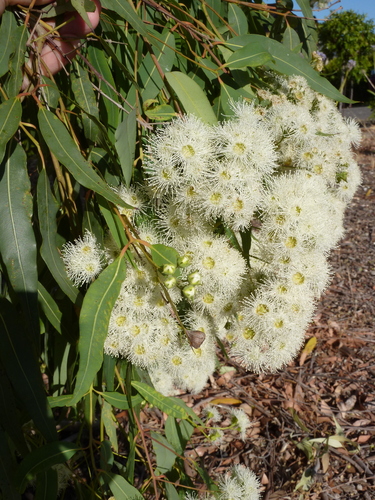
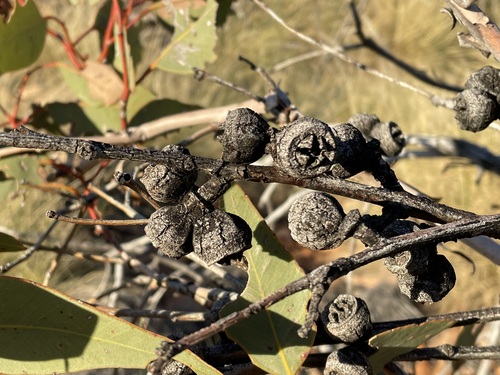
A small tree. It grows 2-4 m high. It spreads 2-5 m wide. The bark is flaky lower down but smooth higher up. The leaves are thick. The buds are ribbed. The flowers are cream. The capsules occur in bunches and are ribbed.
Wikipedia
Source ↗Eucalyptus sessilis, commonly known as Finke River mallee, red bud mallee or river mallee, is a species of mallee that is native to the Northern Territory and central areas along the border of Western Australia. It has smooth bark, sometimes with ribbon of old bark near the base, lance-shaped to egg-shaped or elliptical adult leaves, flower buds in groups of seven, creamy yellow flowers and hemispherical fruit.
Notes
There are at least 500 Eucalyptus species mostly originally in Australia.
References (6)
- Bodkin, F., 1991, Encyclopedia Botanica. Cornstalk publishing, p 449
- Cherikoff V. & Isaacs, J., The Bush Food Handbook. How to gather, grow, process and cook Australian Wild Foods. Ti Tree Press, Australia p 189
- Elliot, W.R., & Jones, D.L., 1992, Encyclopedia of Australian Plants suitable for cultivation. Vol 4. Lothian. p 207
- Key Eucalypts 276. 1934
- Molyneux, B. and Forrester, S., 1997, The Austraflora A-Z of Australian Plants. Reed. p 92
- Paczkowska, G . & Chapman, A.R., 2000, The Western Australian Flora. A Descriptive Calatogue. Western Australian Herbarium. p 382