Eucalyptus transcontinentalis
Maiden
Boongul, Red Wood, Redwood

iNaturalist · cc-by-nc
(c) Dean Nicolle, some rights reserved (CC BY-NC), uploaded by Dean Nicolle
(c) Dean Nicolle, some rights reserved (CC BY-NC), uploaded by Dean Nicolle
iNaturalist · cc-by-nc
(c) Dean Nicolle, some rights reserved (CC BY-NC), uploaded by Dean Nicolle
(c) Dean Nicolle, some rights reserved (CC BY-NC), uploaded by Dean Nicolle

iNaturalist · cc-by-nc
(c) Dean Nicolle, some rights reserved (CC BY-NC), uploaded by Dean Nicolle
(c) Dean Nicolle, some rights reserved (CC BY-NC), uploaded by Dean Nicolle
What to Eat
Edible parts: Water
Water can be extracted from the tree.
How to Identify
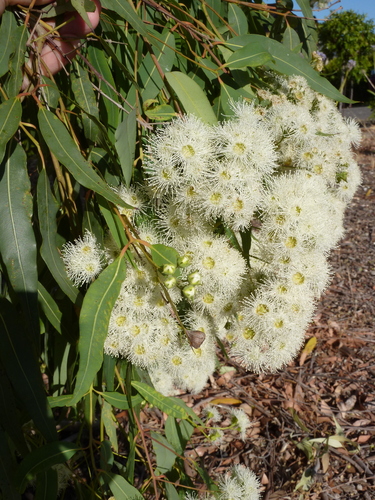
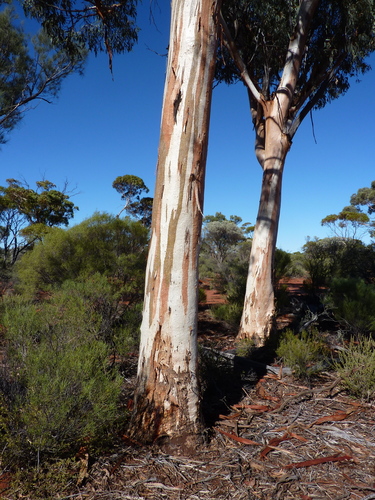
A stunted tree. It grows 2-15 m high. The bark can be smooth or rough. The flowers are yellow and white.
Medicinal Uses
Traditionally used as a source of water.
Wikipedia
Source ↗Eucalyptus transcontinentalis, commonly known as redwood or boongul, is a species of small to medium-sized tree, sometimes a mallet, that is endemic to the southwest of Western Australia. It has smooth bark, lance-shaped adult leaves, flower buds usually in groups of seven, pale yellow flowers and urn-shaped to barrel-shaped fruit.
Notes
There are at least 500 Eucalyptus species mostly originally in Australia.
References (6)
- Bodkin, F., 1991, Encyclopedia Botanica. Cornstalk publishing, p 454
- Elliot, W.R., & Jones, D.L., 1992, Encyclopedia of Australian Plants suitable for cultivation. Vol 4. Lothian. p 230
- J. & Proc. Roy. Soc. New South Wales 53:58. 1919
- Lazarides, M. & Hince, B., 1993, Handbook of Economic Plants of Australia, CSIRO. p 109
- Lord, E.E., & Willis, J.H., 1999, Shrubs and Trees for Australian gardens. Lothian. p 34
- Paczkowska, G . & Chapman, A.R., 2000, The Western Australian Flora. A Descriptive Calatogue. Western Australian Herbarium. p 384