Eucheuma muricatum
(Gmelin) Weber van Bosse
Canot-canot

gbif · cc-by
The New York Botanical Garden
The New York Botanical Garden

gbif · cc-by-nc
University of South Florida - Algae (USF-)
University of South Florida - Algae (USF-)

gbif · cc-by
The New York Botanical Garden
The New York Botanical Garden
What to Eat
Edible parts: Algae, Frond, Seaweed
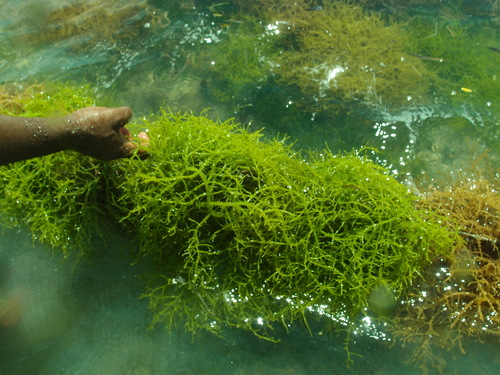
The fronds and seaweed are used to make jelly and agar. It is eaten in salads and as a cooked vegetable.
Where to Find It
A tropical plant.
Asia, China, Indonesia, Malaysia, Pacific, Philippines, SE Asia,
Countries: United Arab Emirates, Afghanistan, Armenia, Australia, Azerbaijan, Bangladesh, Bahrain, Brunei, Bhutan, China, Fiji, Micronesia, Georgia, Indonesia, Israel, India, Iraq, Iran, Jordan, Japan, Kyrgyzstan, Cambodia, Kiribati, North Korea, South Korea, Kuwait, Kazakhstan, Laos, Lebanon, Sri Lanka, Marshall Islands, Myanmar, Mongolia, Maldives, Malaysia, Nepal, Nauru, New Zealand, Oman, Papua New Guinea, Philippines, Pakistan, Palau, Qatar, Saudi Arabia, Solomon Islands, Singapore, Syria, Thailand, Tajikistan, Timor-Leste, Turkmenistan, Tonga, Turkey, Tuvalu, Taiwan, Uzbekistan, Vietnam, Vanuatu, Samoa, Yemen
How to Identify
A tropical seaweed in the family Areschougiaceae with edible fronds and algal portions.
References (7)
- http://www.seavegetables.com
- Kiple, K.F. & Ornelas, K.C., (eds), 2000, The Cambridge World History of Food. CUP p 237
- Subba Rao, G.N., 1965, Uses of seaweed directly as human food. Indo-Pacific Fisheries Council Regional Studies 2:1-32
- Velasquez, G.T., 1972, Studies and utilization of the Philippine marine algae. In Proceedings of the Seventh International Seaweed Symposium, ed. K Nisizawa, 62-5. New York.
- Xia, B., and Abbott, I.A., 1987, Edible seaweeds of China and their place in the Chinese diet. Economic Botany 41:341-53
- Zaneveld, J.S., 1955, Economic marine algae of tropical South and East Asia and their utilization. Indo-Pacific Special Publications, No 3 Bangkok.
- Zemke-White, W. L. & Ohno, M., 1999, World seaweed utilisation: An end-of-century summary. Journal of Applied Phycology 11: 369-376