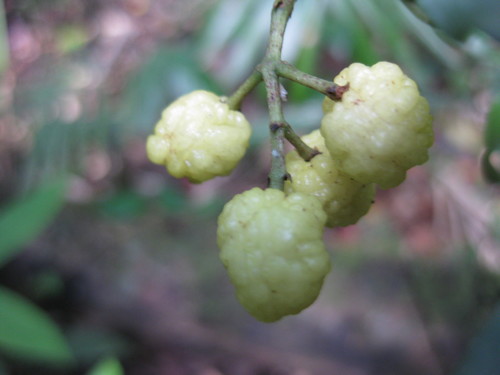
Zanthoxylum bungeanum
Max.

(c) Marco Mussita, some rights reserved (CC BY), uploaded by Marco Mussita
What to Eat
Condiment. Seed - used as a condiment, a pepper substitute. Highly prized. The fruit is rather small but is produced in clusters which makes harvesting easy. Each fruit contains a single seed.
Known Hazards
Where to Find It
E. Asia - China.
TEMPERATE ASIA: China (Anhui Sheng, Zhejiang Sheng, Fujian Sheng, Henan Sheng, Hebei Sheng, Hunan Sheng, Hubei Sheng, Gansu Sheng, Jiangxi Sheng, Jiangsu Sheng, Guizhou Sheng, Liaoning Sheng, Shanxi Sheng, Shandong Sheng, Shaanxi Sheng, Sichuan Sheng, Qinghai Sheng, Yunnan Sheng, Guangxi Zhuangzu Zizhiqu, Ningxia Huizi Zizhiqu, Xinjiang Uygur Zizhiqu (southeast), Xizang Zizhiqu (southeast)) TROPICAL ASIA: Bhutan
How to Identify
Zanthoxylum bungeanum is a deciduous Shrub growing to 6 m (19ft 8in). The species is dioecious (individual flowers are either male or female, but only one sex is to be found on any one plant so both male and female plants must be grown if seed is required). . The plant is not self-fertile. Suitable for: light (sandy), medium (loamy) and heavy (clay) soils and prefers well-drained soil. Suitable pH: mildly acid, neutral and basic (mildly alkaline) soils. It can grow in semi-shade (light woodland) or no shade. It prefers moist soil.
How to Grow
We have very little information on this species and do not know if it will be hardy in Britain, though judging by its native range it should succeed outdoors at least in the milder areas of the country. It is said to be often cultivated for its edible fruit, especially in hot dry river valleys in China. There is some doubt over the correct name for this species, it might be no more than a synonym of Z. simulans. The following notes are based on the general needs of the genus. Prefers a good deep well-drained moisture retentive soil in full sun or semi-shade. Dioecious. Male and female plants must be grown if seed is required. Flowers are formed on the old wood.
Propagation: Seed - best sown in a greenhouse as soon as it is ripe in the autumn. Stored seed may requires up to 3 months cold stratification, though scarification may also help. Sow stored seed in a cold frame as early in the year as possible. Germination should take place in late spring, though it might take another 12 months. Prick out the seedlings into individual pots when they are large enough to handle and grow them on in a cold frame for their first winter. Plant them out in early summer. Cuttings of half-ripe wood, July/August in a frame. Root cuttings, 3cm long, planted horizontally in pots in a greenhouse. Good percentage. Suckers, removed in late winter and planted into their permanent positions.
Medicinal Uses
Anaesthetic Anthelmintic Aromatic Astringent Carminative Diaphoretic Diuretic Dysentery Emmenagogue Stimulant Vasodilator Vermifuge. The fruit is anaesthetic, anthelmintic, aromatic, astringent, carminative, diuretic, emmenagogue, stimulant, sudorific, vasodilator and vermifuge. It is pulverised then mixed with water for internal application in the treatment of chills and pains in the abdomen, vomiting, cold-damp diarrhoea and dysentery, ascariasis-caused abdominal pain and moist sores on the skin. The pericarp is anaesthetic, anthelmintic, antibacterial and antifungal. It is effective against the pork tapeworm, Taenia solium, and is also used in the treatment of gastralgia, dyspepsia, diarrhoea, abdominal pain, ascariasis and dermal diseases. The pericarp contains geraniol. This lowers the blood pressure, is mildly diuretic in small doses but in large doses inhibits the excretion of urine, and also increases peristalsis of the abdomen at low doses though inhibits it at large doses.