Eucheuma spinosum
J. Ag.
Agar-agar, East Indian Carrageen
AreschougiaceaeSeaweed
iNaturalist · cc-by
(c) Thomas Irvine, some rights reserved (CC BY)
(c) Thomas Irvine, some rights reserved (CC BY)

iNaturalist · cc-by-nc
(c) Wild.Rice, some rights reserved (CC BY-NC)
(c) Wild.Rice, some rights reserved (CC BY-NC)

iNaturalist · cc-by-nc
(c) Wild.Rice, some rights reserved (CC BY-NC)
(c) Wild.Rice, some rights reserved (CC BY-NC)
What to Eat
Edible parts: Seaweed, Algae
The seaweed is boiled and used as a jelly base that carries flavors. It thickens soups and sauces and is stored dried for later use.
Where to Find It
A tropical plant. It grows along seashores. It grows in shallow water and occurs where rivers bring down fresh water.
Asia, China, Indian ocean, Indonesia, Malaysia, SE Asia, Taiwan,
Countries: United Arab Emirates, Afghanistan, Armenia, Azerbaijan, Bangladesh, Bahrain, Brunei, Bhutan, China, Georgia, Indonesia, Israel, India, Iraq, Iran, Jordan, Japan, Kyrgyzstan, Cambodia, North Korea, South Korea, Kuwait, Kazakhstan, Laos, Lebanon, Sri Lanka, Myanmar, Mongolia, Maldives, Malaysia, Nepal, Oman, Philippines, Pakistan, Qatar, Saudi Arabia, Singapore, Syria, Thailand, Tajikistan, Timor-Leste, Turkmenistan, Turkey, Taiwan, Uzbekistan, Vietnam, Yemen
How to Identify
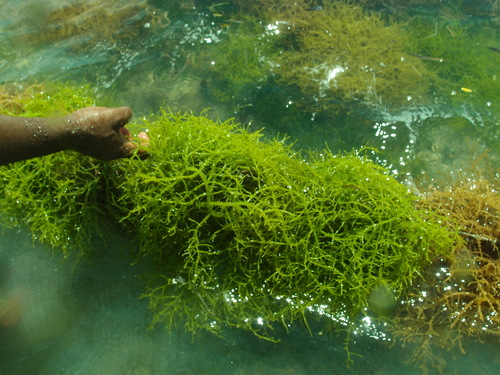
A purplish-red tropical seaweed with string-like, spiny branches. It grows along seashores in shallow water and in areas where rivers bring fresh water.
Names & Synonyms
Karang laut, Unicorn seaweed
References (3)
- Burkill, I.H., 1966, A Dictionary of the Economic Products of the Malay Peninsula. Ministry of Agriculture and Cooperatives, Kuala Lumpur, Malaysia. Vol 1 (A-H) p 970
- Hu, Shiu-ying, 2005, Food Plants of China. The Chinese University Press. p 261
- Macmillan, H.F. (Revised Barlow, H.S., et al) 1991, Tropical Planting and Gardening. Sixth edition. Malayan Nature Society. Kuala Lumpur. p 344