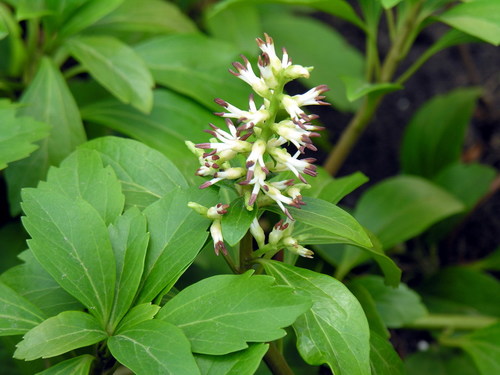
Buxus sempervirens
L.
Box, Common box, American Boxwood

(c) Elaina Pecher, some rights reserved (CC BY-NC), uploaded by Elaina Pecher

(c) Pete Woodall, some rights reserved (CC BY-NC), uploaded by Pete Woodall

(c) Michael Scherer-Lorenzen, some rights reserved (CC BY-NC), uploaded by Michael Scherer-Lorenzen
What to Eat
Condiment. The leaves have been used in France as a substitute for hops (Humulus lupulus) in making beer. They cannot be very wholesome, and would probably prove to be injurious.
Known Hazards
Where to Find It
Europe, including Britain, south and east from France and Germany to N. Africa and Albania.
TEMPERATE ASIA: Iran (north), Turkey, Azerbaijan EUROPE: United Kingdom, Austria, Belgium, Switzerland, Germany, Former Yugoslavia, Albania, Greece, Italy (incl. Sardinia), Spain, France (incl. Corsica), Portugal (incl. Azores) AFRICA: Algeria, Libya, Morocco
How to Identify
Buxus sempervirens is an evergreen Shrub growing to 5 m (16ft) by 5 m (16ft) at a slow rate. See above for USDA hardiness. It is hardy to UK zone 5. It is in leaf all year, in flower from April to May, and the seeds ripen in September. The species is monoecious (individual flowers are either male or female, but both sexes can be found on the same plant) and is pollinated by Bees, flies. It is noted for attracting wildlife. Suitable for: light (sandy), medium (loamy) and heavy (clay) soils, prefers well-drained soil and can grow in heavy clay soil. Suitable pH: mildly acid, neutral and basic (mildly alkaline) soils and can grow in very alkaline soils. It can grow in semi-shade (light woodland) or no shade. It prefers dry or moist soil.
How to Grow
Succeeds in almost any soil that is well-drained, preferring light shade and chalky soils. Succeeds in dry shade. Tolerates a pH range from 5.5 to 7.4. A very hardy plant, tolerating temperatures down to at least -23°c, though it prefers milder winters. A very polymorphic species, it is a very ornamental but slow growing plant and there are many named varieties developed for their ornamental value. This species is notably resistant to honey fungus. A good bee plant. Plants are very tolerant of being trimmed, they can be cut right back to the base if required and will usually resprout freely. The foliage is pungently scented, especially when wet.
Propagation: Seed - stratification is not necessary but can lead to more regular germination. The seed is best sown in a cold frame as soon as it is ripe. Sow stored seed as early in the year as possible in a cold frame. It usually germinates in 1 - 3 months at 15°c but stored seed can take longer. When large enough to handle, prick the seedlings out into individual pots and grow them on in the greenhouse for at least their first winter, planting them out into their permanent positions in late spring or early summer, after the last expected frosts. Cuttings of short side shoots with a heel, September in a frame. High percentage. Rather slow to root. Nodal cuttings in spring in a frame. Fairly easy.
Medicinal Uses
Alterative Antiperiodic Antirheumatic Cathartic Cholagogue Diaphoretic Epilepsy Febrifuge Homeopathy Leprosy Malaria Narcotic Odontalgic Oxytoxic Sedative Tonic Vermifuge. Although it has been used medicinally in the past as a sedative and to treat syphilis, box is very rarely used in modern herbalism. The leaves and the bark are alterative, antirheumatic, cathartic, cholagogue, diaphoretic, febrifuge, oxytocic and vermifuge. The leaves have been used as a quinine substitute in the treatment of malaria. The leaves are harvested in the spring, before the plant comes into flower, and they are dried for later use. The bark can be harvested at any time of the year and is dried for use in decoctions. Use this remedy with caution and preferably only under the supervision of a qualified practitioner. The plant has not been fully tested for its toxic side effects. The wood is diaphoretic, in full dose it is narcotic and sedative, in overdose it is convulsant and emetico-cathartic. A tincture of the wood has been used as a bitter tonic and antiperiodic, it has also had a reputation for curing leprosy. A volatile oil distilled from the wood has been prescribed in cases of epilepsy. An essential oil obtained from the plant is used in dentistry. A homeopathic remedy is made from the plant. It is extensively used in the treatment of rheumatism.
Other Uses
Dye Hedge Hedge Wood. Box makes an excellent hedge from 45cm to 4.5 metres tall according to the variety grown. It is quite slow growing but very tolerant of cutting and is often used in topiary, where the hedge is trimmed into different forms for ornamental effect. The leaves and sawdust, boiled in lye, have been used to dye hair an auburn colour. Wood - hard, close grained, heavy. Although the wood is rather small, it is highly valued on account of its hardness - it is twice as hard as oak (Quercus species). It is used for engraving, printing blocks, bowls, combs etc[4, 7, 11, 46, 100, 115, 178]. The root especially is much liked by turners and cabinet makers.